Stop Counting Second Chances. Start Scoring Durability: The Durability Index and Why It Matters
Apr 07, 2026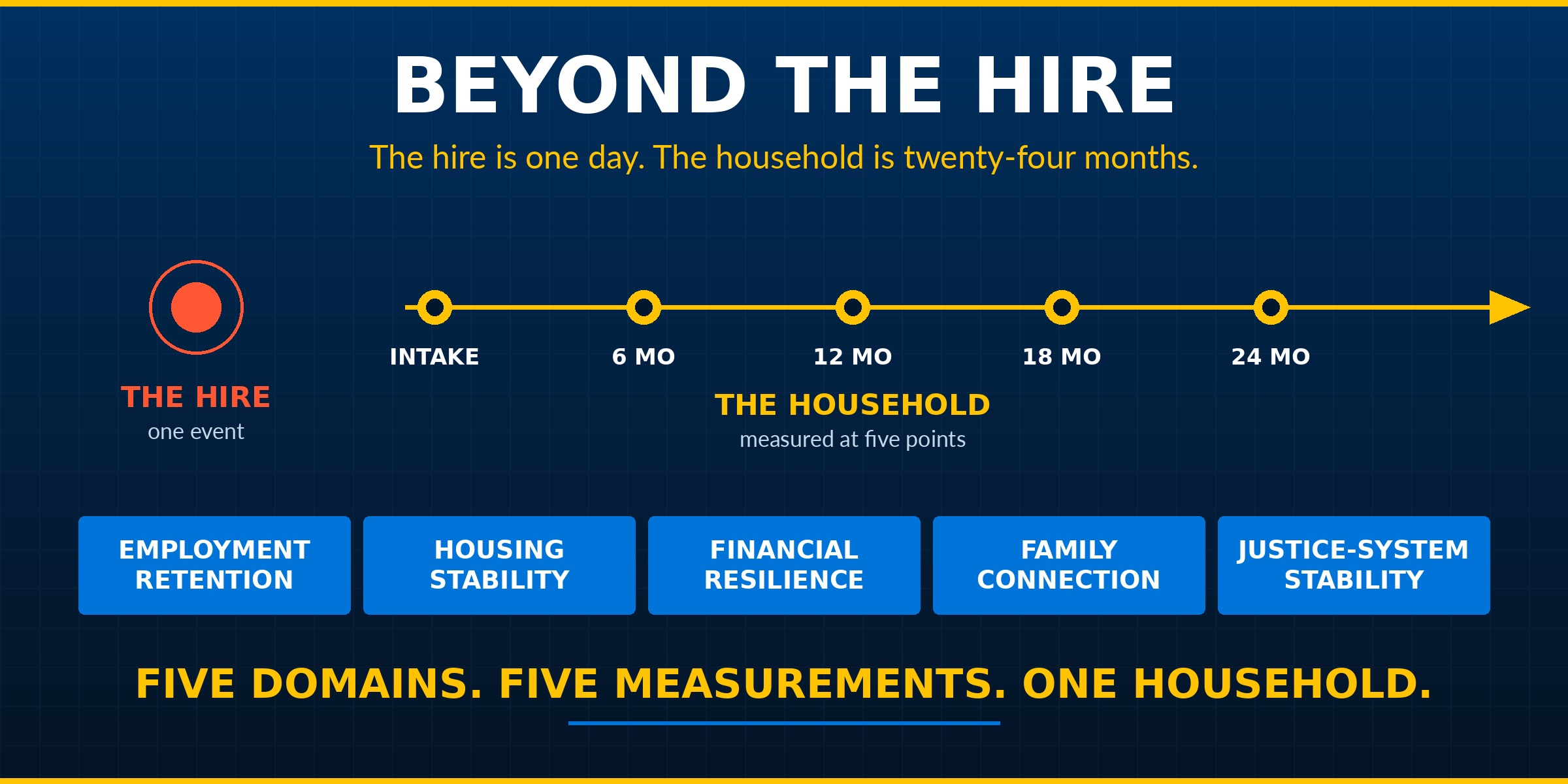
The Durability Index shifts the standard of success from job placement to household stability.
Developed as part of the 2Gen Economy Blueprint, it scores households across five domains ; employment retention, housing stability, financial resilience, family connection, and justice-system stability ; to determine whether workforce interventions are producing lasting economic mobility or temporary activity.
We have made Fair-Chance Hiring normal. We have made it a talking point at conferences, a bullet on ESG reports, a badge on corporate websites.
What we have not done is make durability non-negotiable.
We've made Fair-Chance Hiring normal. We've made it a talking point at conferences, a bullet on ESG reports, a badge on corporate websites.
What we haven't done is make durability non-negotiable.
Right now, most fair chance scorecards still look like this:
- How many people with records did we hire?
- How long did they stay?
- How do they perform compared to everyone else?
Those numbers matter. They've helped show that people coming home from prison are not a risk category, but a talent pool.
Yet you can hit every one of those targets and still leave a household hanging by a thread.
A parent can keep the job and still bounce between couches. A worker can show up early every day and still be buried under court fines, fees, and child care gaps. A company can win numerous second-chance awards, but that doesn't change the fact that their worker's family may still face the same instability that created risk in the first place.
That's the gap I want to talk about.
That's why I'm done counting "second chances."
I want us to start scoring durability.
Not "Did we give someone an opportunity?" But "Did that opportunity hold long enough to stabilize a household and change a trajectory?"
In a 2Gen Workforce Economy, the real scoreboard isn't the number of hires.
It's the Durability Index we share across employers, workforce boards, justice systems, funders, and people with lived experience.
The Pattern and the Stakes
The Durability Index is not a replacement for placement rates. It is what comes after placement rates fail. By scoring five household stability domains at intake, 6, 12, 18, and 24-month intervals, it measures the outcome that every workforce funder claims to want but none currently track.
Here's what the data shows, stripped of spin.
Without strong interventions, roughly two-thirds of people leaving prison are rearrested within three years (BJS).
Many cycle back to prison within five. That is the baseline our systems produce when we don't intentionally change the design.
Now look at what happens when you change the conditions around work.
People who gain new skills and hold a job during incarceration are significantly less likely to return to prison.
When someone maintains employment for a full year after release, their three-year recidivism risk drops sharply compared with those who don't keep that connection to work.
Same population. Same communities. Different time horizon. Different outcomes.
Stable work over time doesn't just feel good.
It bends the curve of public safety, family stability, and workforce participation.
So yes, Fair-Chance Hiring can work.
But here's the uncomfortable truth: we still measure the wrong thing.
We measure inputs and short-term loyalty, not household stability.
"We hired 200 people with records."
"Turnover is lower in this group."
"Supervisors say performance is as good or better than peers."
Those are good business metrics.
They are not impact metrics.
They tell you how the worker is serving the company. They do not tell you whether the opportunity is strong enough to hold a family.
If your metrics stop at corporate performance, you are grading your own work with the wrong answer key.
What the System Currently Incentivizes
Systems do what they are paid to do.
Right now, our metrics quietly incentivize three things:
- Volume: more enrollments, more placements, more people "served."
- Speed: short training cycles, quick starts, fast completions.
- Optics: compelling individual success stories that fit on one slide.
We optimize for placement.
We get...placement.
Then we act surprised when:
- People churn in and out of low-wage jobs.
- Families keep bouncing between unstable housing situations.
- Kids still grow up in environments shaped by scarcity and stress.
- Recidivism barely moves in some places, despite millions in "reinvention" spending ; a pattern that demands we move beyond failed metrics.
The system isn't "broken."
It is succeeding at the metric it was given.
The problem is the metric.
If you want different behavior, you have to give the system a different scoreboard.
The Durability Index: Changing the Metric
A Durability Index is a different way to keep score.
Instead of just asking if someone got a job or completed a program, it asks a more important question: "Is their household measurably more stable at 6, 12, 18, and 24 months?"
For justice-impacted households, a Durability Index might track:
- 12- and 24-month job retention for people with records.
- Family connection for the worker and household: are ties to children, partners, and support networks strengthening rather than fraying?
- Housing stability for the household. Same address? Safer neighborhood? Fewer moves?
- A simple signal of financial resilience: Can this family handle a modest emergency without collapsing their budget?
- Justice-system contact for the worker and immediate family: fewer arrests, fewer violations, fewer nights spent in custody.
We know why these pieces matter.
Long-term employment drives recidivism down more than initial placement alone.
Stable housing is a vital element of successful reinvention; without it, people struggle to keep jobs, reconnect with family, access health care, or comply with supervision.
Whole-family frameworks show that real success is employment, housing, health, and social connection together, not a single "not rearrested" box.
Put it together, and you get a clear verdict:
If you say you care about impact and you're not tracking durability, you're not measuring what you say you value.
A Durability Index doesn't replace your HR dashboard or program outcomes report.
It sits above them, forcing one question every time you look at the numbers:
"Are we building stability, or just generating activity?"
Where Employer Coalitions Help, and Where They Hit the Wall
Let's give credit where it's due.
Employer-led second chance coalitions have changed the conversation. They've:
- Normalized inclusive hiring across industries.
- Generated real evidence that employees with records perform as well as or better than peers.
- Documented cases where First-Chance Hires improve retention and loyalty.
One staffing initiative featured in the research grew its talent pool by roughly 20%, cut turnover by more than half, and improved fill rates by focusing on workers with records.
That is not a charity case. That is operations strategy.
But even the best employer coalitions run into the same wall.
They are built inside company boundaries.
They:
- Optimize hiring practices and career advancement, not housing policy or transit routes.
- Hold HR and business leaders accountable, not probation, parole, or workforce boards.
- Live on corporate dashboards, not in community scorecards.
An employer coalition can do everything "right" on paper and still operate in a landscape where:
- Public transportation makes early or late shifts impossible for parents.
- Rental screening policies quietly bar people with records from safe, stable housing.
- Supervision rules often require check-ins at times that conflict with work schedules.
- Workforce funding rewards enrollments and completions, not 24-month stability.
- No one is tracking whether children in these households are actually better off.
That is not a coalition problem.
It is an architecture problem.
If you want durability, you need a table that can move levers beyond HR policy.
The 2G Economy Council: A Different Table
A 2G Economy Council is that table.
It's not a feel-good advisory group or a logo wall. It is a cross-system action table designed to align metrics, incentives, and decisions around household stability.
At minimum, it includes:
- Employers and HR/operations leaders.
- Workforce boards or public workforce agencies.
- Corrections, probation, parole, and reinvention partners.
- Housing and education stakeholders.
- Public and philanthropic funders.
- People with lived experience of incarceration and reinvention.
The Council has three core responsibilities.
1. Own the Durability Index
First, the Council adopts a starter Durability Index and commits to using it as the shared scoreboard.
Each partner keeps their own internal metrics. HR still tracks performance and turnover. Workforce agencies still track enrollments and completions.
But when they sit at the same table, they are accountable to the same set of household-level outcomes.
This matches where reinvention research is already pointing: track employment and financial stability, housing security, health and wellbeing, and social reintegration together to understand success.
2. Run 90-Day Pilots Against That Scoreboard
Second, the Council stops designing in the abstract.
Instead of months of planning sessions and white papers, it uses the Durability Index to design 90-day pilots:
- Adjusting shifts or transportation supports to improve retention for workers on supervision.
- Pairing specific jobs with short-term housing plus legal and financial help to clear fines and fees.
- Linking reinvention programs to named employers with clear training pathways, not vague "job readiness."
Each 90-day sprint starts with a hypothesis and ends with two questions:
"What changed in the Index?"
"What are we hearing from households that we aren't seeing in the data?"
You don't need a new grant cycle to start this. You need discipline and willingness to learn in public.
3. Remove Structural Barriers
Third, the Council uses the evidence to push on the structures that no single employer or nonprofit can move alone:
- Supervision conditions that conflict with work and family responsibilities.
- Housing policies that treat a 10-year-old conviction the same as a recent offense.
- Funding rules that pay for enrollments and completions, but ignore long-term outcomes.
- Data-sharing rules that make it impossible to see the whole picture for a household.
This is how you turn Fair-Chance Hiring into building the 2Gen workforce economy:
By giving it a governance structure and metric system that match the complexity of people's lives.
Lived Experience = System Intelligence
Most systems still treat lived experience as testimony, not expertise.
People with records are invited to tell their stories at the beginning of events. They get a standing ovation. Then they leave the room, and the decisions begin.
Their role is to inspire, not to design.
A serious 2G Economy Council flips that script.
- Lived-experience members have defined roles and real decision-making power.
- They help co-author the Durability Index: What does stability actually look and feel like in a real household?
- They stay in the room when the data is reviewed and when the next pilot is chosen.
After 20 years in prison and decades working on the outside, I can tell you: the system looks different from the inside.
You see where release dates collide with housing intake dates. You see how supervision conditions quietly undercut work. You see how a "good job" on paper still leaves a parent choosing between rent and food.
Lived experience is not a side note.
It is system intelligence.
Without it, even the most sophisticated Durability Index will end up measuring the wrong things.
A 90-Day Durability Challenge
If you're serious about moving from second chance optics to true 2Gen outcomes, here is a 90-day challenge you can run right where you are.
Step 1 ; Draft a Durability Index (2 hours)
Gather a small group, no more than 6–8 people and sketch a starter Index with just three to five indicators. For example:
- 12-month retention for employees with records.
- Wage progression for those workers over that year.
- Housing stability status for their households.
- Any justice-system contact during that period.
The numbers don't have to be perfect at first.
The key is to identify what really matters and write it down.
Step 2 ; Convene a Prototype 2G Council (90 minutes)
Invite a handful of partners to a 90-minute pilot meeting:
- One or two employers (including you).
- A workforce representative.
- Someone from corrections or reinvention.
- A community organization that serves families.
- At least one person with lived experience.
Put the draft Durability Index on the table.
Give the group a single question:
"What is one 90-day pilot we can run that might move these numbers for justice-impacted households here?"
Then choose one small, realistic experiment that you can actually execute in the next quarter.
Step 3 ; Run the Pilot and Tell the Truth (90 days)
Over the next 90 days:
- Track the indicators you chose, even if the data is rough at first.
- Listen closely when lived-experience voices say, "That's not what families are feeling."
- At the end, ask: "Did this change anything measurable for households?" "What does this tell us about the architecture we're working inside?"
If you do this, even once, you are no longer just a second chance employer, funder, or program.
You are acting as a 2Gen Economy architect.
Your Move
If your organization is already doing Fair-Chance Hiring or reinvention work, you've already done the hard part of opening your doors. Our consulting practice helps you build what comes next.
The next step is to build an architecture around those doors that can hold a household, not just a job.
If this edition of Justice & Second Chances resonates, you have two simple ways to move:
Reply with the word "Durability" and your role in one sentence. My team will follow up with a brief set of questions to see whether a Durability Index + 2G Council makes sense in your context.
Or use the scheduling link in the footer to book a 30-minute strategy conversation. We'll map your current metrics against a draft Durability Index and identify one 90-day move you can make right now.
We don't need more "second chances" on our dashboards.
We need durable outcomes in people's homes.
Change the metrics. Change the incentives. Change the outcomes.
Until next time, keep building what they said couldn't be built.
Khalil Osiris
Author and Founder, Khalil Osiris Consulting | Market Architect, The Durability Economy Workforce Architecture
The Durability Economy. Workforce redesign, fair-chance hiring, and household stability. For leaders who measure what lasts.
Change the metrics. Change the outcomes.
Subscribe to The Durability Economy
Get the weekly briefing on workforce transformation, criminal justice reform, and the 2Gen Economy, delivered straight to your inbox. Evidence over ideology. Households over headcounts.
We hate SPAM. We will never sell your information, for any reason.