Criminal Justice Reform Consulting for Policy, Reentry, and Systems Redesign

Evidence-Based Criminal Justice Reform Consulting
Our Criminal Justice Reform Consulting helps policymakers, corrections agencies, advocacy organizations, and foundations design and implement reforms that reduce incarceration, improve public safety, and create pathways to economic participation for justice-impacted individuals and families. Every engagement is grounded in the 2Generation Economy Workforce Ecosystem Blueprint, which measures household stability rather than individual compliance.
The Problem We Solve
Most criminal justice reform initiatives focus on individual outcomes such as job placement or recidivism reduction in isolation. But when the household around the returning citizen is unstable, those individual gains collapse. Agencies spend billions annually on programs that optimize for the wrong metric. The result is a revolving door that costs taxpayers, destabilizes families, and perpetuates cycles of poverty and incarceration.
Who We Serve
Government Agencies and Corrections Departments
We help state and local agencies redesign reentry systems around household stability metrics, shifting from compliance-based supervision to outcome-driven programming that produces durable results.
Foundations and Funders
We advise philanthropic organizations on investment strategies that fund systems change rather than temporary program cycles, with measurable 12-to-24-month household outcomes.
Advocacy Organizations and Nonprofits
We support nonprofits in building evidence-based program models, stakeholder engagement strategies, and policy platforms that center impacted voices and generate bipartisan support.
Legislative Bodies and Policy Leaders
We provide policy advisory services including cost-benefit analysis, reform recommendations, and implementation roadmaps that demonstrate ROI while improving public safety outcomes.
What We Deliver
- Policy analysis and reform recommendations grounded in evidence and the 2Generation Economy Blueprint
- Stakeholder engagement strategies that build bipartisan and cross-sector support
- Program design for reentry, diversion, and alternatives to incarceration centered on household stability
- Cost-benefit analysis demonstrating ROI of reform initiatives to legislators and funders
- Community engagement frameworks that center impacted voices in system redesign
- Measurement and evaluation systems that track household-level outcomes over 12 to 24 months
- Implementation support from diagnosis through deployment and durable systems design
The 2Generation Economy Blueprint in Justice Reform
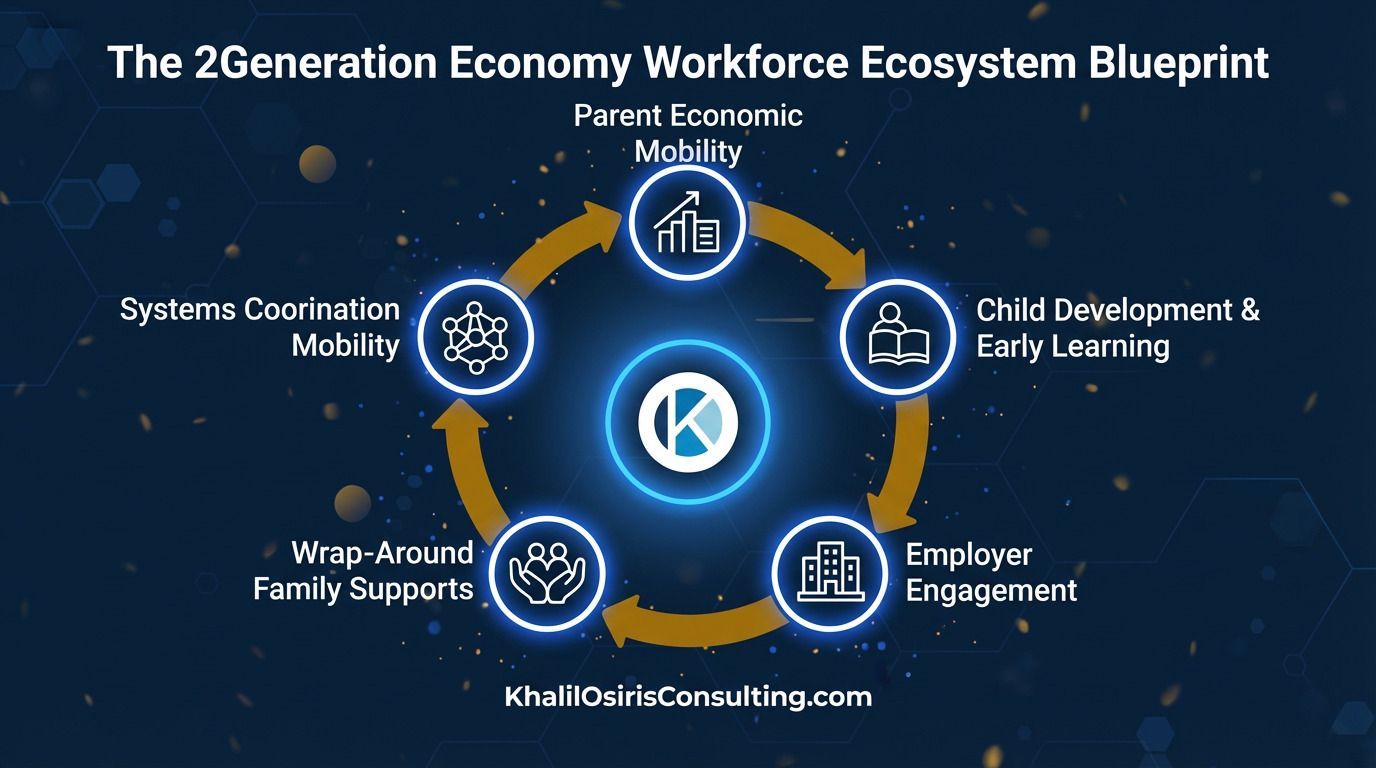
The 2Generation Economy Workforce Ecosystem Blueprint provides the systems-level architecture for our justice reform work. It connects employer engagement, parent economic mobility, child development, wraparound family supports, and systems coordination into a single measurable framework. When applied to criminal justice reform, the Blueprint shifts the unit of change from the individual to the household and the standard of success from placement to long-term economic stability.
How We Work
Diagnose: We assess your current systems, identify where the household is invisible in your programming, and map the failure patterns that create revolving-door outcomes.
Design: We build a household-centered reform strategy using the 2Generation Economy Blueprint, tailored to your jurisdiction, population, and political context.
Deploy: We implement the strategy with your team, build measurement infrastructure for household outcomes, and create durable systems that outlast any single administration.
Start the Conversation
Ready to move beyond compliance-based reform? Request a strategy session to discuss how the 2Generation Economy Blueprint can transform your criminal justice reform approach. You can also book Khalil Osiris for a keynote on justice reform and household stability, or explore our latest insights on reentry, policy, and systems redesign.
Reform Areas and Consulting Scope
Our criminal justice reform consulting addresses the structural challenges that create revolving-door incarceration and economic exclusion. We work across the full arc of reform using the 2Generation Economy Workforce Ecosystem Blueprint as the architecture for every engagement.
Reentry Systems Redesign
We help corrections agencies and reentry organizations redesign programming from compliance-based to household-stability models. This includes pre-release planning, employer engagement infrastructure, wraparound support coordination, and measurement systems tracking household outcomes over 12-24 months.
Policy Development and Reform Advisory
We provide policy advisory services to legislative bodies, state agencies, and advocacy organizations. Our work includes evidence-based reform recommendations, cost-benefit analysis, stakeholder engagement strategies for building bipartisan support, and implementation roadmaps.
Diversion and Alternatives to Incarceration
We support design and implementation of pre-arrest diversion, deflection, and alternatives-to-incarceration programs. Our expertise includes program model development, community partnership frameworks, outcome measurement, and stakeholder engagement strategies.
Economic Reintegration Strategy
We build the economic pathway from incarceration to household stability: workforce development, employer engagement, credentials access, and benefits navigation systems designed specifically for justice-impacted individuals and their families.
Community and Stakeholder Engagement
Reform initiatives fail without community trust. We build stakeholder engagement strategies that center impacted voices in system redesign as genuine co-design, not token participation. Our frameworks help build the community relationships necessary for sustainable reform.
Measurement and Cost-Benefit Analysis
We build data infrastructure and cost-benefit frameworks that legislators and funders need. Our analysis translates household stability outcomes into fiscal language: reduced recidivism costs, lower social services utilization, increased tax revenue from employed returning citizens.
Impact, Deliverables and Success Indicators
Criminal justice reform work must produce outcomes that are measurable, defensible, and durable. Here is what clients receive and what success looks like.
What Clients Receive
Success Indicators
Reduced Recidivism at 24 Months
Household stability is the strongest predictor of sustained reintegration. Systems built around household outcomes consistently outperform compliance-based models.
Bipartisan Policy Traction
Reform grounded in cost-benefit analysis and household economics attracts bipartisan support.
Improved Family Economic Outcomes
When the household stabilizes, children outcomes improve: reduced foster care, improved school performance, reduced intergenerational incarceration.
Demonstrated Fiscal ROI
Reduced re-incarceration costs, lower social services utilization, and increased tax revenue create a compelling fiscal argument for reform.
Frequently Asked Questions
What makes your criminal justice reform approach different?
Our approach is architectural. We use the 2Generation Economy Workforce Ecosystem Blueprint to redesign the entire system around household stability, not just individual compliance. Khalil Osiris brings lived experience inside the system, academic credentials from Boston University, and 27+ years building solutions that address root causes.
Do you work with state corrections agencies directly?
Yes. We work directly with state and local corrections agencies to redesign reentry programming, build employer engagement infrastructure, and implement household outcome measurement systems.
Can you help us make the case for reform to skeptical legislators?
Yes. We translate household stability outcomes into fiscal and public safety language that resonates across the political spectrum. Our cost-benefit frameworks demonstrate the ROI of reform investment.
How do we start a criminal justice reform consulting engagement?
The first step is a discovery conversation. Request a reform consultation here. There is no obligation, just a conversation to determine fit.
The Criminal Justice Reform Problems We Solve
The criminal justice system spends over $80 billion annually on incarceration, yet recidivism rates have remained largely unchanged for decades. The fundamental problem is architectural: reform initiatives focus on individual outcomes in isolation while ignoring the household instability that drives reoffending. Here are the specific challenges our consulting addresses.
For State and Local Government Agencies
- Reentry programs are funded at scale but recidivism rates remain flat because supervision and compliance do not produce long-term stability
- Corrections departments manage individual cases without coordinated household-level strategy, missing the family instability that drives reoffending
- Siloed agencies across corrections, workforce development, housing, and child welfare fail to coordinate around the household as the unit of change
- Difficulty demonstrating ROI to legislators and budget committees because metrics measure compliance rather than durable community outcomes
- Probation and parole systems designed to monitor individuals rather than stabilize families, creating surveillance without support
For Foundations and Policy Organizations
- Justice reform investments produce short-term activity reports but fail to demonstrate durable community impact at 18 to 24 months
- Grant portfolios lack a coherent theory of change connecting justice reform to household economic mobility and child outcomes
- Advocacy organizations generate policy wins that do not translate to measurable changes in recidivism or community safety
- No shared measurement standard exists for comparing reform initiatives across jurisdictions or grantees
- Political shifts threaten reform gains because outcomes were never documented in fiscal or public safety terms that survive administration changes
For Nonprofits and Reentry Service Providers
- Reentry case management is crisis-driven rather than pathway-driven, responding to emergencies instead of building durable plans
- Programs inherited compliance-based models from the system they are trying to reform, reproducing the same structural failures
- Staff lack tools for household-level assessment and cannot distinguish between individual barriers and systemic ones
- Difficult to demonstrate organizational impact when everyone measures the same inputs and no one measures household stability
For Legislators and Elected Officials
- Criminal justice spending continues to grow while public safety outcomes remain stagnant in many jurisdictions
- Reform proposals face bipartisan resistance because cost savings and public safety benefits are not clearly articulated
- Lack of credible fiscal impact analysis that connects household stability to reduced incarceration costs and improved tax revenue
- Constituents demand both accountability and compassion, requiring reform that produces measurable results
These are not isolated problems. They are symptoms of a system designed around individual compliance rather than household stability. Our consulting practice redesigns the architecture.
Our Criminal Justice Reform Methodology
Our consulting process applies the 2Generation Economy Workforce Ecosystem Blueprint to criminal justice reform. Every engagement follows a structured methodology that moves from systemic diagnosis through strategy design to durable implementation with measurable outcomes.
Phase 1: Systems Diagnosis and Landscape Mapping
We begin by mapping the full criminal justice ecosystem in your jurisdiction: corrections infrastructure, reentry programming, workforce connections, housing systems, family services, and supervision models. We identify where the household is invisible in current operations, where agency silos prevent coordinated strategy, and where metrics reward compliance over outcomes. We also assess the political landscape, including stakeholder positions, funding streams, and legislative opportunities that shape what is possible. This phase produces a comprehensive Systems Diagnostic Report that names the architectural failure patterns specific to your jurisdiction.
Phase 2: Household-Centered Reform Strategy Design
Using the 2Generation Economy Blueprint, we design a reform strategy that shifts the unit of change from the individual to the household. This includes reentry systems redesign with employer engagement and retention infrastructure, policy development supported by cost-benefit analysis, pre-arrest diversion program design, economic reintegration strategies for justice-impacted households, bipartisan stakeholder engagement, and fiscal ROI measurement protocols. Every strategy element is designed to produce outcomes that are measurable in both household stability terms and fiscal or public safety terms that resonate across political perspectives.
Phase 3: Implementation and Measurement Infrastructure
We deploy the reform strategy alongside your team, establishing the operational changes, staff training, interagency coordination protocols, and measurement systems needed to track household-level outcomes over 12 to 24 months. The Durability Index is implemented as the core measurement tool, tracking employment retention, housing stability, family economic security, child development indicators, and systems coordination. This phase ensures that reforms are not just announced but embedded in daily operations with accountability structures that produce verifiable results.
Phase 4: Sustained Advisory and Political Strategy
Criminal justice reform is a multi-year endeavor that requires sustained strategic support. Our ongoing advisory retainer provides quarterly performance reviews, legislative strategy support, funder relationship management, and continuous refinement of reform approaches based on Durability Index data. We help organizations translate household stability outcomes into the fiscal and public safety language that builds and maintains political support across administrations.
Criminal Justice Reform Deliverables
Every criminal justice reform engagement is structured to produce tangible deliverables that your organization owns and operates, building the infrastructure for durable systems change.
✓ Justice Systems Diagnostic Report — A comprehensive analysis of your jurisdiction's criminal justice ecosystem, identifying structural failure patterns, agency silos, and where household stability is invisible in current operations.
✓ 2Gen Reform Strategy Blueprint — A customized reform strategy applying the 2Generation Economy Blueprint to your jurisdiction, including reentry redesign, diversion programming, employer engagement, and household-centered measurement.
✓ Fiscal Impact and ROI Analysis — A detailed cost-benefit analysis demonstrating the fiscal return on investment of household-centered reform, including reduced incarceration costs, increased tax revenue, and reduced social service expenditures.
✓ Bipartisan Stakeholder Engagement Plan — A strategy for building and maintaining political support across the ideological spectrum by framing reform outcomes in fiscal responsibility, public safety, and family stability terms.
✓ Implementation Roadmap — A phased action plan with milestones, responsible agencies, timelines, and accountability structures for deploying reform strategies over 6 to 24 months.
✓ Durability Index for Justice Reform — Implementation of our household stability measurement system adapted for criminal justice contexts, tracking recidivism alternatives, household economic mobility, and child welfare outcomes.
✓ Interagency Coordination Protocol — A structured framework for breaking down silos between corrections, workforce development, housing, child welfare, and community organizations to create coordinated household-level interventions.
Outcomes and Impact of Justice Reform Consulting
Organizations and jurisdictions that implement household-centered criminal justice reform experience measurable shifts in outcomes, political positioning, and community impact.
→ Reduced Recidivism at 24 Months — Systems built around household stability produce measurably lower recidivism over 24 months because the structural conditions that drive reoffending are addressed, not just the individual behavior.
→ Bipartisan Political Support — Reform strategies framed in fiscal responsibility and public safety terms build support that survives administration changes and political cycles.
→ Taxpayer Savings — Household-centered reform reduces the per-person cost of criminal justice involvement by decreasing reincarceration, emergency service utilization, and child welfare system involvement.
→ Improved Child and Family Outcomes — When justice-impacted households stabilize economically, children's educational outcomes improve, family reunification succeeds at higher rates, and intergenerational system involvement decreases.
→ Credibility with Funders and Legislators — A documented household-stability measurement system provides the evidence base that funders, legislators, and budget committees require to sustain and expand reform investments.
→ Coordinated System Response — Interagency coordination protocols break down silos and create a unified response that addresses the full range of household needs rather than managing isolated services.
Why This Consulting Practice Exists
Khalil Osiris was arrested at 16 and spent decades in the criminal justice system. During his second incarceration, he earned two degrees from Boston University and began developing what would become the 2Generation Economy Workforce Ecosystem Blueprint. Over 27 years of field-tested methodology, he has built an approach to criminal justice reform that starts where most consultants cannot: inside the system itself, with the lived experience of its structural failures.
This is not reform from theory. It is reform from architecture, built by someone who experienced the system's design flaws firsthand and spent decades developing the tools to fix them. As a board member of the National Association of Reentry Professionals (NARP) and through strategic partnerships with Bluu Kazi, EC-Council, and CypherWorx, Khalil Osiris connects criminal justice reform to workforce credentialing, employer engagement, and technology-enabled career pathways that produce household stability, not just program completions.
Explore our workforce development strategy consulting for organizations addressing the workforce dimensions of justice reform, or view our full consulting practice for a complete overview of engagement options.
Frequently Asked Questions About Criminal Justice Reform Consulting
Who is this criminal justice reform consulting designed for?
Our criminal justice reform consulting serves state and local corrections agencies, probation and parole departments, legislative bodies and policy committees, district attorneys and public defenders, foundations investing in justice reform, nonprofit reentry organizations, and advocacy groups. If your jurisdiction is spending on incarceration without seeing recidivism reduction, or if your reform efforts lack a measurement system that demonstrates durable impact, this consulting was built for your situation.
What makes this approach different from other criminal justice reform consultants?
Most justice reform consultants focus on policy changes, sentencing reform, or program design within the existing paradigm. Our approach is architecturally different: we apply the 2Generation Economy Workforce Ecosystem Blueprint to shift the unit of reform from the individual to the household. This means every reform element, from reentry programming to diversion initiatives to supervision models, is designed to stabilize households rather than manage individuals. Combined with Khalil Osiris's 27 years of lived experience and field-tested methodology, this approach offers a perspective and capability that conventional consulting firms cannot replicate.
How does this approach gain bipartisan political support?
We translate household stability outcomes into the language that resonates across the political spectrum. For fiscal conservatives, we provide cost-benefit analysis showing reduced incarceration expenditures and increased tax revenue. For public safety advocates, we demonstrate how household stability reduces reoffending more effectively than supervision alone. For family values constituencies, we show improved child outcomes and family reunification rates. The Durability Index provides the evidence base that makes these arguments credible regardless of political orientation.
What reform areas does your consulting cover?
Our criminal justice reform consulting covers reentry systems redesign, pre-arrest and pre-trial diversion program design, sentencing and supervision reform with household-centered alternatives, economic reintegration strategies for justice-impacted households, workforce pathway development connected to employer retention infrastructure, interagency coordination for corrections, workforce, housing, and family services, fiscal impact analysis and legislative strategy, and community engagement for reform implementation.
How do you measure success in criminal justice reform?
We measure success through the Durability Index applied to criminal justice contexts: recidivism reduction at 12 and 24 months, employment retention and wage progression for justice-impacted individuals, housing stability for returning citizens and their families, family economic security, child development and educational outcomes, and systems coordination across agencies. We also measure fiscal impact including reduced incarceration costs, reduced emergency service utilization, and increased tax revenue from employed returning citizens.
Can this work with current political opposition to reform?
Yes. Our approach is specifically designed to work in politically challenging environments. By grounding every reform proposal in fiscal data and public safety outcomes, we remove the ideological framing that creates opposition. Legislators who would resist reform framed as compassion or leniency are often receptive when the same reforms are presented as taxpayer savings, improved public safety, and stronger families. The 2Gen Blueprint provides the measurement infrastructure to sustain these arguments over time.
How long does a criminal justice reform engagement take?
Reform engagements typically range from a diagnostic strategy session to multi-year advisory retainers. For jurisdictions ready to implement comprehensive reform, a 6 to 12-month Blueprint implementation engagement provides the systems diagnosis, strategy design, and initial implementation infrastructure. Ongoing advisory retainers of 12 months or longer support sustained implementation, legislative strategy, and measurement optimization. View all engagement models.
How do I get started with a criminal justice reform consultation?
Begin with a no-obligation discovery conversation. Request a reform consultation and we will schedule a call to discuss your jurisdiction's current challenges, political landscape, and how the 2Generation Economy Blueprint can transform your criminal justice outcomes.
Case Study: Redesigning Reentry Around Household Stability
A state corrections agency was tracking recidivism at 36 months and seeing the same pattern: individuals who completed reentry programming were returning to custody not because of new criminal behavior, but because the household conditions they returned to — unstable housing, no childcare, benefits cliffs, and disconnected services — made sustained stability impossible. The agency engaged Khalil Osiris Consulting to apply the 2Generation Economy Blueprint to their reentry system. The diagnostic phase revealed that no single agency was tracking household-level outcomes. The redesign connected corrections discharge planning to workforce onboarding, housing navigation, and family support coordination — with the Durability Index providing a shared measurement framework across agencies. The result: a reentry architecture that measures what actually predicts long-term stability, not just what satisfies compliance reporting.
The Durability Index Applied to Criminal Justice Reform
The Durability Index is the measurement backbone of every criminal justice reform engagement. Adapted from the 2Generation Economy Workforce Ecosystem, it scores household stability across five domains at baseline, 12 months, and 24 months — providing corrections agencies, funders, and policymakers with evidence that goes beyond recidivism rates.
Employment Retention — Is the individual connected to consistent employment? Measured through payroll continuity, attendance patterns, and advancement records. A worker can keep a job and still live one emergency away from collapse — this domain captures whether employment is durable, not just present.
Wage Progression — Is income improving over time? Wages that look acceptable on paper can still leave a family in crisis. This domain tracks whether earned income is moving toward household self-sufficiency.
Housing Stability — Is the household in a more stable housing situation than at baseline? Post-release housing is one of the strongest predictors of recidivism. This domain tracks lease status, move frequency, and shelter use.
Financial Resilience — Can the household absorb a modest financial shock? Fines, fees, and unexpected expenses are among the most common triggers for re-offense. This domain measures savings patterns, missed bills, and debt reduction.
Justice-System Stability — Is justice-system contact decreasing over time for the individual and the immediate household? This domain captures supervision compliance, new contacts, and the household environment's relationship to the justice system.
Each domain is scored 0–4 (Crisis to Durable) for a total possible score of 20. Durability Bands tell agencies whether a household is in crisis, fragile, stabilizing, stable, or durable — and what to change in policy, practice, and funding to move the score upward.
Lived Experience as System Intelligence
Most criminal justice reform efforts say they "center lived experience," but too often they use it as testimony instead of design intelligence. The foundational claim of this consulting practice is different: lived experience is system intelligence.
That means the people most impacted by the justice system are not an advisory add-on. They are a source of irreplaceable knowledge about how the system actually behaves in real life — across housing, work, supervision, transportation, family life, benefits, and daily survival. If lived experience does not change what gets measured, how success is defined, which pilots are funded, and who holds decision-making power, then it is not being used as system intelligence. It is being used as public relations.
In every engagement, people with direct justice experience help design the measurement tools, interpret the data, and surface design failures that spreadsheets alone cannot see — like release dates that do not match housing intake, supervision rules that compete with employment, or parole conditions that make family reunification structurally impossible.
The Fiscal Case for Household-Centered Reform
Criminal justice reform is not only a moral imperative — it is a fiscal one. The cost of incarcerating one person for one year ranges from $25,000 to over $60,000 depending on the state. When recidivism rates remain high, taxpayers fund the same cycle repeatedly. The 2Generation Economy approach produces fiscal ROI by addressing the household conditions that drive re-offense:
Reduced Incarceration Costs — When households stabilize, recidivism decreases. Every individual who does not return to custody represents direct savings in corrections, courts, and supervision costs.
Increased Tax Revenue — Stable employment with wage progression generates income tax revenue and reduces reliance on public assistance programs.
Reduced Child Welfare Costs — When parents are stably employed and housed, children are less likely to enter foster care or require emergency services.
Cross-System Savings — Household stability reduces emergency room visits, homeless shelter use, and crisis-driven service utilization across multiple agencies.
Our fiscal ROI analysis quantifies these savings for your specific jurisdiction, giving legislators and funders the evidence they need to support reform with confidence.
Additional Frequently Asked Questions
How does this approach differ from traditional reentry programming?
Traditional reentry focuses on individual compliance — did the person get a job, report to parole, attend programming. The 2Generation Economy approach shifts the unit of change to the household. It asks: did this family become more stable, better housed, and better positioned economically over time? That architectural difference is what separates temporary activity from durable outcomes.
Can this work in politically conservative jurisdictions?
Yes. The 2Generation Economy approach translates reform outcomes into fiscal responsibility and public safety terms. Our bipartisan stakeholder engagement strategy frames household stability as a taxpayer savings issue and a public safety strategy — not a social program. Cost-benefit analysis and Durability Index data give conservative legislators evidence-based reasons to support reform.
What if our jurisdiction has already invested in reentry programs?
We do not ask you to discard existing investments. The diagnostic phase identifies what is working and what is not. The redesign builds on existing infrastructure while adding the household stability layer and measurement system. Many jurisdictions find that their current programs become more effective — not less — when connected to the 2Gen Blueprint.
How do you handle interagency coordination challenges?
Interagency silos are one of the most common barriers to effective reform. Our Interagency Coordination Protocol creates a structured framework for breaking down silos between corrections, workforce development, housing, child welfare, and community organizations. The Durability Index provides a shared measurement language that all agencies can use, replacing competing metrics with a unified household stability framework.
What is the typical timeline for seeing results?
The diagnostic and strategy design phases typically take 60 to 90 days. Implementation begins immediately after. The Durability Index captures baseline data at the start and measures progress at 12 and 24 months. Early indicators — such as improved interagency coordination, employer engagement, and household assessment completion — are visible within the first quarter. Durable outcome data emerges at the 12-month mark.
The Credential Behind the Consulting
Arrested at 16. Sentenced to prison in 1976. Twenty years incarcerated across two sentences. Two Boston University degrees earned inside. Developed the Psychology of Incarceration curriculum, now implemented in correctional facilities nationwide. Released at 40. Khalil Osiris has spent 50 years studying the criminal justice and workforce systems from both sides — 27 of those years as a consultant, researcher, and advocate. He is a board member of the National Association of Reentry Professionals (NARP) and architect of the 2Generation Economy Workforce Ecosystem. This consulting practice exists because the system needs architecture built by someone who lived it.
Projected Outcomes of Household-Centered Reform
The 2Generation Economy Blueprint shifts criminal justice reform from individual compliance to household stability measurement. Based on the research literature and our consulting methodology, programs that center household outcomes target improvements across these domains.
Recidivism Reduction: Research shows that addressing housing instability, childcare gaps, and benefits cliffs during the first 90 days post-release are key drivers of sustained desistance. Programs redesigned around household stability target lower recidivism rates by stabilizing the conditions that drive re-offense.
Fiscal Savings: Household-centered reform targets per-person cost reductions through reduced reincarceration, lower emergency service utilization, and decreased child welfare system involvement. Each diverted reincarceration represents significant savings to jurisdictions.
Employment Retention for Justice-Impacted Individuals: When employer engagement infrastructure and household stability supports are implemented together, programs target meaningful improvements in 12-month employment retention for returning citizens compared to traditional job placement models.
Family Reunification and Child Outcomes: Households receiving coordinated reentry support through the 2Gen Blueprint show improved family reunification rates, reduced foster care involvement, and measurable improvements in children's school attendance and performance.
Bipartisan Legislative Support: Reform proposals grounded in fiscal ROI analysis and household stability data have achieved bipartisan support in jurisdictions where previous reform efforts stalled due to political opposition.
Put the 2Generation Economy Blueprint to Work
Download the complete 2Gen Economy Toolkit — the Report, Guide, and Playbook — and start building workforce systems that deliver household stability, not just placements.
Get the Free Toolkit