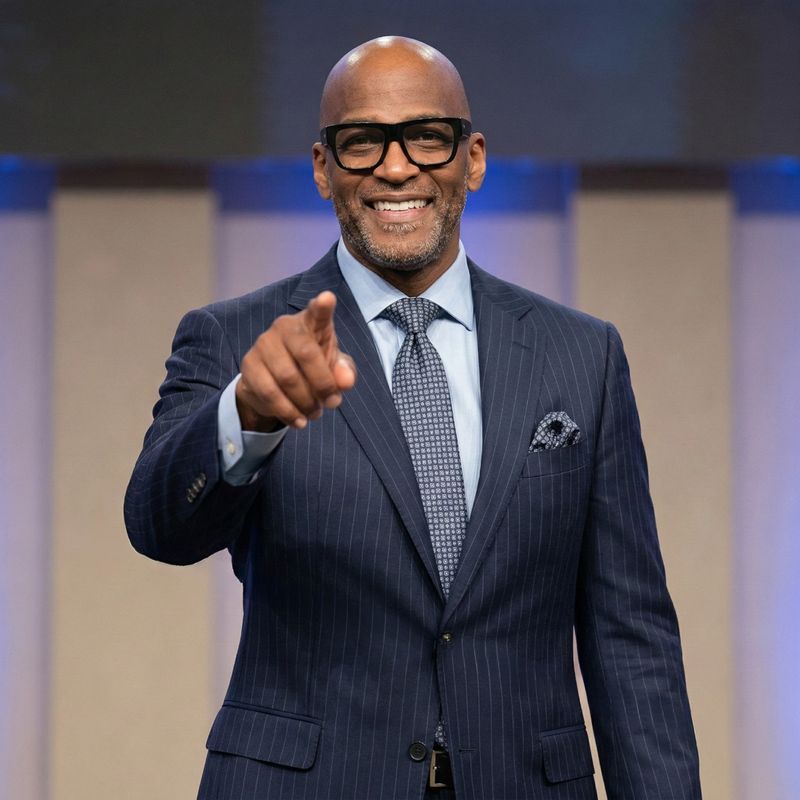
Speaking That Challenges Systems
and Moves Leaders to Action
Keynotes, workshops, and executive briefings on workforce development, criminal justice, second-chance hiring, and economic mobility.
Request AvailabilityWhy Event Leaders Book Khalil Osiris
Lived Experience Plus Systems Insight
Twenty years incarcerated. Twenty-seven years redesigning the systems that failed him.
Khalil does not speak from theory. He speaks from proof — the intersection of personal navigation and institutional architecture.
Audiences don't just hear ideas. They hear evidence tested by experience.
Research-Backed Ideas With Implementation Value
Every talk includes data. Every framework includes a playbook.
Khalil delivers research-driven content that audiences can act on — not inspiration that fades by Monday morning.
Attendees leave with metrics to track, questions to ask, and systems to redesign.
Fluent Across Every Audience in the Room
Employers. Funders. Policymakers. Workforce leaders. Reentry practitioners.
Khalil speaks to all of them — in the same room, in the same hour — because his frameworks connect what each stakeholder needs to hear.
No audience is left behind. Every seat has a next step.
Signature Topics
The ROI of Second Chances
The business case for hiring, retaining, and advancing justice-impacted talent.
Stop Calling It Reentry
Why reinvention — not reentry — is the frame that produces long-term outcomes.
The 2Gen Economy
Two-generation workforce ecosystems and household stability as economic strategy.
From Incarceration to Innovation
Career pathways from lived experience to high-wage opportunity — and what systems must change to make them real.
What Each Topic Delivers
The ROI of Second Chances
The talent pipeline your organization overlooks is also the one with the strongest retention data.
This talk unpacks the business case for second-chance hiring — from WOTC tax credits and retention metrics to the infrastructure that makes inclusive hiring profitable, not just ethical.
Audience walks away with:
- The real cost of exclusion (and the ROI of inclusion)
- Retention data comparing second-chance hires to general population
- A three-step infrastructure framework for sustainable fair-chance hiring
- The metrics that prove it to your board, your CFO, and your workforce
Stop Calling It Reentry
The word "reentry" traps people in a cycle of returning to systems that were never designed for them.
This talk reframes the conversation. Reinvention — not reentry — is the paradigm that produces durable outcomes. Khalil challenges audiences to examine the language, logic, and incentive structures that keep the revolving door spinning.
Audience walks away with:
- A new frame for how organizations talk about and design for returning citizens
- The hidden incentive structures that perpetuate recidivism
- A blueprint for reinvention-centered programming
- The metrics that distinguish activity from actual progress
The 2Gen Economy
You cannot stabilize a worker without stabilizing their household.
This talk introduces the 2Generation Economy framework — a systems-level model that invests in parent and child simultaneously. It connects workforce development, childcare, housing, and economic mobility into one household-centered ecosystem.
Audience walks away with:
- The three phases of the 2Generation model (Stabilize → Connect → Compound)
- Data linking household stability to employment retention
- A comparison: traditional workforce approaches vs. two-generation architecture
- Implementation pathways for funders, boards, and employers
From Incarceration to Innovation
The workforce system's biggest blind spot is the talent it refuses to see.
This talk maps the career pathways available to justice-impacted individuals — from technology and cybersecurity to entrepreneurship — and names the structural barriers that block access. It is equal parts challenge and playbook.
Audience walks away with:
- Career pathway models from incarceration to high-wage sectors
- The structural barriers systems must remove (not just acknowledge)
- Employer engagement strategies for high-opportunity sectors
- A reframe: lived experience as competitive advantage, not liability
Delivery Formats
Keynotes
30–60 minute presentations designed for mainstage impact. High-energy, evidence-driven, and structured to challenge assumptions — then deliver actionable frameworks before the audience leaves the room.
Workshops
Half-day or full-day interactive sessions for teams and leadership cohorts. Participants work through real scenarios using Khalil's frameworks. Every workshop ends with a customized action plan — not just notes.
Executive Briefings
Focused 60–90 minute sessions for C-suite, board members, and senior decision-makers. Concise, data-forward, and designed for leaders who control budgets, policy, and strategy. No filler. Just the evidence, the framework, and the decision.
Built for These Audiences
Conferences and Summits
Workforce, criminal justice, economic development, and social innovation conferences. National, regional, and state-level events where systems-change leaders convene.
Workforce Boards and Agencies
State and local workforce development boards, American Job Centers, and reentry service agencies. Audiences designing programs and allocating funding.
Employer Groups and HR Leaders
Corporate HR teams, employer coalitions, SHRM chapters, and talent acquisition leaders building or scaling second-chance hiring strategies.
Funders, Nonprofits, and Policy Audiences
Philanthropic organizations, policy convenings, legislative briefings, and nonprofit leadership forums. Audiences that shape investment, regulation, and system design.
Let's Build Your Session
Every engagement is customized for your audience, event goals, and format. One conversation to determine fit — and build something your audience will act on.
Request Availability