Executive Summary
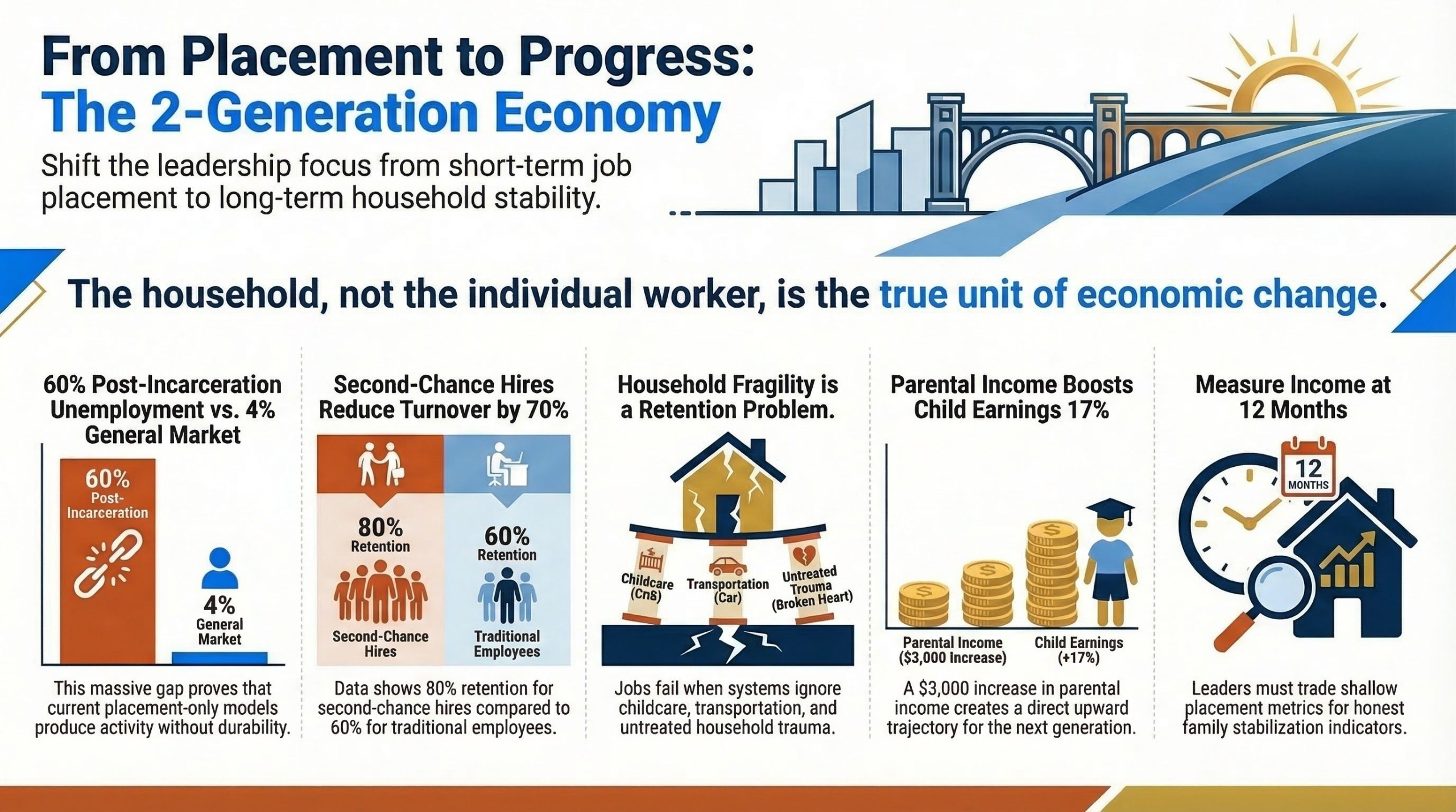
The workforce and reentry field has spent decades optimizing for the wrong metric. Programs count job placements. Funders count grant cycles. Corrections counts compliance. None of them count household stability, and that is why outcomes have not changed in 20 years. This report names the blind spot, quantifies the cost, and presents the 2Generation Economy Workforce Ecosystem Blueprint as a corrective architecture for employers, funders, policymakers, and workforce leaders who are ready to build for durability.
Key Findings
- The measurement problem: Workforce systems nationwide optimize for placement metrics that do not predict long-term stability, resulting in billions in misallocated resources annually
- The household gap: When the household around the worker is unstable, individual employment gains collapse within 90 to 180 days regardless of program quality
- The generational cost: Children in households disrupted by incarceration and economic instability face compounding disadvantages that perpetuate poverty cycles
- The Blueprint solution: The 2Generation Economy Workforce Ecosystem Blueprint connects employer engagement, parent economic mobility, child development, wraparound supports, and systems coordination into a single measurable architecture
- The ROI case: Employers, funders, and systems that adopt household-centered metrics see improved retention, reduced recidivism, and measurable generational mobility within 12 to 24 months
Who Should Read This Report
Employers and CHROs
Learn why your second-chance hiring programs underperform and what retention infrastructure looks like when you account for household stability. See our employer guide for implementation details.
Funders and Foundations
Understand why grant-cycle metrics perpetuate the problem and how to invest in systems that produce measurable 12-to-24-month household outcomes.
Policymakers and Government Agencies
See the cost-benefit case for shifting from compliance-based supervision to household-centered programming. Explore our criminal justice reform consulting for policy implementation support.
Workforce Boards and Reentry Leaders
Get the data and the framework to redesign programs around the unit of change that actually matters: the household. See our workforce development strategy consulting for systems-level support.
From Report to Action
This report is not just analysis. It is a blueprint for action. After reading, you can:
Follow us and stay up to date