Why Second-Chance Hiring Alone Is Not Enough
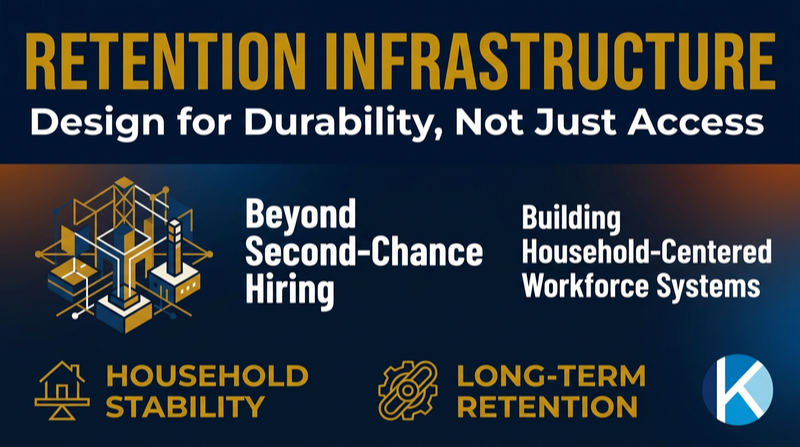
Most employers approach second-chance hiring as a talent access strategy. They open the door, make the hire, and count it as progress. But when the household around the worker is unstable, when childcare falls apart, when housing is precarious, when a single missed bus means a lost shift, the hire collapses. The problem is not the worker. The problem is the architecture.
Employer Pain Points We Address
- High early turnover: Fair-chance hiring efforts often fail when onboarding and retention systems do not account for household instability, transportation barriers, childcare gaps, or supervision requirements.
- Manager frustration: Frontline supervisors lack the tools and training to support workers facing household instability
- Compliance without outcomes: Fair-chance hiring policies check a box but do not produce durable workforce results
- Missing retention infrastructure: No systems exist to identify and address household-level barriers before they become turnover events
- Unmeasured costs of exclusion: Many employers lack a clear way to evaluate the full workforce cost of excluding justice-impacted talent, including missed hiring opportunities, avoidable vacancies, and potential tax-credit considerations.
The Implementation Model
Phase 1 - Diagnose: We assess your current hiring, onboarding, and retention systems to identify where household instability creates failure points.
Phase 2 - Design: We build a household-aware retention framework using the 2Generation Economy Workforce Ecosystem Blueprint, including manager training protocols, benefit navigation support, and 90-day stabilization checkpoints.
Phase 3 - Deploy: We implement the framework with your HR and operations teams, establish measurement infrastructure, and track household-level outcomes over 12 to 24 months.
The ROI of Getting This Right
Employers that build retention infrastructure around household stability are better positioned to reduce preventable turnover, improve retention conversations, strengthen onboarding, and evaluate the business case for fair-chance hiring over time. The business case is not charity. It is operational discipline applied to a workforce segment many employers have not yet learned how to support and retain.
Retention Strategies That Work
- Household stability assessments during onboarding, not just background checks
- Manager training on trauma-informed supervision and benefit navigation
- 90-day stabilization checkpoints that address housing, childcare, and transportation barriers
- Career pathway mapping that connects entry-level roles to wage progression milestones
- Peer support networks that reduce isolation and increase engagement
Start Building Better
Request a strategy session to discuss how your organization can move beyond second-chance hiring to build workforce systems that actually hold. Explore our workforce development strategy consulting for a systems-level approach, or book Khalil Osiris for a keynote on employer strategy and household stability. Visit our blog for the latest insights on fair-chance hiring, retention, and the 2Generation Economy.