Stop Measuring Jobs. Start Measuring Households: The 2Gen Metric That Actually Matters
Mar 31, 2026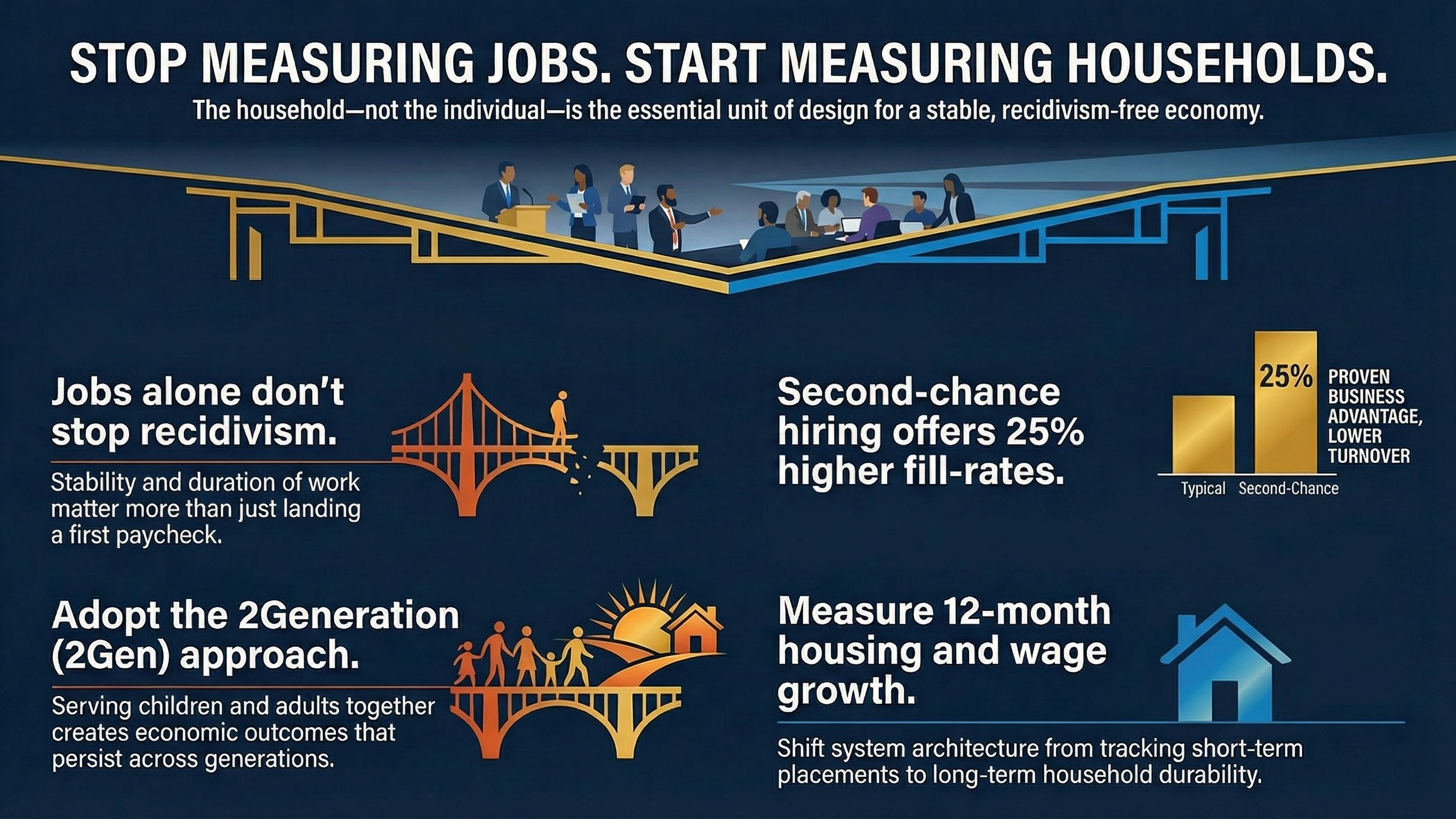
Workforce development and reentry programs across the United States measure success by job placements, but research consistently shows that unstable, low-quality employment fails to deliver long-term desistance or household stability.
The 2Gen Economy metric shifts the unit of measurement from individual job placement to household economic mobility ; tracking the five domains of the Durability Index ; employment retention, housing stability, financial resilience, family connection, and justice-system stability ; measured at intake, 6, 12, 18, and 24 months. This article examines why measuring households instead of jobs produces more durable workforce outcomes.
We are counting the wrong thing. We are obsessed with jobs. Families are trying to survive.
We are counting the wrong thing.
We are obsessed with jobs.
Families are trying to survive.
That gap is why I argue for a 2Gen Workforce Economy built on what the best evidence tells us about reinvention, economic mobility, and family well-being.
The Failure Inside Our "Success" Stories
Household stability is not a social work metric. It is a workforce durability metric that predicts whether a hire will still be employed at month 18. When programs measure placements instead of households, they optimize for exits, not outcomes.
Here's what the data actually shows.
A 2024 Justice Quarterly article following more than 1,600 people returning from prison found that stable, sustained employment;not just any job;is strongly associated with reduced recidivism.
That matters.
Because other studies show transitional or short-term employment programs can bump up employment in the short run, but have mixed or limited effects on recidivism when broader instability is ignored.
A 2025 reentry brief makes the same point from a different angle: if you only track rearrest or reincarceration, you miss housing, employment and financial stability, health, and social reintegration.
That's a polite way of saying we're measuring shadows, not lives.
Housing research reinforces it.
A 2024 federal report on reentry and housing stability finds that people in programs with stable housing and support have better access to work, health care, community supports;and relatively low recidivism over 18 months.
The combination of stability + support moves the needle.
Not just a paycheck.
So when we point to job placements and say, "Look, it worked," we are ignoring what the research keeps telling us:
• Employment matters when it is stable, adequate, and supported.• Housing and family context shape whether that employment can last.• 2Gen approaches are more effective than adult-only or child-only strategies.
Our spreadsheets can be full of "success."
If the household is still hanging by a thread, the system has not done its job.
What the Evidence Actually Points To
Over the last few years, the pattern has become hard to ignore.
• A 2023 systematic review of employment interventions after prison: more people start work and work more hours, but recidivism effects are uneven without other supports.• A 2023 vocational education study: a certificate alone does not reliably improve recidivism or employment; you need risk-needs-responsivity and stronger employer connections.• A December 2024 HHS/ASPE report on reentry and housing stability: permanent or stable housing is tied to better service connections and lower recidivism over time.• 2Gen research from Ascend at Aspen: programs serving children and adults together;coordinating education, income, and supports;are more likely to improve family well-being and long-term economic outcomes.• State-level policy: economic mobility strategies are shifting toward whole families, with hundreds of bills targeting family income, benefits, and opportunity;not just isolated adult outcomes.
Put it together and the verdict is clear:
Focusing on jobs alone is too narrow.
Focusing on individuals alone is too narrow.
Systems that ignore housing, family, and long-term stability are built to disappoint us.
That's why we need a new design language: a 2Gen Workforce Economy.
Five Sources That Should Reset Your Metrics
If you want to see the shift from jobs to households on paper, start here.
1. Kolbeck & López (2024, Justice Quarterly) – Stable, sustained employment after prison is strongly associated with lower recidivism for more than 1,600 people; quality + duration matter.
2. U.S. HHS, ASPE (2024), "Reentry and Housing Stability" – Housing stability is a vital element of successful reentry; without it, people struggle to keep jobs, access health care, or comply with supervision.
3. CSG Justice Center (2025), "Beyond Recidivism" – Argues reentry must be evaluated on employment and financial stability, housing, health, and social connections;not recidivism alone.
4. Ascend at the Aspen Institute (2025), "2Gen Approach" – Defines 2Gen as centering the whole family to create a legacy of educational success and economic prosperity.
5. MIT Sloan (2024), "The Bottom-Line Benefits of Fair-Chance Hiring" – Employers with fair-chance practices see 25% higher fill rates and significantly lower turnover than peers.
Taken together, they say something simple and radical:
If we keep asking, "Did they get a job?", we are ignoring what actually drives safety, stability, and mobility for families.
From Programs to Architecture
Most responses are programmatic.
Another training. Another transitional job. Another initiative.
Those can help. But they usually sit in isolation from housing, health, and family supports.
Programs matter.
But programs live inside an architecture;rules, incentives, and metrics that decide what's possible.
Right now, that architecture looks like this:
• Employers are rewarded for quick hiring and low perceived risk.• Workforce systems are rewarded for enrollments, completions, and placements.• Corrections is judged on crowding and technical compliance.• Funders chase "innovation" but measure short-term outputs.• The household is an afterthought.
That's the blind spot.
Recent reentry work calls for broader measures like financial stability, housing security, health, and social connections;because those are the conditions where employment and desistance stick.
2Gen research says the same thing in different language: if you want a legacy of educational success and economic prosperity, you must coordinate services for parents and children together.
The research is telling us to fix the architecture.
What I Mean by a 2Gen Workforce Economy
When I talk about a 2Gen Workforce Economy, I'm not talking about a new program.
I'm talking about redesigning how we build and judge workforce and reentry systems.
A 2Gen Workforce Economy:
• Treats the household as the unit of design, not just the worker.• Makes durable stability;retention, wage growth, housing, and well-being;its primary outcome set.• Aligns employers, workforce boards, corrections, education, and funders around shared metrics that reflect real family life.
This is what happens when you read the last decade of reentry and economic mobility research and take it seriously.
If we believe the evidence, we cannot keep doing business as usual.
Lived Experience as System Intelligence
This is not abstract for me.
I spent 20 years in prison and earned my degrees inside.
I watched men cycle in and out, not because they lacked motivation, but because every system around them was calibrated for short-term compliance, not long-term stability.
From the inside, you see how release dates collide with housing rules, how fines and fees sabotage income, and how one missed paycheck can unravel everything.
From the outside, working with employers, workforce systems, and communities, you see people trying to do better;and getting trapped by the way we've built the system.
The research is clear.
The lived experience is clear.
Our architecture is out of alignment with our goals.
A 90-Day Challenge for Leaders
If you lead in workforce, justice, business, or philanthropy, you don't have to wait for new legislation to start shifting toward a 2Gen Workforce Economy.
Start in the next 90 days.
1. Adopt One Household-Centered Metric
Choose a measure like 12-month housing stability, or retention and wage growth for justice-impacted parents, and commit to tracking it.
2. Convene One Cross-Sector Table
Bring together an employer, a workforce partner, a reentry or corrections leader, a community organization, and someone with lived experience.Give yourselves one question:What would it take for justice-impacted households in our community to be stable 24 months after release?
3. Design One Small Pilot
Use that metric and table to build a 90-day pilot where you share data, adjust supports, and learn in real time.Evaluate it against the broader outcomes current research recommends;not just recidivism and placements.
We already know too much to pretend job counts are enough.
Recent research on reentry, employment, housing, and 2Gen strategies all point in the same direction: households, durability, and coordinated systems are where real change happens.
What does your organization score on this?
Take the free Durability Index Self-Assessment. Twenty questions. Five domains. One score.
Until next time, keep building what they said couldn't be built.
Khalil Osiris
Author and Founder, Khalil Osiris Consulting | Market Architect, The Durability Economy Workforce Architecture
The Durability Economy. Workforce redesign, fair-chance hiring, and household stability. For leaders who measure what lasts.
Change the metrics. Change the outcomes.
Subscribe to The Durability Economy
Get the weekly briefing on workforce transformation, criminal justice reform, and the 2Gen Economy, delivered straight to your inbox. Evidence over ideology. Households over headcounts.
We hate SPAM. We will never sell your information, for any reason.