The Fair Chance Paradox: Why Good Policies Don't Automatically Produce More Hires
Mar 10, 2026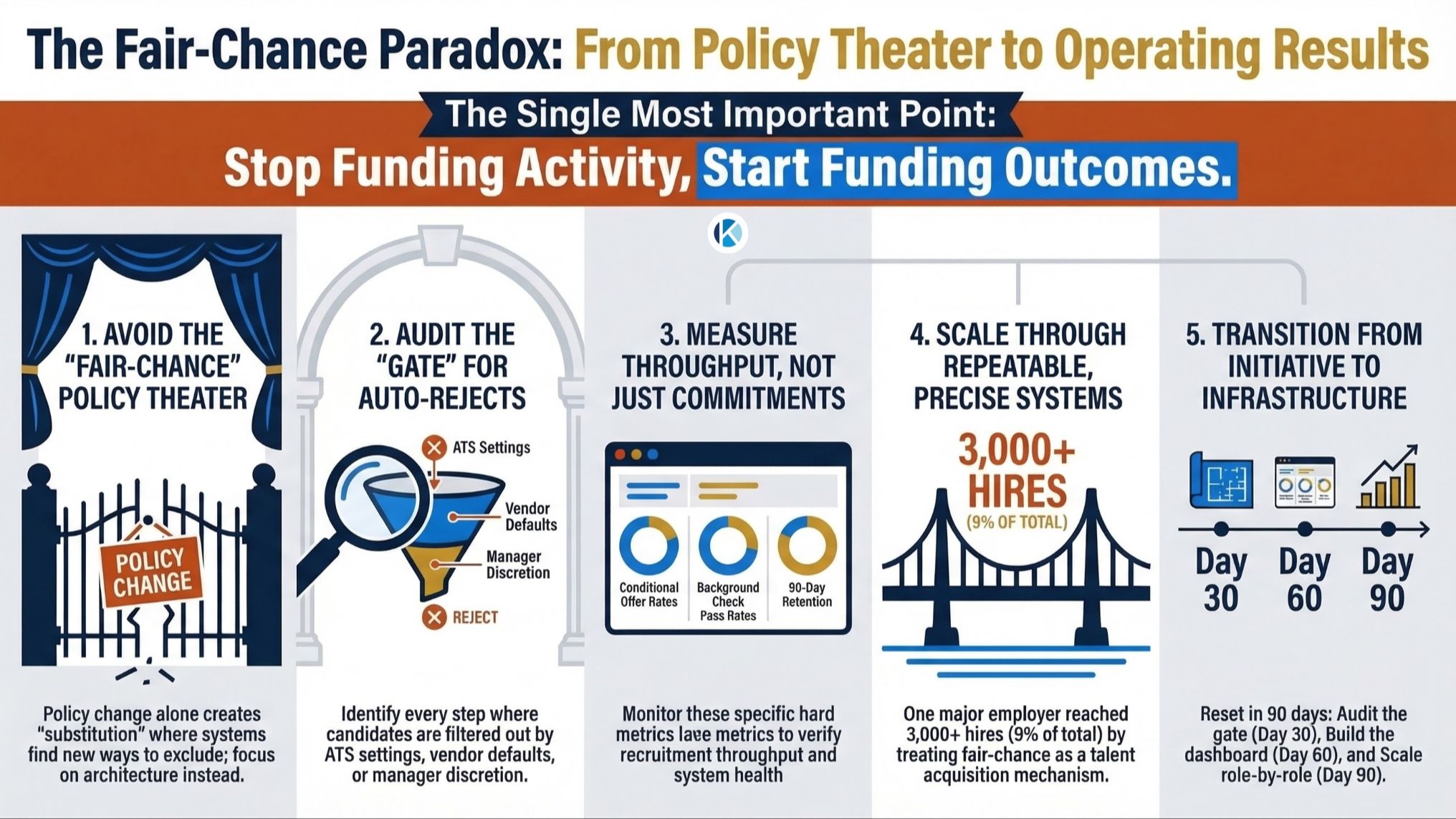
Fair chance hiring policies have expanded across the United States.
Yet many of these reforms leave actual hiring outcomes for people with records basically unchanged.
The fair chance paradox occurs when organizations adopt inclusive policies without building the operational infrastructure ; manager training, retention systems, and measurable outcomes ; needed to convert policy into results. This article examines why good policies alone do not produce more hires and what organizations must build instead.
And I’ll go one step further, because the data forces us to:
Some of the most popular “fair-chance” reforms can leave hiring outcomes basically unchanged for people with records.
Not because the idea is wrong.
Because the system is still doing what it was designed to do: protect itself.
That’s the paradox.
You can change the policy. And still preserve the exclusion.
You can remove the box. And watch the gate rebuild itself using proxies.
You can join the coalition. And still fail the CEO test: measurable outcomes, month over month.
Let’s talk about the CEO test.
The CEO Test
Fair chance hiring is not a policy success. It is a policy paradox. When legislation opens the door but the household infrastructure behind the worker remains unstable, the hire churns within 90 days. The paradox is not the policy. It is the missing architecture.
Can you see results on one dashboard in 30 days?
Not vibes. Not commitments. Not “we trained managers.”
Results.
If you can’t, you don’t have an operating model.
You have theater.
And you already know what happens to theater when the market tightens:
It gets “paused.” “Temporarily.” Until it disappears.
The Uncomfortable Evidence Most Leaders Avoid
Here’s what the research is telling us, in plain language:
When employers lose access to criminal history early in the process, some don’t become more open.
They become more indirect.
They substitute.
They lean harder on other signals correlated with criminal history.
And the end result? The rate at which people with records progress to offers may not meaningfully increase.
That’s not a moral claim.
That’s a systems claim.
And it’s the reason I’m pushing leaders away from feel-good reforms and toward measurable design.
Because if a policy change doesn’t change throughput, it doesn’t change the labor market.
It just changes the story we tell about it.
“But we’re doing the work.”
Good.
Now prove it.
Coalitions are useful. Shared learning matters. Toolkits matter.
But here’s the problem with most coalition-era messaging:
It is optimized for alignment, not accountability.
It emphasizes adoption:
- We review candidates individually.
- We updated HR policies.
- We partnered with community organizations.
- We created a guide.
All good.
But adoption isn’t impact.
Adoption is activity.
Impact is outcomes.
And CEOs do not fund activity forever.
They fund outcomes.
The Paradox in One Sentence
If your “fair chance” approach is primarily a policy change, you are vulnerable to substitution.
If your approach is an operating system with outcome metrics, you can scale.
That’s the line.
What Scale Actually Looks Like
A major employer reported hiring over 3,000 people with records in one year, more than 9% of its U.S. new hires.
That’s not a slogan.
That’s capacity.
That’s what happens when an organization builds a repeatable process instead of running a campaign.
So don’t tell me “it can’t be done.”
Tell me what you redesigned.
Because that’s the real difference between organizations that hire at scale and organizations that announce at scale.
You Don't Have a Fair Chance Problem
You have a design problem.
And design problems don’t get solved with statements.
They get solved with mechanisms.
Here are the mechanisms that actually determine outcomes inside a company:
- Where does the process auto-reject?
- What triggers “no” without human review?
- What’s the exception path?
- Who owns the exception path?
- How fast does Legal respond?
- What roles are eligible, specifically?
- What do managers say in the interview when fear shows up?
- What metrics are reviewed monthly, and by whom?
If you can’t answer those questions, you don’t have a strategy.
You have a narrative.
And narratives don’t fill roles.
What CEOs and CHROs Should Demand
If you’re in the C-suite, stop asking, “Are we committed?”
Ask questions that force architecture:
- Where is the gate? Show me the exact step where candidates get filtered out, role by role.
- What’s the throughput? How many candidates with records enter the funnel, and how many exit with offers?
- Where do we lose them? Application stage? Interview stage? Background check stage? Day 30? Day 90?
- What’s the cost of our current design? Time-to-fill. Turnover. Overtime. Vacancy drag. Manager churn.
- Who owns the numbers? Name the operator. Not the spokesperson.
This isn’t about being “nice.”
This is about being accountable.
Because accountability is what scales.
Precision Talent Acquisition
Here’s the shift I’m asking CEOs and CHROs to make:
Stop treating this as a fairness initiative.
Treat it as accuracy.
Accuracy in decision-making.
Accuracy in screening.
Accuracy in predicting performance.
That means role-relevant decisions.
Not blanket exclusion. Not blanket inclusion.
Precision.
And precision requires measurement.
Not quarterly storytelling.
Monthly operating cadence.
The Only Metrics That Matter
If you want this to survive and perform you need outcome metrics that executives recognize:
- Time-to-fill (before vs. after redesign)
- Conditional offer rate for justice-impacted applicants
- Background check pass rate at the final stage
- Retention at 90 / 180 / 365 days
- Wage progression
- Incident rate (role-relevant)
Now we’re speaking CEO language.
Now we’re talking performance.
Because once these metrics exist, incentives realign.
Budgets stop being mood-based.
Ownership stops being “shared.”
And the work moves from “initiative” to “infrastructure.”
The Layer Most Companies Ignore: Household Stability
Even if you fix the gate, you can still fail.
Here’s why:
Employment alone is not the destination.
Household stability is the destination.
If you hire someone, and the system still punishes them with:
- unstable schedules
- transportation gaps
- child care breakdowns
- financial access barriers
You didn’t create mobility.
You created churn.
And churn is expensive.
That’s why I keep building the Durability Economy Workforce Architecture.
Because the future of workforce development isn’t just getting someone in.
It’s building the conditions that keep a household stable long enough for advancement to become normal.
If your workforce strategy isn’t thinking in households, you’re not building the future.
You’re managing turnover.
The 30-90 Day Reset
If you want to move from policy theater to operating results, here’s the reset:
Days 1–30: Audit the gate
- Identify every auto-reject trigger across application, ATS, vendor settings, and manager discretion.
- Select your highest-volume roles first.
- Install a clear “review path” so the default isn’t silent exclusion.
Days 31–60: Build the dashboard
- Track offer rates, pass rates, retention, wage progression, and incidents by role.
- Review monthly. No exceptions.
- Publish the action log: decision, owner, due date.
Days 61–90: Scale role-by-role
- Expand based on outcomes, not internal opinions.
- Train managers with scripts that reduce fear and increase consistency.
- Align Legal to enable role-relevant decisions with a turnaround SLA.
That’s the work.
That’s the system.
That’s what turns slogans into throughput.
The Forcing Question
If your organization is still celebrating adoption…
But can’t show outcome dashboards…
What are you actually leading?
A strategy?
Or a story?
Because the workforce of the future won’t be built by well-written commitments.
It will be built by leaders willing to redesign the gate, measure outcomes monthly, and stabilize households so talent can actually stay.
What does your organization score on this?
Take the free Durability Index Self-Assessment. Twenty questions. Five domains. One score.
Until next time, keep building what they said couldn't be built.
Khalil Osiris
Author and Founder, Khalil Osiris Consulting | Market Architect, The Durability Economy Workforce Architecture
The Durability Economy. Workforce redesign, fair chance hiring, and household stability. For leaders who measure what lasts.
Change the metrics. Change the outcomes.
Subscribe to The Durability Economy
Get the weekly briefing on workforce transformation, criminal justice reform, and the 2Gen Economy, delivered straight to your inbox. Evidence over ideology. Households over headcounts.
We hate SPAM. We will never sell your information, for any reason.