Probation Is a Volatility Machine. Put It on a Household Stability Budget.
Sep 10, 2026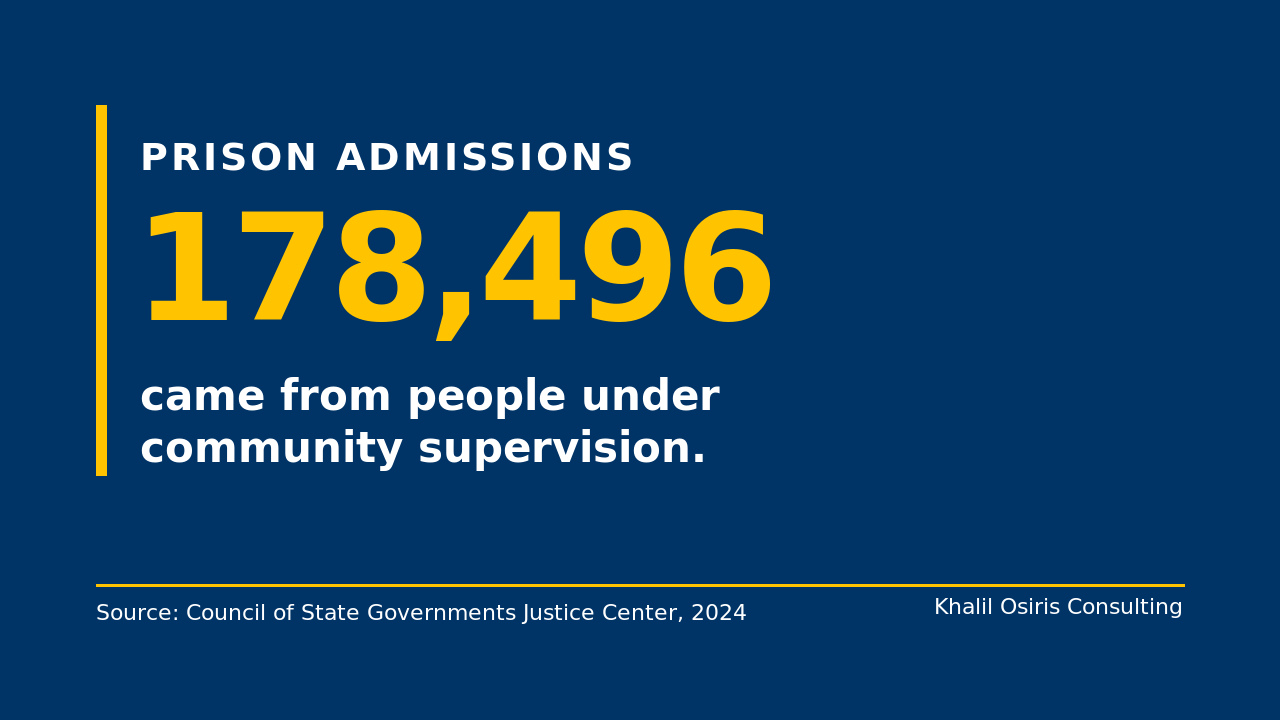
At the end of 2023, an estimated 3,772,000 adults were under community supervision in the United States. The probation population grew 1.3 percent that year while parole fell 2.9 percent, and among comparable agencies the total supervision population declined 23 percent over the decade ending in 2023. The footprint is shrinking, and no supervision agency reports what the shrinkage does for households (Bureau of Justice Statistics).
The field judges that system by compliance, completion, and recidivism. Those are system metrics.
They record what an agency did and whether a person satisfied it. They do not record what supervision did to the household underneath the person: the work shifts lost to appointments, the rent money diverted to fees, the caregiving disrupted by movement restrictions, the family plans that cannot survive revocation exposure.
I want to propose a different operating rule. Supervision should run on a household stability budget.
Every condition must justify the volatility it imposes. Every month of continued supervision must add more stability than risk.
This is not an argument for leniency. It is an argument for accounting.
The ledger prices the prison, not supervision
Start with what the current bookkeeping can see. In 2021, approximately 44 percent of all prison admissions, 178,496 of 406,228, came from people under community supervision. About one third of all admissions were for technical violations, conduct that involved no new crime.
States reported spending over $10 billion incarcerating people who were serving supervision terms, including approximately $3 billion for technical violations. The analysts called the $10 billion conservative and cautioned that the estimates mix fixed and variable costs, so eliminating the admissions would not free the full amount immediately (Council of State Governments Justice Center).
Read that ledger carefully. It prices the prison bed.
It does not price the household consequences that precede the bed: the job lost during a violation hold, the apartment lost during the job loss, the child care arrangement that collapsed with the apartment. The system counts its own event and calls the accounting complete.
A violation entry closes a case file. It also opens a hole in a household. Only one of those appears in a budget.
Conditions are not free
Here is the mechanism the compliance ledger misses. Supervision conditions consume the same resources a household needs to stabilize: time, cash, mobility, and predictability.
The cash side is documented. A 2024 national study for the National Institute of Corrections found monthly supervision fees ranging from $10 to $150 across states. Among states with available budget data, fee revenue ranged from less than 1 percent to 70 percent of agency budgets.
Fourteen states allow revocation when fees go unpaid and unwaived. And only about 28 percent of responding jurisdictions could produce collection or waiver rates at all, which means most agencies charging families cannot say what they collect or forgive (National Institute of Corrections).
An agency that cannot report its collection rate is not running a revenue system. It is running an unmeasured tax on households under its authority.
Now the honest complication. A 2023 Census Bureau working paper used five natural experiments across Florida, Michigan, North Carolina, Texas, and Wisconsin and found precise null effects of criminal court fees on population-level earnings and recidivism, ruling out long-run impacts larger than 3.6 percent on earnings and 4.7 percent on recidivism (U.S. Census Bureau).
The authors argue the findings cut against fees as revenue and against fees as crime control. They also cut against the poverty-trap story told at population scale.
I will not discard that finding because it complicates my argument. Precision is a discipline, not a decoration. The volatility case does not rest on the claim that fees wreck average earnings.
It rests on the claim that conditions, fees, appointments, and revocation exposure interact inside specific households, and that nobody is measuring the interaction. A population null and a destabilized household can both be true. The instrument that would tell us which households absorb the load and which ones fracture under it does not exist in supervision practice.
That is the gap. Not a missing argument. A missing measurement.
The exit is broken by design
If supervision adds stability, it should end when stability arrives. Federal law has allowed exactly that since the structure was built: under 18 U.S.C. 3583(e)(1), a court may terminate supervised release after one year when conduct and the interest of justice warrant it.
The 2025 analysis in the American Criminal Law Review shows how rarely the door opens. In 2022, federal judges granted early termination to 6.6 percent of people on supervised release. Only 25 percent of those who successfully completed supervision were terminated early.
The system recorded 8,546 early terminations against 16,954 revocations. No rule requires anyone to tell an eligible person the option exists, and the judgment form does not mention it (American Criminal Law Review).
The same article proposes an empirically based guideline: for most criminal history categories, the probability of revocation falls below 5 percent somewhere between 18 and 38 months, which supports presumptive termination in ordinary cases after 18 to 36 months. The bipartisan Safer Supervision Act of 2023 proposed notice at the halfway point and a presumption of termination for people with good conduct and compliance.
A market that pays for continued monitoring but cannot execute a routine exit is not a safety system. It is a subscription the customer cannot cancel.
The household stability budget
Here is the redesign. Measure the Durability Index at supervision intake and at 6, 12, 18, and 24 months: five domains, Employment Retention, Housing Stability, Financial Resilience, Family Connection, and Justice-System Stability, twenty sub-measures, one composite from 5 to 25. The composite shows direction.
The weakest domain shows where support must move. The calendar shows whether progress holds.
Then attach three rules. First, every condition carries a stated stability cost, in hours, dollars, and mobility, and a supervisor must justify that cost against the risk it manages. Second, when a household reaches a defined durable range and holds it, early termination review triggers automatically, with notice to the person.
Third, the priceable outcome is a durable supervision exit: no new offense, sustained employment, no housing loss attributable to a supervision demand, manageable financial obligations, and preserved caregiving. Agencies and outcome buyers pay for safe contraction, not for contact counts.
Recidivism asks whether the system saw the person again. Durability asks whether the household could finally stop bracing.
What to do this budget cycle
For supervision leaders. In the next 90 days, inventory every standard condition and price it in household terms: hours demanded, dollars charged, mobility restricted.
Publish your collection and waiver rates. If you cannot produce them, that is the finding.
For judges and policymakers. In the next 90 days, adopt notice and presumptive review for early termination on the 18 to 36 month evidence.
An eligibility no one hears about is not a policy. It is a filing cabinet.
For funders. In the next 90 days, fund one supervision agency to run the Durability Index at intake and 6 months. Before anyone prices a durable exit, someone has to prove the baseline can be measured inside supervision operations.
Take the free Durability Index Self-Assessment. Twenty questions. Five domains. One score.
Until next time, keep building what they said couldn't be built.
Khalil Osiris
Author and Founder, Khalil Osiris Consulting | Market Architect, The Durability Economy Workforce Architecture
The Durability Economy. Workforce redesign, fair chance hiring, and household stability. For leaders who measure what lasts.
Change the metrics. Change the outcomes.
Subscribe to The Durability Economy
Get the weekly briefing on workforce transformation, criminal justice reform, and the 2Gen Economy, delivered straight to your inbox. Evidence over ideology. Households over headcounts.
We hate SPAM. We will never sell your information, for any reason.