Lived Experience Is System Intelligence: Redesigning Metrics for Real Justice and Household Stability
Apr 14, 2026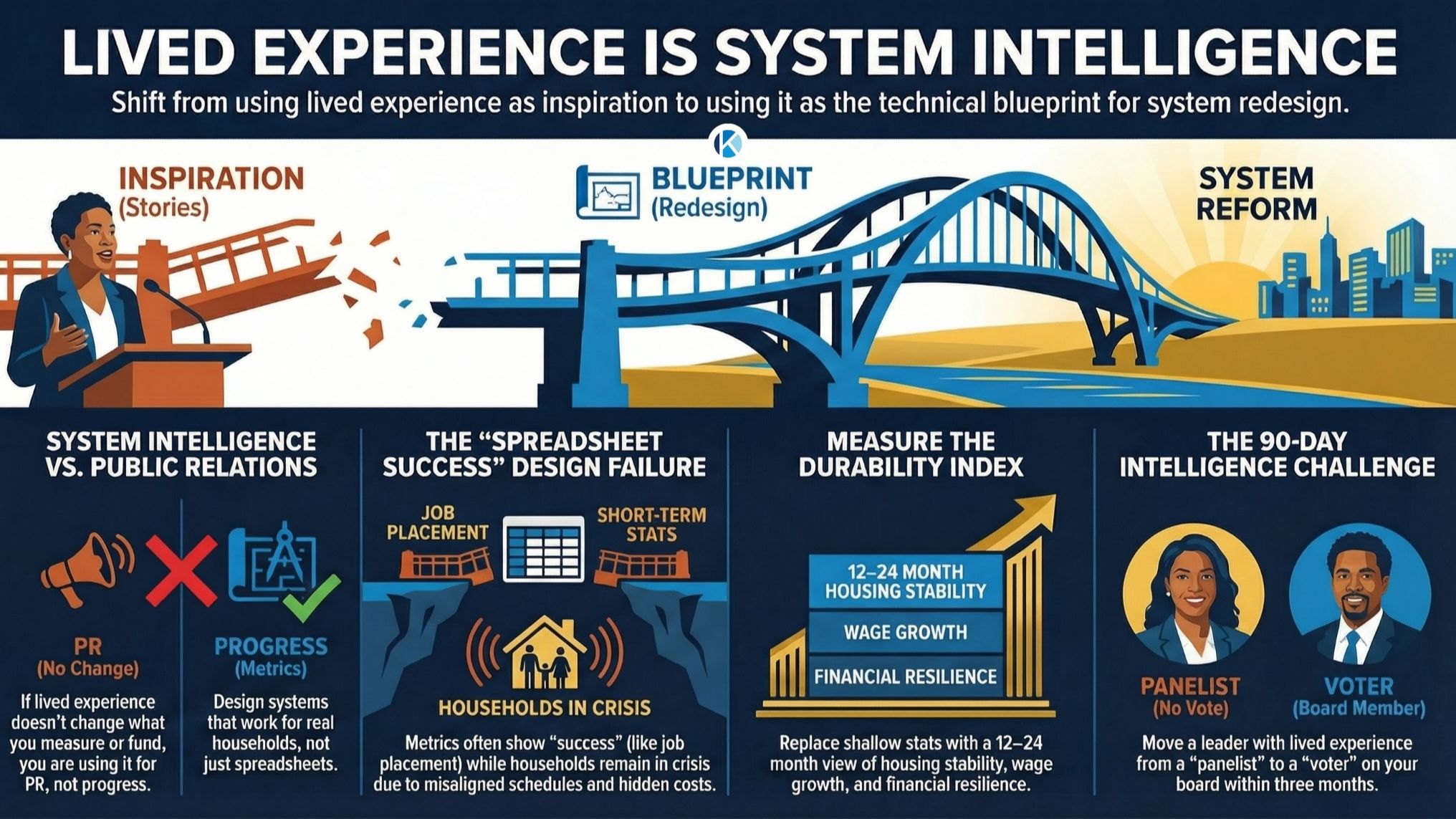
Lived experience is one of the most underutilized assets in workforce development and criminal justice reform.
When organizations treat it as system intelligence rather than personal testimony, it transforms how programs are designed, how success is measured, and who holds decision-making power.
This article explores why centering lived experience in metric design produces more durable outcomes for justice-impacted households.
Most Systems Say They "Center Lived Experience." Here's What That Usually Looks Like.
You invite someone with a record to tell their story at the beginning of an event. People cry. Standing ovation. Then they leave the room while the real decisions begin.
Their role is to inspire, not to design.
After 20 years in prison and 27 years working on the outside, I can tell you: that's how good people build systems that measure the wrong things.
We treat lived experience as personal stories, but it's really a form of system intelligence.
That's not a slogan. It's a standard.
Until we start designing like it's true, our metrics will keep telling us we're winning while families are still losing.
What I Mean by "System Intelligence"
When I say, "lived experience is system intelligence," I mean something very specific.
Lived Experience Is System Intelligence treats the people most impacted by a system as irreplaceable experts in how that system actually behaves, and uses that knowledge to shape metrics, incentives, and implementation. This is the foundation of any serious workforce development strategy.
If lived experience does not change:
- what you measure
- how you define success
- which pilots or programs get funded
Then you are not using it as system intelligence. You are using it as public relations.
System intelligence asks harder questions:
- What does the system look like from inside the cell, the shelter, the probation office, the kitchen table?
- Where do policies and timelines collide with real life?
- Which "good" outcomes on paper still feel like crisis in a real household?
Those answers rarely show up in spreadsheets on their own. They show up when you bring lived experience into the design of the scorecard itself.
Measurement is destiny. If you get the metric wrong, you get the incentives wrong. If you get the incentives wrong, you get the outcomes we have now.
Three Design Failures You Can't See From a Spreadsheet
When you've been on both sides of the wall, you see things differently.
Data tells one story. Lived Experience Is System Intelligence reveals where that story breaks down for real households.
Here are three failures I see over and over again;failures that drive the 2Gen consulting work I do every day.
1. Release Dates vs. Housing Intake
On paper, "housing referrals" look like success.
In real life:
- People are released at times when shelters don't do intake.
- Transportation is unreliable or nonexistent.
- One missed intake window means days on the street.
Meanwhile, homelessness is rising, and people coming out of prison are far more likely to be homeless than the general public.
The timing architecture is broken, but the metric still says "housed."
System intelligence doesn't just say "be more compassionate." It says: your time horizon and intake rules are misaligned with reality.
The metric should not be "referral given." It should be "stable housing secured and sustained at 90 and 180 days";and your release and intake policies must be redesigned to make that possible.
2. Supervision vs. Work
On paper, supervision conditions look reasonable:
- Regular check-ins
- Geographic restrictions
- Curfews and reporting requirements
The narrative: "We are promoting accountability and public safety."
In practice:
- Check-in times conflict with shifts.
- Offices are across town, far from job sites and bus lines.
- One missed bus becomes "non-compliance."
People lose jobs not because they're irresponsible, but because supervision and employment were designed in separate universes;exactly the kind of structural misalignment that criminal justice reform consulting is designed to fix. The metric says "violation." The mechanism is a design failure.
System intelligence names it clearly: you are asking people to choose between keeping their job and staying in compliance. Your recidivism metric is catching the symptom, not the cause.
3. "Good Job" vs. a 2Gen Household Budget
Program reports love the line: "We placed 100 people in full-time jobs above minimum wage."
On a dashboard, that looks like progress. On a kitchen table, it often looks like:
- A wage that still forces a parent to choose which bill not to pay.
- Child care swallowing half the paycheck.
- One sick day or car repair sending the household back into crisis.
When a parent has been incarcerated, the stakes are even higher. Incarceration strips families of income and leaves children with lower lifelong earnings.
The metric says "success." The household says, "we're still drowning."
System intelligence insists on a different unit of analysis: Show me the household at 12 and 24 months. Show me retention, wage progression, housing stability, and whether the justice system is still sitting in the middle of this family's life. Then we can talk about success.
From Story to Scorecard: The Durability Index
This is where the Durability Index comes in.
The Durability Index asks a different question: Is this pathway actually holding a household through intake, 6, 12, 18, and 24 months?
It looks at:
- Employment retention and wage progression
- Housing stability
- Financial resilience
- Family connection in the household
- Justice-system stability in the household
Here's the critical piece: the Durability Index cannot be designed only by agencies, employers, and consultants. If it is, it will drift back to what's easy to count and defend in a budget meeting.
When lived-experience leaders co-author the Durability Index, they push you to:
- Redefine success at the household level
- Set thresholds that reflect real life, not just compliance
- Add indicators a traditional system would never think to track
This isn't theory. When people with lived experience are embedded as co-designers and decision-makers, systems start to focus on the right problems and build more trustworthy, effective interventions.
That's how the scorecard stops lying. It starts telling you whether your architecture is strong enough to hold a family, not just fill a report.
Measurement is destiny. Change the metric, change the outcome.
Governance: The 2Gen Economy Council
Metrics alone don't change systems. Power does.
A serious 2Gen Economy Council is where Lived Experience Is System Intelligence becomes governance:
- Lived-experience leaders hold defined roles, not token seats.
- They have real voting power on metrics, pilots, and investments.
- They stay in the room when data is reviewed and when the next experiment is chosen.
This goes beyond "engagement."
In powerful co-production models, people with lived experience don't just tell stories;they shape priorities, co-create designs, and make decisions. The result is better insight, greater well-being and agency, and agendas grounded in the reality of parenting, working, and surviving under supervision.
Without Lived Experience Is System Intelligence in governance, you get:
- Policies that look rational and land as chaos
- "Evidence-based" programs that are impossible to live inside
- Dashboards glowing green while households are one crisis away from collapse
With it, you get design constraints that match reality. Once your constraints are honest, your solutions can finally work.
Diagnose incentives, not people. Redesign systems, not character.
Why This Matters for Employers
This isn't just a moral argument. It's a competitive one.
We're in a labor market where turnover is high and leaders are scrambling to retain front-line talent.
Fair-chance and Fair-Chance Hiring are often framed as charity or compliance. But in practice, justice-impacted workers can be your most stable, loyal performers;when the system is designed to let them win.
When employers actually listen to system intelligence from justice-impacted workers, they stop designing jobs in a vacuum. They see:
- How transportation, supervision, and scheduling quietly break retention
- Why some workers walk away from "good jobs" that were never actually livable
- Where simple design changes;shift timing, supervision flexibility, child care support;unlock major performance gains
In one company I highlight in my work, when leaders built Fair-Chance Hiring with whole-person support, turnover dropped dramatically and fill rates outpaced competitors. That wasn't charity. That was ROI.
Unit of change: the household. Outcome: retention, wage growth, stability;for workers and employers.
A 90-Day Challenge
You don't have to rebuild everything overnight.
Here's a simple 90-day challenge if you want justice and second chances to be more than branding.
Days 1–30: Change Who's in the Room
- Identify at least one lived-experience leader with real credibility;not just a moving story, but an eye for patterns and blindspots.
- Add them as a real decision-maker on your core table: board, council, or strategy committee. Not a panelist. A vote.
- Be transparent about scope, compensate fairly, and strip out jargon that keeps people from participating fully.
Days 31–60: Co-Define One Metric
- Choose one core metric;jobs, housing, recidivism, retention;where you know the current number hides household-level pain.
- Sit with your lived-experience leader(s) and ask: What does this metric miss about real life? What time horizon would actually matter;90 days, 12 months, 24 months? What else must be true for this number to mean stability in a real household?
- Rewrite it into a Durability Index metric focused on household stability over time.
Days 61–90: Run One Pilot Where That Metric Is the Test
- Design one program, grant, or employer partnership where the co-defined metric is the primary measure of success.
- Align policies and supports;supervision schedules, transportation, child care, coaching;with that metric.
- Bring your lived-experience leader into the learning loop and let their intelligence guide mid-course corrections, not just the spreadsheet.
At the end of those 90 days, you'll have:
- One seat with power
- One metric that tells the truth
- One pilot that shows what happens when you design with system intelligence instead of assumptions
Then the real question hits: Are we funding placement, or progress?
Do we go back to telling powerful stories while our metrics stay shallow? Or do we keep redesigning the architecture until the numbers on our dashboards finally match life at the kitchen table?
Until next time, keep building what they said couldn't be built.
Khalil Osiris
Author and Founder, Khalil Osiris Consulting | Market Architect, The Durability Economy Workforce Architecture
The Durability Economy. Workforce redesign, fair-chance hiring, and household stability. For leaders who measure what lasts.
Change the metrics. Change the outcomes.
Subscribe to The Durability Economy
Get the weekly briefing on workforce transformation, criminal justice reform, and the 2Gen Economy, delivered straight to your inbox. Evidence over ideology. Households over headcounts.
We hate SPAM. We will never sell your information, for any reason.