From Reentry to Reinvention: A 2Gen Architecture
Apr 21, 2026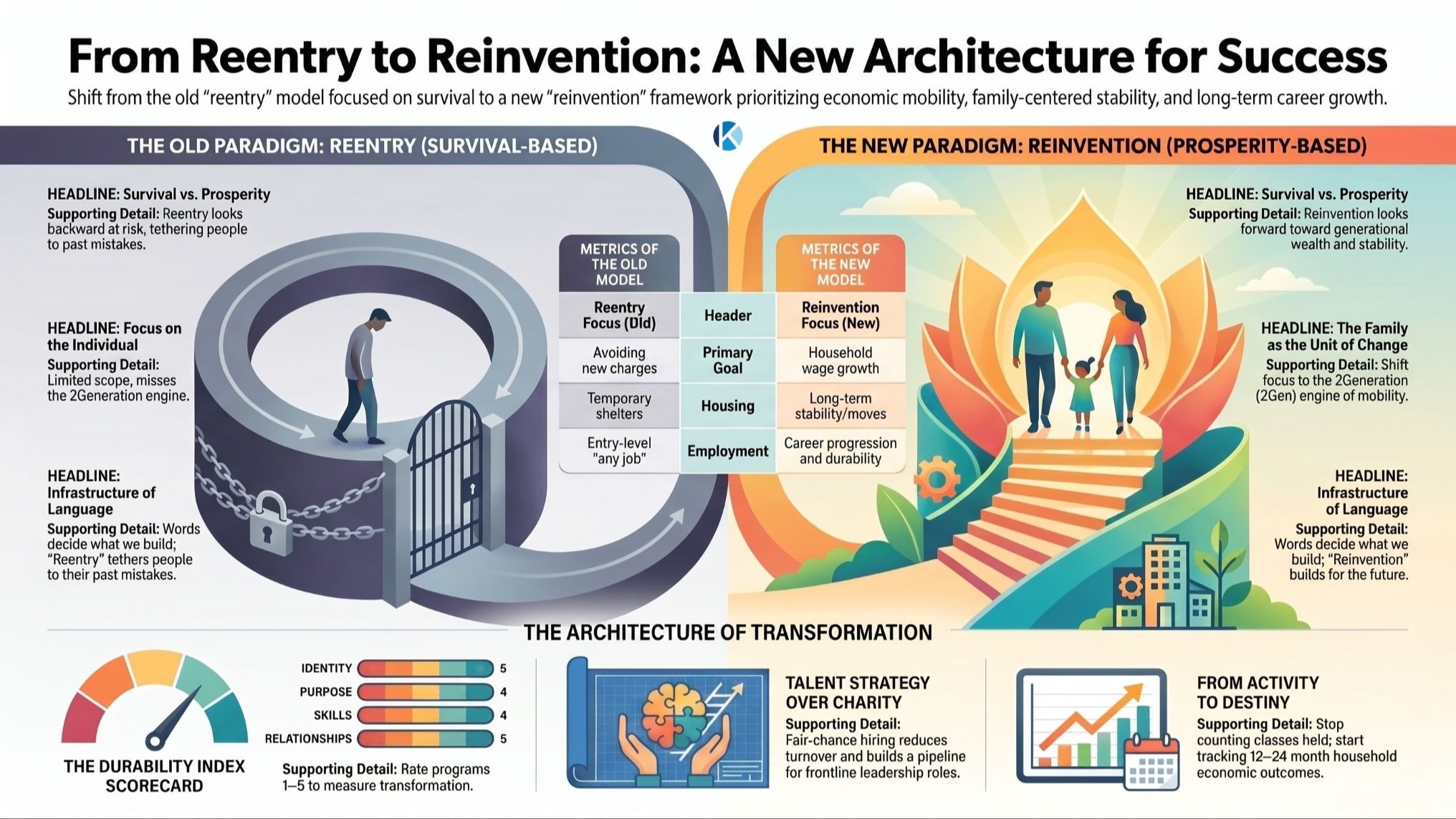
For twenty years, I lived within a system that was never meant to transform me.
It was designed to contain me.
I turned my cell into a classroom. I earned degrees from Boston University. I built the early version of what later became the Psychology of Incarceration framework.
But there was something I did not do in those twenty years.
I did not prepare to “reenter” anything.
There was nothing worth going back to. The neighborhoods had changed. The economy had shifted. The man I had become could not return to the life that produced my incarceration in the first place.
When I walked out of prison in 1999, I wasn’t reentering.
I was reinventing.
That is the core argument of my new book, Stop Calling It Reentry. It’s Reinvention. And it’s the shift I believe our entire system needs to make.
Why “Reentry” Is Too Small
Reentry is not a destination. It is a holding pattern. When the system defines success as not returning to prison, it has set the lowest possible bar. Reinvention measures forward trajectory: wage progression, household stability, and generational economic mobility.
Language is not a cosmetic exercise. It’s infrastructure.
Words quietly decide what we build.
When we use the word reentry, here’s the story we’re telling, even when we don’t say it out loud:
You left society.
Now you’re coming back.
If we can plug you into a basic job and a bed, we’ve done our part.
Reentry language keeps people tethered to their past: their charges, their record, their worst decisions. It makes survival the ceiling.
Most “reentry programs” reflect that frame:
- Entry-level jobs that barely cover rent
- Temporary housing and shelters
- A few classes and forms
- Case management that tracks compliance more than transformation
I’m not dismissing any of this. It meets real, urgent needs.
But if our only question is, “Did this person get a job and avoid a new charge?” We are aiming far too low.
Reentry is about managing risk.
Reinvention is about building futures.
Reinvention does not ask anyone to forget their past. It asks us to stop making it the organizing principle of their future.
Reentry says: You’re going back to what was.
Reinvention says: You are creating what comes next.
In the book, I lay out a simple contrast:
- Reentry looks backward. Reinvention looks forward.
- Reentry is survival-focused. Reinvention is prosperity-focused.
- Reentry treats the individual as the unit of change. Reinvention treats the family as the unit of change.
That last shift, from individual to family, is where things get interesting.
A 2Gen Economy, Not a One-Off Miracle
I talk a lot about the 2Gen economy.
A 2Gen approach treats parents and children together as the engine of mobility. It forces us to ask different questions.
Not just: “Did this person get a job?”
But: “Did this family become more stable, better housed, and better positioned economically over time?”
Incarceration doesn’t just punish one person. It drains income from families, destabilizes housing, disrupts children’s education, and creates cycles of multigenerational poverty.
So if we are serious about change, our metrics must move from “Did we place them?” to “Did the household move forward, measured at intake, 6, 12, 18, and 24 months?”
In the book, I argue that we should be tracking:
- Household income and wage growth
- Number of earners and career progression
- Employment durability
- Housing stability and moves
- Debt reduction and asset growth
- Child and family outcomes
If those numbers aren’t moving, we didn’t build reinvention.
We just managed reentry.
Let me give you a picture of what 2Gen reinvention looks like in real life.
I tell the story of James in the book.
James assumed that when he came home, he’d go back to the warehouse where he used to stock shelves. That was the path he could see: low wage, high risk, no ladder.
A reinvention counselor challenged him:“You’ve got discipline. You understand systems. Why not aim higher?”
James pursued community-college coursework and industry certifications in supply-chain management. Within two years, he moved into logistics coordination, and then into leadership.
Here’s the 2Gen part:
- His wages increased.
- His role changed.
- His teenage son watched the whole thing.
When his son came to shadow him at work, he didn’t see “a guy lucky to have any job.” He watched his father command a team, solve problems, and earn the trust of others.
That one promotion didn’t just change James’s life. It rewrote the script for his son.
That’s 2Gen.
Reinvention is not “one man with a second chance.”
Reinvention is a family moving from crisis management to wealth-building.
A Simple Question for Every Program: The Durability Index
Our field is very good at counting activity.
Classes held. Services delivered. Intakes completed. Reports filed.
Activity is not destiny.
To cut through the noise, the Durability Index measures household stability, not program activity. Five domains. One score.
The five domains are Employment Retention, Housing Stability, Financial Resilience, Family Connection, and Justice-System Stability. Each has four sub-measures, for twenty in total, each scored from 1 to 5.
Average each domain’s four sub-measures, then round to the nearest 0.5, with ties rounding up. Add the five domain scores for a composite from 5 to 25.
The five bands are:
- Crisis: 5 to below 8.5.
- Fragile: 8.5 to below 12.5.
- Stabilizing: 12.5 to below 15.5.
- Stable: 15.5 to below 18.5.
- Durable: 18.5 to 25.
At each boundary, the score enters the higher band. Assessments take place at intake baseline and at 6, 12, 18, and 24 months.
Where the justice pathway applies, assessment begins at arrest, not release. The question is whether household stability holds over time, not whether a program counted another completed service.
It’s intentionally blunt.
If a program doesn’t move Employment Retention, Housing Stability, Financial Resilience, Family Connection, and Justice-System Stability, it’s not designed for transformation. It’s designed for throughput.
The Durability Index gives practitioners, funders, and policymakers a shared language to ask a hard question:
Are we building durable lives, or just cycling people through services?
You can sit down with your team and your portfolio and ask, program by program:
- Where are we strong?
- Where are we pretending activity equals impact?
- What would it take to move households toward the Durable band?
That’s where real redesign begins.
Why Employers Should Care (Beyond “Doing the Right Thing”)
When I talk to CEOs about Fair Chance Hiring, I don’t lead with morality.
I lead with outcomes.
In one logistics company I worked with, Fair Chance Hiring combined with better program design led to significantly reduced turnover and meaningful cost savings in recruitment, onboarding, and lost productivity.
Across employers and documented fair chance programs, we see the same pattern:
- Dramatically lower turnover in hard-to-fill roles
- Strong internal candidates for frontline leadership
- In well-designed fair chance programs, employers commonly see materially higher retention measured at intake, 6, 12, 18, and 24 months when household barriers are addressed alongside employment support.
Why?
Because when someone has reinvented their life, they are not looking for a gig. They are looking for a career.
The book walks employers through a clear blueprint:
- Map where you have chronic shortages
- Define credentialed, high-wage roles
- Partner with training providers who can deliver those credentials to justice-impacted people
- Build cohort-based hiring and support models
- Track retention, advancement, and household outcomes, not just time-to-fill
Fair Chance Hiring, done right, is not a risk mitigation project.
It’s a talent strategy, and a way to align your business needs with real public safety and economic mobility.
Who This Book Is For
I didn’t write Stop Calling It Reentry. It’s Reinvention only for people who’ve lived incarceration.
I wrote it for four groups who hold real levers in their hands:
- Justice-impacted people and families who are tired of being spoken about and want a serious blueprint for building something different.
- Employers who suspect their “talent shortage” is really a design problem.
- Workforce boards and practitioners who are sick of counting activities and want a Durability Index they can use to defend outcome-driven models.
- Policymakers and funders who are ready to stop paying for motion and start paying for household-level change.
The book is a practical tool for you to use in your own life and work.
You can use it to:
- Rewrite your RFPs and contracts around 2Gen metrics.
- Redesign programs using the Durability Index as your internal scorecard.
- Build a fair chance talent strategy that’s grounded in data, not charity.
- Guide justice-impacted people in your life (or in your programs) from “I’m reentering” to “I’m reinventing.”
Where We Go From Here
We can keep calling it reentry and build systems that aim for the bare minimum:
No new charges. Any job. A place to sleep.
Or we can treat reinvention as the standard and build for:
- High-wage careers
- Stable, multi-earner households
- Children who grow up watching transformation in real time
When we stop calling it reentry and start designing for reinvention, we don’t just change language.
We change lives.
If you want the deeper framework, including the Durability Index, 2Gen metrics, and practical playbooks for employers, workforce boards, and policymakers, that’s exactly what Stop Calling It Reentry. It’s Reinvention delivers.
What does your organization score on this?
Take the free Durability Index Self-Assessment. Twenty questions. Five domains. One score.
Until next time, keep building what they said couldn't be built.
Khalil Osiris
Author and Founder, Khalil Osiris Consulting | Market Architect, The Durability Economy Workforce Architecture
The Durability Economy. Workforce redesign, fair chance hiring, and household stability. For leaders who measure what lasts.
Change the metrics. Change the outcomes.
Subscribe to The Durability Economy
Get the weekly briefing on workforce transformation, criminal justice reform, and the 2Gen Economy, delivered straight to your inbox. Evidence over ideology. Households over headcounts.
We hate SPAM. We will never sell your information, for any reason.