The Release Date Is Not a Transition Plan
Nov 03, 2026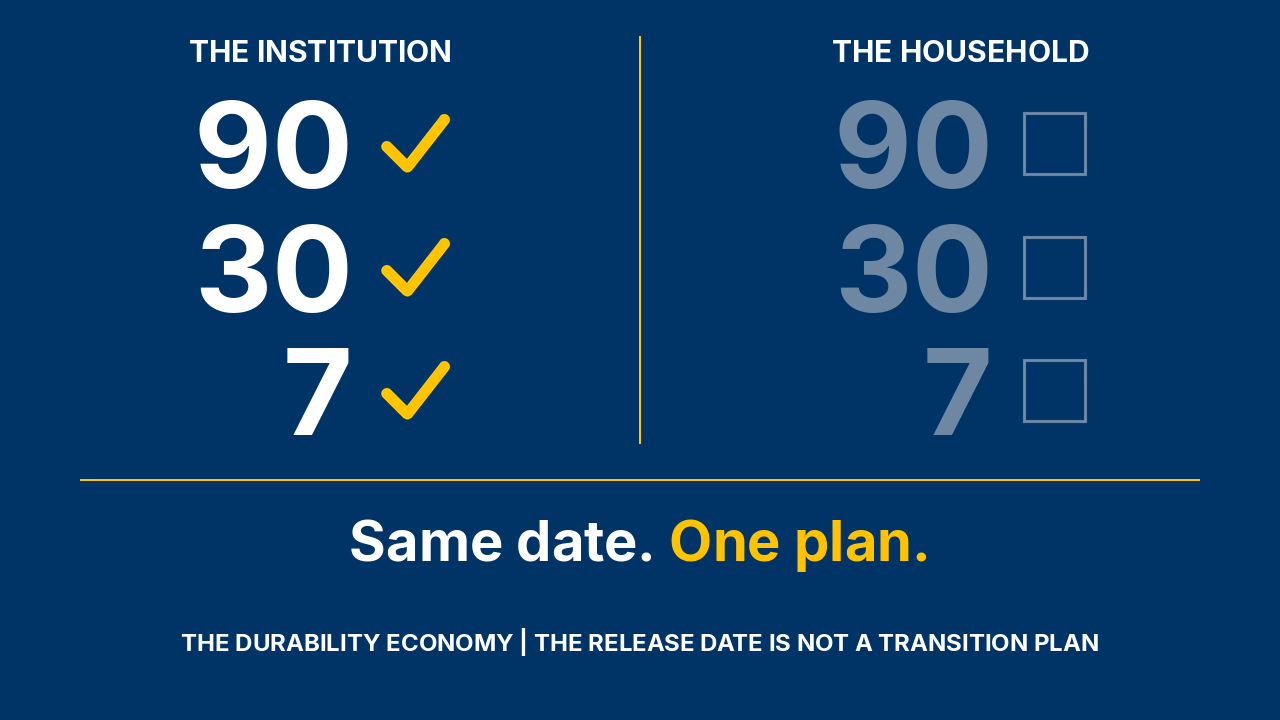
A release date is information, and a transition plan is coordination. The system delivers the first and calls it preparation.
The institution counts down to the end of custody. The household counts down to the reorganization of a life: who changes a work schedule, where the returning person sleeps, what the supervision conditions mean inside the home, what money has to move before the first week, and what the children have been told.
A family can know a release date for years and still reach it unprepared. The family did not fail to plan; the family was treated as a party to be notified rather than a partner in the planning.
Two countdowns run toward the same date. One ends a sentence; the other has to hold a household together; only one is managed.
The Evidence
Start with the systems. In the most recent national questionnaire of state corrections departments, 37 states answered: 76 percent assess housing needs, 97 percent ask housing questions during discharge planning, and 47 percent hold a person until a specific address is identified (Council of State Governments Justice Center, March 2023).
Asking is not confirming. A December 2024 federal review reports that fewer than 25 percent of systems ensure every returning person has housing at release, a figure drawn from a 2008 survey the review cites (ASPE, December 2024).
North Carolina released 19,690 people in 2024, and 5,610 of them, 28 percent, left with no verified home plan or went to a shelter, a treatment facility, a transitional program, or an intersection address (North Carolina Department of Adult Correction, July 2025). Minnesota released 4,799 people in 2024 and counted about 15 percent as homeless to a known or unknown location (Minnesota Department of Corrections, 2024 report).
Documents follow the pattern. Twenty-eight states have laws directing corrections to provide or help obtain a photo ID before release (Reason Foundation, February 2026), and among 33 people released after 20 to 43 years, 9 percent said the prison helped them obtain identification (The Sentencing Project, April 2026; small sample).
The household side has no national record. No source reports when families learn a release date or how often they join the planning; one state's policy reviews the plan with the family "if possible" (New Mexico Corrections Department, revised September 2024).
What the record does measure is association. In England and Wales, 25.0 percent of visited prisoners reoffended within a year against 28.0 percent of the unvisited, and 85 percent were housed on release against 82 percent, differences the analysts call modest (Ministry of Justice, March 2026).
The Reframe
Run the two countdowns side by side.
Ninety days out, the institution's list is moving. Classification is reviewed, programming wraps up, the release plan opens in the case system, and a projected date is confirmed to the person inside.
Ninety days out, the household's list is not open anywhere. Nobody has asked who will give up hours at work, whether the lease allows another adult, or what the supervision conditions will require of the people already living in the home.
Thirty days out, the institution is verifying. An address is checked if supervision follows; a transportation voucher is cut or not cut; a medication supply is ordered or not ordered; a prison ID is printed.
Thirty days out, the household is guessing. The address being verified is a family member's address, and the family member has not been told what verification means, what a home visit involves, or that a relative with a record in the same house may be a violation on day one.
Seven days out, the institution is closing the file. Paperwork is signed, property is inventoried, and a gate time is set.
Seven days out, the household is scrambling for money. Deposits for a phone, a bus pass, clothes, and the first week of food have to move from one or two paychecks, and nobody has written down who pays for what or what happens when the first thing goes wrong.
On release day the two countdowns meet. The institution's ends on schedule, because it was managed by named staff against a dated checklist.
The household's countdown does not end; it converts into the first ninety days at home, with every unsettled item still unsettled.
Here is the structural point. The household's countdown is unmanaged because no role owns it: not the case manager, whose client is one person; not the supervision officer, whose caseload begins at the gate; not the family, who were never given the information, the lead time, or the standing to run it.
A plan that nobody owns is not a plan. A date that everybody knows is still only a date.
The National Scale
The volume makes the gap a national condition, not a local lapse. State and federal prisons released 453,242 people in 2023 (Bureau of Justice Statistics, September 2025), and local jails recorded 7.9 million admissions in the year ending June 2024 (Bureau of Justice Statistics, September 2026).
Pre-release practice is expanding on the institution's side. Twenty-two states and the District of Columbia now hold approved Medicaid reentry demonstrations, which pay for pre-release case management and a 30-day medication supply at release (Centers for Medicare and Medicaid Services, October 2026).
The window is shrinking, not growing. Federal guidance in September 2026 set future pre-release coverage at up to 60 days for adults, down from 90 (CMS, September 2026).
In North Carolina, the start of home planning "varies widely," from nine months to 90 days before release (North Carolina Department of Adult Correction, July 2025). None of these systems is designed to begin the household's countdown.
The Fix
Three steps, and the steps carry the timeline.
1. Ninety days out: set the home base. Name the housing, the income, and the care, and confirm each one rather than assume it.
Housing means the specific address, who holds the lease, and whether a landlord or a supervision agency must approve the arrangement. Income means which paychecks carry the household in month one and what the returning person can realistically earn by day 90.
Care means who covers the children, the elders, and the appointments when a work schedule changes. An item without a name beside it is not confirmed.
2. Thirty days out: align the conditions. Read the supervision conditions against the household's actual life before release day, not after.
Who lives in the home, who visits, what work the returning person can hold, and where the person can travel are governed by rules the household has not seen. The National Inventory of Collateral Consequences of Conviction, the free searchable database published by the Council of State Governments Justice Center, lets a household check the legal restrictions that will reach into the home; the database is informational and is not legal advice.
Anything the conditions forbid gets resolved now, while there is still time to change the plan.
3. Seven days out: protect the first week. Write a 72-hour plan that covers the first three days hour by hour in outline.
The outline names arrival and who meets the person; documents and who holds them; money and who carries it; transportation and who drives; reporting and who knows the appointment time; and, for each piece, the household member who owns it. A plan nobody in the house can recite is not finished.
Before any of this, the household needs one place to put what it already knows. The free Family Knowledge Map (https://map.khalilosirisconsulting.com) is the tool a household uses to put that knowledge in one place before the release, so the three steps start from the family's information rather than from a blank page.
Who Owns This
Corrections leaders: give the household the same lead time you give yourselves. Open a household plan at 90 days with a named family contact, share the projected date and the conditions with that contact, and record whether the household's three items are confirmed before the gate opens.
Program directors: assign the household's countdown to a role. Someone on your staff owns the family's list from 90 days out, meets the household before release, and reports the 72-hour plan alongside the client's plan.
Funders: require household-side reporting. Ask every grantee you fund for pre-release work to report, for each release, whether a named household member could describe the first 72 hours.
The Decision
The test: for the next ten releases, ask one question of each file: can a named member of the household describe the first 72 hours? If nobody can, the release plan is incomplete, whatever the file says.
The design implication: a release plan that confirms the institution's items and assumes the household's items is half a plan, and the half that is missing is the half that decides whether the release lasts.
The next step: open the household's countdown at 90 days, give it an owner, and measure it the way you measure your own, with the same lead time and the same named staff. The argument is developed in We Served the Sentence Too, publishing December 1, 2026.
Until next time, keep building what they said couldn't be built.
Khalil Osiris
Author and Founder, Khalil Osiris Consulting | Market Architect, The Durability Economy Workforce Architecture
The Durability Economy. Workforce redesign, fair chance hiring, and household stability. For leaders who measure what lasts.
Change the metrics. Change the outcomes.
Subscribe to The Durability Economy
Get the weekly briefing on workforce transformation, criminal justice reform, and the 2Gen Economy, delivered straight to your inbox. Evidence over ideology. Households over headcounts.
We hate SPAM. We will never sell your information, for any reason.