The Market Is Measuring the Event. It Should Measure the Household.
Aug 25, 2026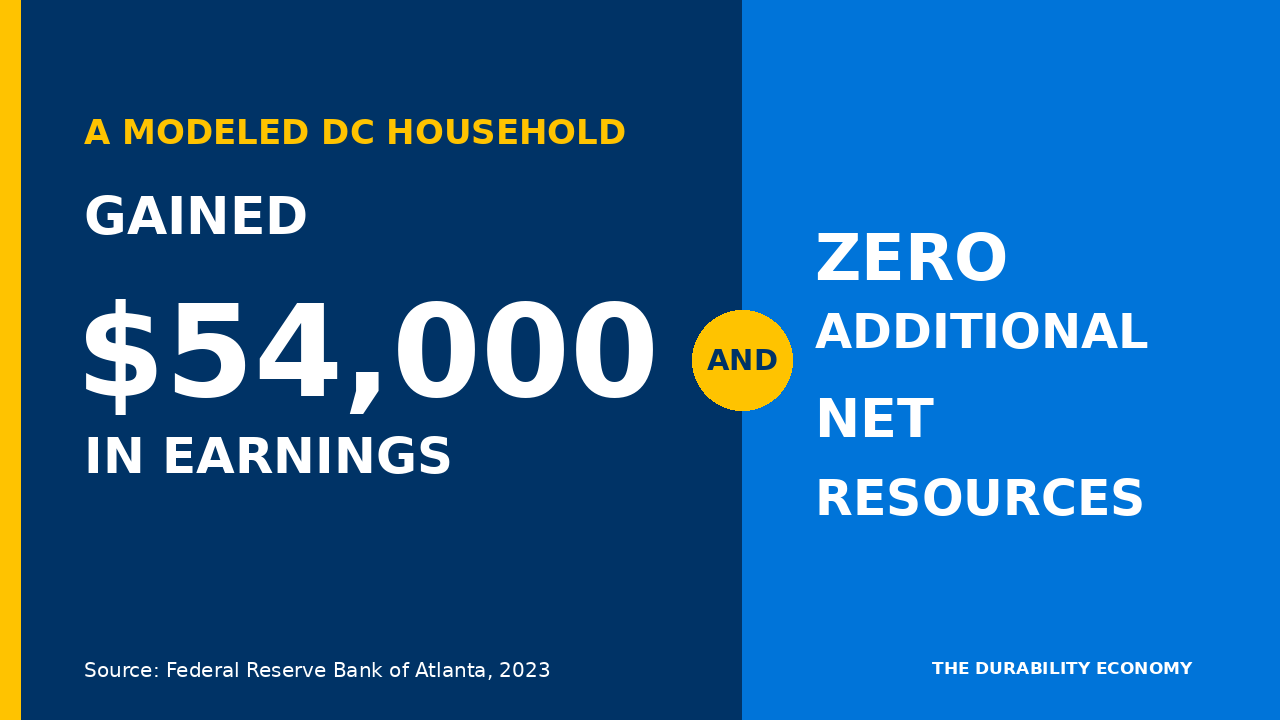
You're measuring the event because it's easy to count. But the household pays the price for what your dashboard can't see.
The newest evidence does not support the story our field is most comfortable telling.
Garin and colleagues linked 464,919 felony defendant-cases in North Carolina and Ohio to IRS records. Their 2025 Econometrica study found a 12-month sentence reduced cumulative five-year earnings by $2,914, or 13 percent, with no detectable damage beyond year five.
Before their cases, defendants averaged under $6,000 a year. For those with pre-case earnings above $15,000, the study found an 8 percent long-run loss, statistically significant only at the 10 percent level.
Precision is not optional when the evidence complicates the story.
Incarceration imposes a real five-year cost. For much of this population, the longer economic scar appears before the sentence. It is poverty.
A record-centered strategy can open a door. It cannot rebuild a household economy that was fragile before the charge. Reinvention must start with the household as the unit of analysis.
This is not a softer standard. It is a harder one.
The Evidence
The field uses recidivism as if it were a household outcome. It is not. Reincarceration records what a public system did. Rearrest records another system event. Neither tells us whether rent was paid, child care held, or a family absorbed a shock.
The bookkeeping can deliver conflicting verdicts. Three-year reincarceration fell 23 percent from the 2008 exit cohort to the 2019 cohort, while a ten-year measure found 82 percent of state prisoners released across 24 states in 2008 were rearrested.
The workforce ledger has the same boundary. WIOA runs six primary indicators, and its employment measures stop at the second and fourth quarters after exit.
In Program Year 2023, the Adult program served 278,770 participants. Not one indicator measures household stability.
Longer observation changes the verdict: a 2023 federal reanalysis of seven subsidized employment programs found three improved earnings beyond three years, two for as long as eight.
A short ledger does not just miss the household. It certifies a verdict it never tested.
The Reframe
A person can stay employed while pay, hours, housing, and care arrangements move underneath the job. An NBER working paper found pay changed from the prior month in about three quarters of months. The median change was about 5 percent, and one quarter brought a change of 17 percent or more.
Month 1. A retention rate records a person who remains on payroll.
Month 2. The same rate does not show whether pay, hours, housing, or care arrangements have moved underneath the job.
Month 3. A retention rate counts the worker whose pay holds steady and the worker whose pay swings 17 percent in a month as the same success. A Durability Index measure would not.
A raise can also be a household risk event. Atlanta Fed modeling for a single parent with one three-year-old in Washington, DC found $11,000 and $65,000 in annual earnings could produce the same net resources after taxes and benefit changes, with a modeled effective marginal tax rate of 173 percent at the child care subsidy phaseout.
Those ceilings assume full benefit take-up. The controlling source cautions that modeled cliffs can overstate what a typical family loses.
The behavioral floor is serious. In a 2024 ASPE survey experiment, 85 percent of respondents said a worker should accept a higher-paying job when no benefits would be lost.
When benefits would be lost, 76 percent accepted if benefits would be automatically reinstated, and 67 percent accepted if the worker would have to reapply.
The correct question is not whether wages rose. It is whether net resources, stability, and shock capacity rose across the household.
The National Scale
Employers need the whole funnel. A 2025 PLOS ONE study followed 22,946 applications at a public academic health center. Any offense was associated with a 10.51 percentage point lower probability of beginning employment, and the employer's fair-chance policies did not change how often applicants with records survived the final background check.
The study reports associations, not a universal causal estimate.
The missing ledger is the full sequence: application, screening, conditional offer, background check, correction, start, retention, advancement.
Removing a box is a process change. Survival through the funnel is an outcome.
Every program that stops at a job event leaves the household outcome outside the record.
The Fix
That is why the Durability Index belongs in the contract, not only in the evaluation. It is a bounded composite, repeated on a fixed schedule, with the weakest domain always visible. The composite shows direction.
The weakest domain shows where support must move. The calendar shows whether progress holds.
- Measure a household composite in one renewal's reporting schedule, not as a payment trigger, so the portfolio has a baseline before a federal standard lands.
- Protect household support data with a governance firewall that keeps it out of discipline, promotion, and screening. A household should not pay for honesty with lost opportunity.
- Publish an anti-gaming protocol for the twenty sub-measures before the instrument prices a contract.
- Use the free Durability Index Self-Assessment to begin the organizational conversation: Twenty questions. Five domains. One score.
Run the baseline this week. Set the data firewall within 30 days. Publish the protocol before the next outcomes contract.
Who Owns This
- Funders: Write a household composite into one renewal's reporting schedule in the next 90 days, without making it a payment trigger.
- Policymakers: Ask within 90 days whether H.R. 9469 can accept a household-level composite or quietly forecloses one.
- Operators: Pull the weakest-domain distribution for the households you serve within 30 days, so you know which outcomes you control and which you would price on someone else's behavior.
The Decision
Run the test. If your outcome report cannot show whether net resources, stability, and shock capacity rose across the household, it cannot establish the outcome it claims to price.
Name the failure. The absence is a design failure, not a people failure. The metric rewards a short event and leaves the household underneath the job unmeasured.
Choose the next step. In June 2026, Representatives Erin Houchin and Ritchie Torres introduced the bipartisan Outcomes-Based Financing for Students Act, H.R. 9469, to set federal rules for outcomes-based financing in workforce training and postsecondary education. The architecture is being written now.
Contracts can price what is easy to count. That does not make the event a durable household outcome.
A system event can be real and still be incomplete when it leaves net resources, stability, and shock capacity outside the record.
If you price the event while the household remains unmeasured, you are not documenting a durable outcome. You are documenting a short-term system event.
What are you funding: placement, or progress?
Take the free Durability Index Self-Assessment. Twenty questions. Five domains. One score.
Until next time, keep building what they said couldn't be built.
Khalil Osiris
Author and Founder, Khalil Osiris Consulting | Market Architect, The Durability Economy Workforce Architecture
The Durability Economy. Workforce redesign, fair-chance hiring, and household stability. For leaders who measure what lasts.
Change the metrics. Change the outcomes.
Subscribe to The Durability Economy
Get the weekly briefing on workforce transformation, criminal justice reform, and the 2Gen Economy, delivered straight to your inbox. Evidence over ideology. Households over headcounts.
We hate SPAM. We will never sell your information, for any reason.