The Family Knows What No Intake Form Asks
Nov 10, 2026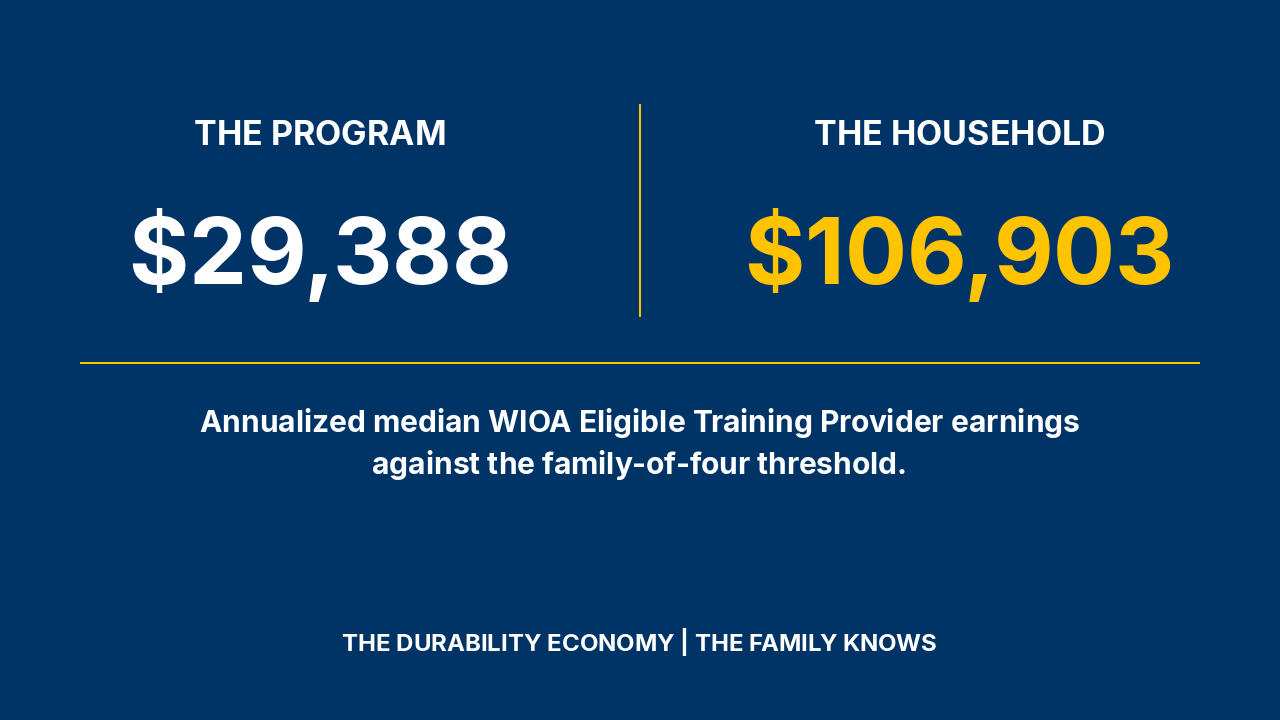
A name is a claim before it is anything else. It tells a reader what the author believes the work is for.
A program named for the individual will measure the individual. A name can point somewhere else.
On December 1, 2026, four books publish under one name: The Family Knows. Three weeks ahead of the books, this issue makes the case for the name.
The curriculum of record, "The Family Knows: A Household Stability Curriculum for Justice-Impacted Families," is grounded in two sentences.
"The family knows things no intake form asks. This curriculum is built on that knowledge."
The rest of this issue argues that the family does know things no intake form asks, and that a name should say so.
The Evidence
Start with what the workforce system counts as success. The median Eligible Training Provider program under the Workforce Innovation and Opportunity Act (WIOA) shows annualized earnings of $29,388 (Harvard Project on Workforce, 2023).
Read the $29,388 for what it is: a program's annualized earnings, not a participant's wage, not an hourly rate, and not an average.
Now state the household's number. The Durability Index, my proprietary teaching instrument, sets the household stability threshold for a family of four at $106,903 a year, or $107,000 rounded.
Run the subtraction. Model one earner at the program's $29,388, and a second earner in part-time work at $18,000 a year, a disclosed modeling assumption.
Subtract the program earnings and the part-time earnings from the rounded threshold. $107,000 minus ($29,388 plus $18,000) leaves $59,612 a year.
The model does not measure any particular family. It is a receipt, arithmetic that anyone can rerun with the same inputs.
Notice what each number belongs to: the first describes a program, a list of courses and what the median one reports, and the second describes a household, what four people need in a year.
A program can meet every target on its annualized earnings figure and leave the household threshold untouched. The household has to live against the threshold.
A program report can be accurate and still say nothing about the household. Accuracy about one unit is not information about the other.
The family knows which part of the household threshold is failing: the rent, the child care, the car, the debt. The program's measure never needed to ask.
The Reframe
Read the name as architecture, not decoration.
The print library holds two pairs. The first pair is "We Served the Sentence Too: What Justice-Impacted Families Know and the System Never Measured," with its companion workbook, "Family Knowledge Map: A Workbook for the Knowledge No Intake Form Asks For."
The first book names the knowledge, and its companion workbook gives a family a place to write it down.
The second pair is "Durability Household Company," with "Durability Household Company: Templates," the working forms volume of the Durability Household Company curriculum. The curriculum book carries the approach, and the forms volume carries the pages a household works on.
For the Durability Household Company pair, the articulation of record begins with one line: "One curriculum, three ways to hold it."
The line continues with three instructions: "Read it in the book. Work it in the workbook. Walk it in the course."
Without one name, four titles read as four products from four fields: a research book, a workbook, a curriculum, and a set of forms. With one name, the four read as one conviction held at four levels of use: to know it, to record it, to learn it, and to work it.
The approach is "architecture built from lived experience, disciplined by research, and aimed at measurable outcomes." The core finding is one sentence: "The family, not the individual, is the true measure of sustainability."
A name that carries the core finding has to stand over every title that tests it. I have made the intent standing: The Family Knows is to be synonymous with my brand and my thought leadership, a distinction on the order of Durability Household Company.
Stability is built or lost in the household. The people who carry the sentence alongside the person who served it are the ones who know how.
The name is the shortest accurate description of where stability is built or lost. It points at what, in the book's own subtitle, the system never measured.
The National Scale
A name scales when it appears everywhere a family and a practitioner meet the work.
The name already stands in three places before any book publishes: the curriculum of record, the navigation of my website, and the metadata that identifies the print series. In the series, the name appears alone, with no volume numbers anywhere.
Every title stands on its own. A reader can enter through the book, the workbook, the curriculum, or the forms, and the name says that all four ask the same question.
The name does not depend on a single book, a single channel, or a single program. A household that meets the curriculum first and a household that meets the workbook first arrive at the same sentence.
The gap in The Evidence is a measurement problem. A measurement problem needs a name that can travel to every place a measure is set.
The Fix
Three steps, and each step carries its own deadline.
1. This week: add the question. Put one question into the intake or the case conversation: "What does this household know that this form did not ask?"
Ask the household, not only the individual, and ask in the first meeting, before any form is filled.
A household might answer the question with a shut-off notice, a custody schedule, or a cousin who holds the only car. The form had no line for any of it.
Write the household's answer to the question in its own words, and keep it in the file beside the individual's record. An answer that stays in someone's memory is not data.
2. Within 30 days: give the household a place to put what it knows. The free Family Knowledge Map (https://map.khalilosirisconsulting.com) is an online tool that helps a family organize what it knows and write its statement of experience.
Nothing entered in the Family Knowledge Map is saved or stored, so the family keeps what it writes. Ask the household to bring the finished statement to the next meeting, and read it before the plan is written, not after.
A practitioner can use the statement as a second plan: set it beside the program's own plan, and note every place the two disagree.
3. Within 90 days: measure at the household. For a family of four, write the household's annual income beside the $106,903 threshold, at intake and again 90 days later.
The household's income and the threshold will not match for most households. The distance between them is the number the program is actually working on.
At 90 days, the question is not whether the household passed. The question is which part of the household's budget moved, and who in the household knows why.
Record the household's own explanation of each change beside the figures. The figures say that something moved, and the household says why.
Who Owns This
Program directors: put the household question in every intake, and name one staff role that reads the answers each month. A question that nobody reads is decoration, and a household can tell.
Workforce board leaders: publish a household stability threshold beside the earnings figure of every program you list, so a reader sees both numbers at once. A figure that stands alone invites the wrong conclusion.
Funders: ask each grantee to report the household question it asks and what the household answered, next to the individual completion count. Pay for the instrument that records the family, not only the one that records the person.
The Decision
The test: pick one program you run or fund, and ask its staff to name one thing the households it serves know that the intake form does not ask. If nobody can name one, the design cannot see the household.
The design implication: a name, like a measure, tells people where to look. A program built on one person's earnings will look at the person, and a program built on the household will have to ask the family.
The next step: add the question this week, and write down who owns the answers. The argument is developed in "We Served the Sentence Too: What Justice-Impacted Families Know and the System Never Measured," publishing December 1, 2026.
Until next time, keep building what they said couldn't be built.
Khalil Osiris
Author and Founder, Khalil Osiris Consulting | Market Architect, The Durability Economy Workforce Architecture
The Durability Economy. Workforce redesign, fair chance hiring, and household stability. For leaders who measure what lasts.
Change the metrics. Change the outcomes.
Subscribe to The Durability Economy
Get the weekly briefing on workforce transformation, criminal justice reform, and the 2Gen Economy, delivered straight to your inbox. Evidence over ideology. Households over headcounts.
We hate SPAM. We will never sell your information, for any reason.