He Rebuilt His Life at Sea. Florida Is About to Treat Him Like a Sex Offender.
Sep 15, 2026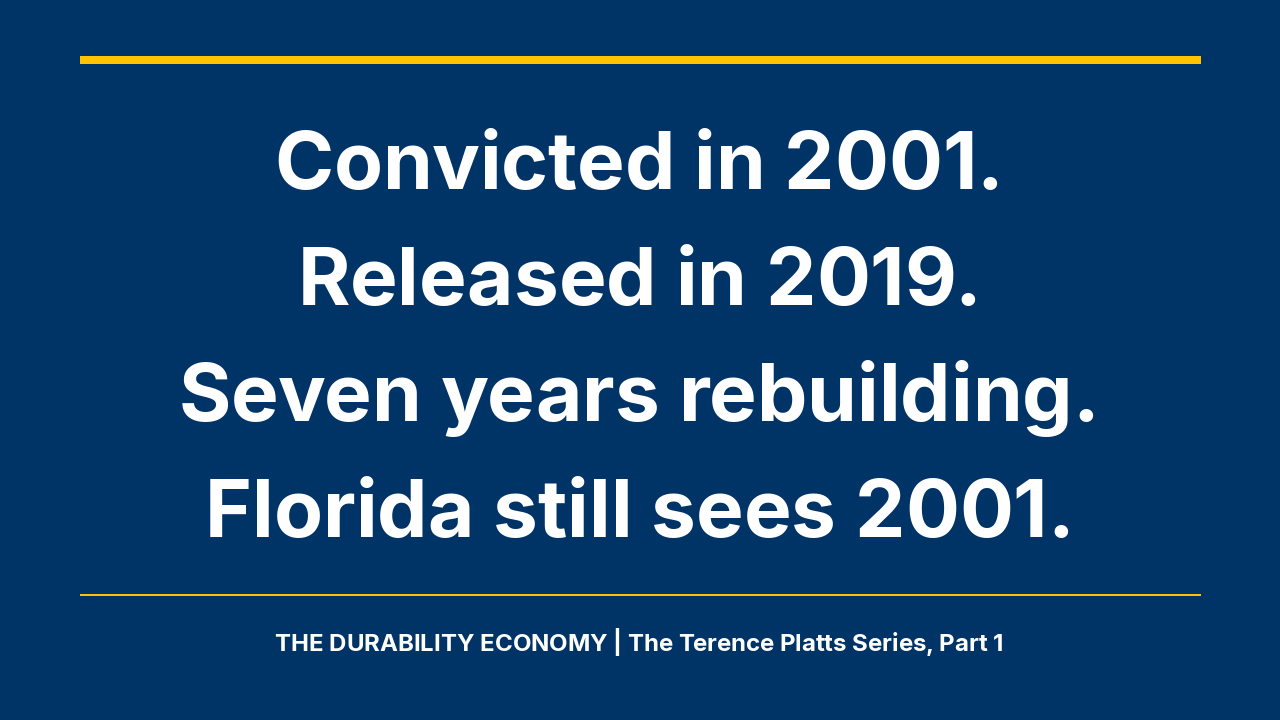
Terence Platts was convicted of attempted robbery with a deadly weapon in 2001. He served eighteen years and three months, was released in 2019, and has spent the seven years since building exactly the life our systems say they want. On October 1, 2026, Florida will place him under a registration regime copied, almost part for part, from the machinery built for sexual predators. He is not one.
Start with what he built, because the record is the argument.
After his release in 2019, Terence chose a hard trade. In the fall of 2023 he enrolled at Bluewater Maritime School in Jacksonville and earned his Ordinary Seaman endorsement. He went to sea. In early 2026 he returned to Bluewater to advance his credentials and earned his Able Seaman endorsement. He built a career on the water, the kind of lawful, skilled, living-wage work that reentry programs are designed to produce and rarely get to celebrate.
He also gives back, returning to talk with men and women standing where he once stood, telling them he rose from the bottom because he never stopped praying, never gave up, and was never too afraid to ask for help.
The school that made it possible
Terence did not do this alone, and the institution behind him deserves its name in this story.
Bluewater Maritime School, at 3787 Old Middleburg Road North in Jacksonville, is a United States Coast Guard-approved maritime training school. Through short, intensive, hands-on programs, it moves people into Coast Guard-recognized credentials and real commercial-maritime careers. Its president, Trey Baker, has spent more than two decades in adult education and workforce development, and he leads Bluewater with a simple conviction, in his own words: we believe in second chances and stronger futures.
In June 2025, Bluewater was acquired by the Bob Barker Company, and its Bob Barker Foundation, which has granted more than eleven million dollars to reentry and recidivism-reduction organizations, folded the school into a deliberate strategy: build a direct pipeline from training to living-wage employment, because work is one of the most reliable ways to keep a person from returning to prison. Bluewater graduates are the proof of concept. Terence is the proof.
Then the notice arrived
In 2026, Terence was handed a four-page notice from the Jacksonville Sheriff's Office and the Florida Department of Law Enforcement. Under Florida's Career Offender Registration Act, effective October 1, 2026, his 2001 sentence, twenty years as a habitual felony offender with fifteen years mandatory as a Prison Releasee Reoffender, now triggers a lifetime of obligations that did not exist when he was sentenced, was released, or built his career.
Read the notice against the sexual-offender statutes and the resemblance is unmistakable. The same in-person reporting within forty-eight hours of nearly any change. The same annual appearance during his birth month. The same driver license stamped with a statute number, in his case 775.261, F.S. The same lifetime duration. The same publication of his information on a public state website. The machinery was built for sexual predators. Terence is not one. His crime, twenty-five years ago, was a robbery.
The receipt
Here is the arithmetic the law refuses to run. Convicted in 2001. Released in 2019. Seven years, since then, of lawful work, a maritime career, and a clean record. Twenty-five years between the offense and the notice. The statute counts none of it. It reads a designation fixed at the start and applies the most restrictive tracking apparatus the state owns, for life, retroactively, to a man who has spent a quarter century becoming someone else.
The national scale
Florida is not alone in this direction. Across the country, registration regimes first built for a narrow, specific danger have been widened, lengthened, and pointed backward at people released long ago. Florida's version reaches anyone released from a state sanction since July 1, 2002. The people it captures are, by design, those who have been living in the open the longest, which means they look least like the danger the machinery was built to track.
The fix this series builds toward
None of this requires pretending Terence's crime did not happen, and none of it requires abandoning public safety. It requires the law to measure present risk instead of a decades-old label. Over the next four parts, this series lays out what the notice actually requires, why it collides with a lawful maritime career, what changed and who it reaches, and three concrete fixes that let a law like this protect the public without punishing the reformed.
Who owns this
Three groups can change what happens to Terence. Legislators can distinguish a present danger from a man twenty-five years past his offense. The agencies that implement the law can build workable procedures for people whose lawful work requires travel. And employers, schools, and advocates, Bluewater chief among them, can keep proving that the pathway works and demand that the law stop threatening it.
The decision this leaves you
Look at what the machinery measures, and what it ignores.
It cannot tell the difference between a man who is dangerous today and a man who committed a crime in 2001 and has spent seven years since release doing everything we asked.
That failure is not a people problem. It is a design choice, and design choices can be remade.
Terence did everything we asked him to do. The question this series asks is whether Florida's law, and the way it is carried out, will recognize it, or bury it under machinery built for someone else.
Verified sources
| # | Claim | Source | Year |
|---|---|---|---|
| 1 | Career Offender Registration Act: birth-month in-person reregistration, 48-hour reporting, "775.261, F.S." marked ID, lifetime registration, public FDLE website | FDLE Career Offender Notice of Responsibilities, form FDLE/SJC/MPOE/ORS-066 (8/2026); Fla. Stat. 775.261 | 2026 |
| 2 | Effective October 1, 2026; retroactive to releases on or after July 1, 2002 | FDLE Notice; Ch. 2026-151, Laws of Florida | 2026 |
| 3 | Career Offender predicates include Prison Releasee Reoffender (s. 775.082(9), F.S.) | FDLE Notice, definitions | 2026 |
| 4 | Bluewater Maritime School, USCG-approved, Jacksonville; acquired by Bob Barker Company June 2025; Foundation granted $11M+ to reentry | Bluewater / Bob Barker Company; Bob Barker Foundation | 2025 |
This is Part 1 of a five-part series. Terence Platts has consented to the telling of his story, including his name, his record, and his history. His account of his own experience is presented as his own. This is general policy discussion, not legal advice.
How many men and women do we ask to rebuild their lives, only to move the finish line the moment they reach it?
Learn about and support Bluewater Maritime School, the Jacksonville school turning fair-chance hiring into maritime careers: maritimeschool.org/contact | [email protected]
Until next time, keep building what they said couldn't be built.
Khalil Osiris
Author & Founder, Khalil Osiris Consulting | Market Architect, The Durability Economy Workforce Architecture
Subscribe to The Durability Economy for the workforce, justice, and family redesign the market has not caught up to yet.
Change the metrics. Change the outcomes.
Subscribe to The Durability Economy
Get the weekly briefing on workforce transformation, criminal justice reform, and the 2Gen Economy, delivered straight to your inbox. Evidence over ideology. Households over headcounts.
We hate SPAM. We will never sell your information, for any reason.