A Referral Is Not a Resolution.
Sep 29, 2026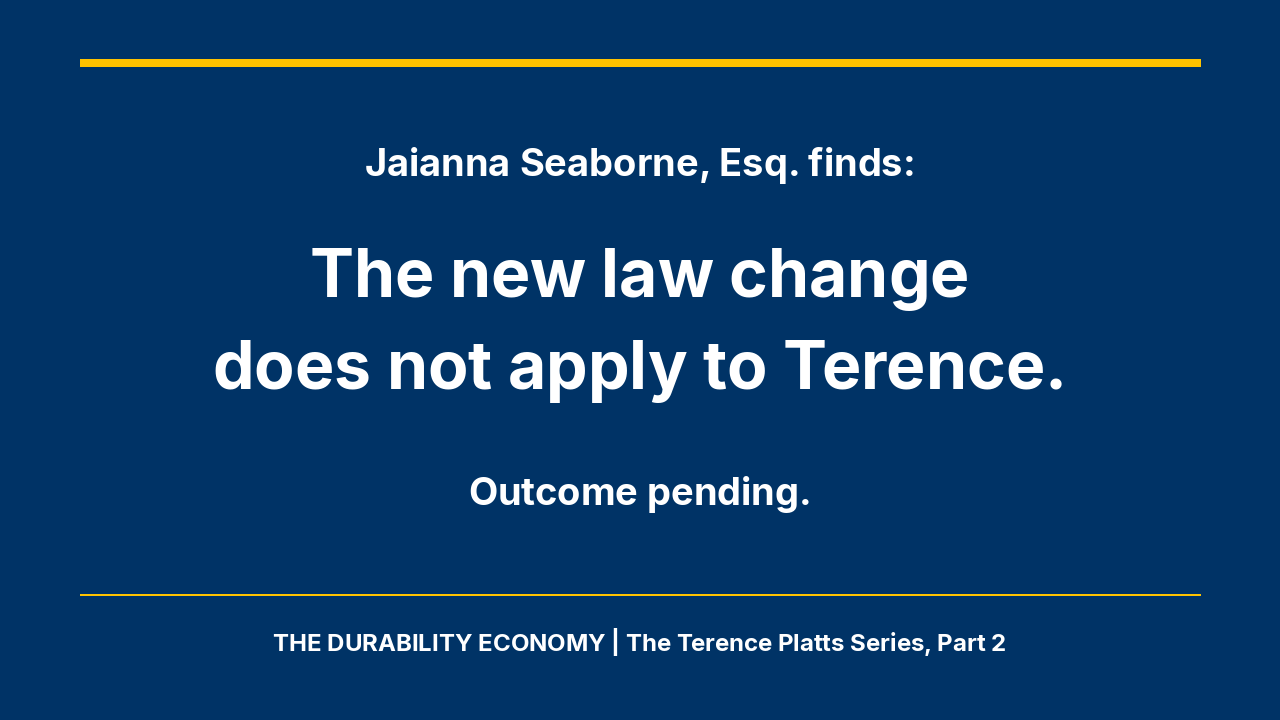
Terence Platts was told a change in the law applied to him. According to Florida attorney and NARP board member Jaianna Seaborne, Esq., her investigation found that it does not.
That is the turn in this story. It is not a report that the case has been resolved, and it is not a determination from the prosecutor's office.
As of September 28, 2026, Jaianna has contacted that office and consulted a longtime prosecutor about how to correct the issue. The outcome remains pending.
Our earlier account needs a correction, not a more confident ending.
The question now is how to distinguish an answer someone received from an answer that has been checked against their case.
Separate The Claim From Evidence
The September 15 email described Florida's Career Offender Registration Act as placing Terence under lifetime registration requirements. That statement was too categorical in light of Jaianna's subsequent finding.
I am correcting that applicability claim. According to Jaianna's investigation, the new law change does not apply to Terence, despite what he had been told. Her finding should be attributed to her, not presented as a court ruling or a decision by the prosecutor's office.
We do not have an established account of who gave Terence the earlier information or why. This article will not supply one. It will not turn an unresolved engagement into an accusation against an official or an office.
The distinction can be recorded plainly:
| Question | What can be reported now |
|---|---|
| What was Terence told? | That the new law change applied to him. |
| What did Jaianna find? | According to her investigation, it does not apply to him. |
| What action has she taken? | Contacted the prosecutor's office and consulted a longtime prosecutor about correcting the issue. |
| What is the result? | The outcome remains pending as of September 28, 2026. |
These are different stages, not interchangeable descriptions of success. Outreach is an action; a corrected determination would be an outcome.
The record needs to preserve that difference before anyone counts the matter as closed.
Put Accuracy Before Compliance
For a reentry program, the first question should not be whether a person has followed an instruction that the program has never checked. It should be whether the instruction applies, what supports it, and who is qualified to assess that question.
That is a proposed operating standard, not a finding about how every program behaves. Terence's case gives us a reason to ask the question. It does not give us a prevalence estimate.
The household is the unit of change, not the individual case-review transaction. Household stability belongs in this discussion because a legal instruction can enter practical decisions about work, housing, and family responsibilities. Those are categories a service provider should ask about, not harms I can assign to Terence without evidence.
I am not claiming that this episode cost him a job, changed his housing, or produced a particular financial loss. His real circumstances do not need an invented consequence to make accurate information matter.
Nor should the person seeking an answer have to become a case study stripped of privacy. A useful record can document the question, the review, and the current status without publishing a private file or circulating a board email.
Jaianna's involvement shows an attorney examining the case and seeking a correction. It does not yet establish that the correction has been accepted, that a particular remedy is available, or that the engagement will end in a particular way.
The point is to improve the standard of proof around the story, including my own account of it.
A referral is not a resolution. A legal assessment is not an official disposition.
Name The Evidence Gap
How often do people navigating reentry receive inaccurate information about the law governing their circumstances? The sources reviewed for this issue do not establish an answer, and this case cannot supply a national rate.
There is, however, a public resource designed to make relevant law easier to locate. The Council of State Governments Justice Center's National Inventory of Collateral Consequences of Conviction identifies and categorizes statutes and regulations imposing collateral consequences across jurisdictions. Its disclaimer states that the information is educational and informational, not legal advice.
That boundary matters. A searchable inventory can support a question; it cannot, by itself, decide how a provision applies to a person's record.
A different example comes from the Tompkins County District Attorney in New York. Its published Conviction Review Protocol describes written requests, screening criteria, an investigative team, and a decision by the District Attorney.
That protocol concerns local conviction review, including claims of innocence or clear injustice. It is not a Florida procedure, a general remedy for registration questions, or evidence that Terence qualifies for such a process.
The sources document information and review mechanisms, not the prevalence of misinformation or a promised correction.
Build A Traceable Correction Process
The following are proposed practices for reentry organizations and their legal partners. They are not instructions to Terence, descriptions of steps already taken in his case, or substitutes for advice from qualified counsel.
-
Record the question before recording compliance. Identify the instruction being relied on, the source provided, the date, and the issue requiring review. Distinguish what the person reports from what the organization has independently verified.
Use the National Inventory of Collateral Consequences of Conviction as a public research starting point where relevant. Preserve its legal-advice limitation and route the individual question to qualified counsel rather than converting a search result into a legal conclusion.
-
Assign responsibility for the review. Name the authorized person responsible for follow-up, obtain the permissions needed to share records, and identify the appropriate recipient for a correction request. Document what was actually submitted and what acknowledgment, if any, was received.
Do not label an outgoing message as an accepted correction. A published protocol, where one exists and applies, can help identify a process, but another jurisdiction's procedure cannot establish eligibility in the case at hand.
-
Track the disposition separately from the activity. Keep the reported concern, professional assessment, requested action, response, and final disposition distinct. If the response is still pending, record it as pending.
A program could track the time from a reported concern to qualified review and, separately, to a documented disposition. These are proposed case-review process measures for local testing, not validated indicators or evidence that a program has improved household outcomes. Time to review and a documented disposition do not, by themselves, establish household stability; household outcomes must be assessed separately.
Start by identifying the owner of each open question. Have that owner and counsel set the next review date, then report unresolved matters as unresolved at each check; do not invent a deadline for the prosecutor.
Give Each Role A Job
- Reentry program leaders: Audit how your records distinguish a person's report, a verified legal assessment, and an official disposition, without asking staff to practice law.
- Legal partners: Define a consent-based route for case-specific questions and document the scope and limits of any advice or review you provide.
- Funders and board members: Ask what happened after the referral and resource appropriate follow-up, rather than treating contact with an office as evidence that a problem was corrected.
Those are recommendations for the organizations reading this, not a scorecard of NARP's performance. The evidence available here establishes Jaianna's reported role and actions, not an organizational outcome study.
Keep The Record Open
Test the claim. Can your organization show the difference between an instruction someone received and a case-specific assessment of whether it applies?
Name the missing step. If the record ends at a referral, the outcome is unknown. Calling it resolved does not fill that gap.
Make the next action visible. Identify who will seek the next update and when the status will be reviewed, without promising the decision another office will make.
Future reporting should distinguish verified findings from what remains unknown.
Do not count a correction before the record supports it.
What does your success report count before the answer is verified?
Take the free Durability Index Self-Assessment. Twenty questions. Five domains. One score.
Until next time, keep building what they said couldn't be built.
Khalil Osiris
Author and Founder, Khalil Osiris Consulting | Market Architect, The Durability Economy Workforce Architecture
The Durability Economy. Workforce redesign, fair-chance hiring, and household stability. For leaders who measure what lasts.
Change the metrics. Change the outcomes.
Subscribe to The Durability Economy
Get the weekly briefing on workforce transformation, criminal justice reform, and the 2Gen Economy, delivered straight to your inbox. Evidence over ideology. Households over headcounts.
We hate SPAM. We will never sell your information, for any reason.