Your Hiring Strategy Looks Great. The Child Care Math Doesn't.
Jun 15, 2026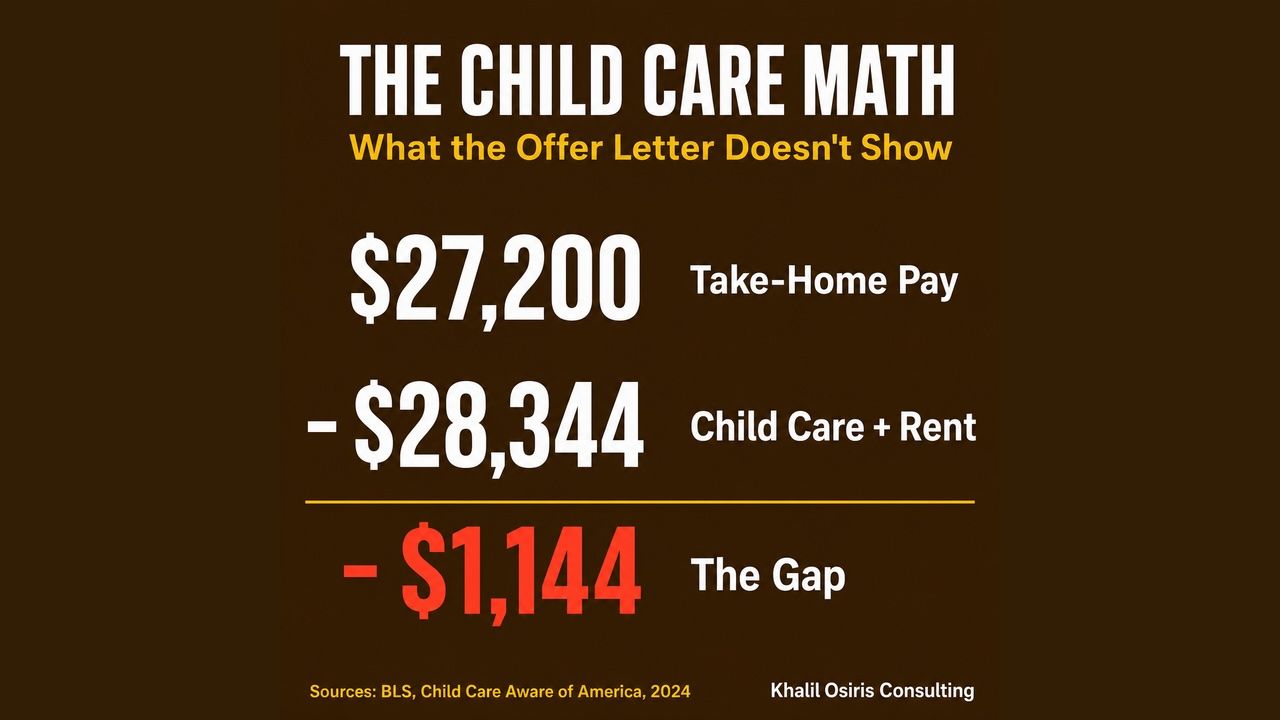
You placed the worker. You never checked whether the household could survive the offer.
Every fair chance hiring program in the country has a placement number. How many hired. How many reached 90 days. How many employers signed on.
Here is the number none of them track: the cost of child care in the worker's market against the wage on the offer letter.
That is not an oversight. It is a design failure.
And it is collapsing households faster than your program can count placements.
The Math Nobody Ran
Child care in the United States averages $13,184 a year for one child (Child Care Aware of America, 2025 Price & Supply Report).
For a single parent, that is 33% of their median household income, before rent, food, transportation, or anything else.
Now run the math your hiring manager has never been asked to run.
The most common placement for justice-impacted workers is warehouse and material-moving labor. The Bureau of Labor Statistics reports the median wage for hand laborers and material movers at $18.12 an hour as of May 2024.
Full-time annual gross: ~$37,690
Estimated take-home pay: ~$30,150
Subtract one child's care: − $13,184
Remaining: $16,966/yr → $1,414/mo
Median gross rent (Census 2024): $1,487/mo → $17,844/yr
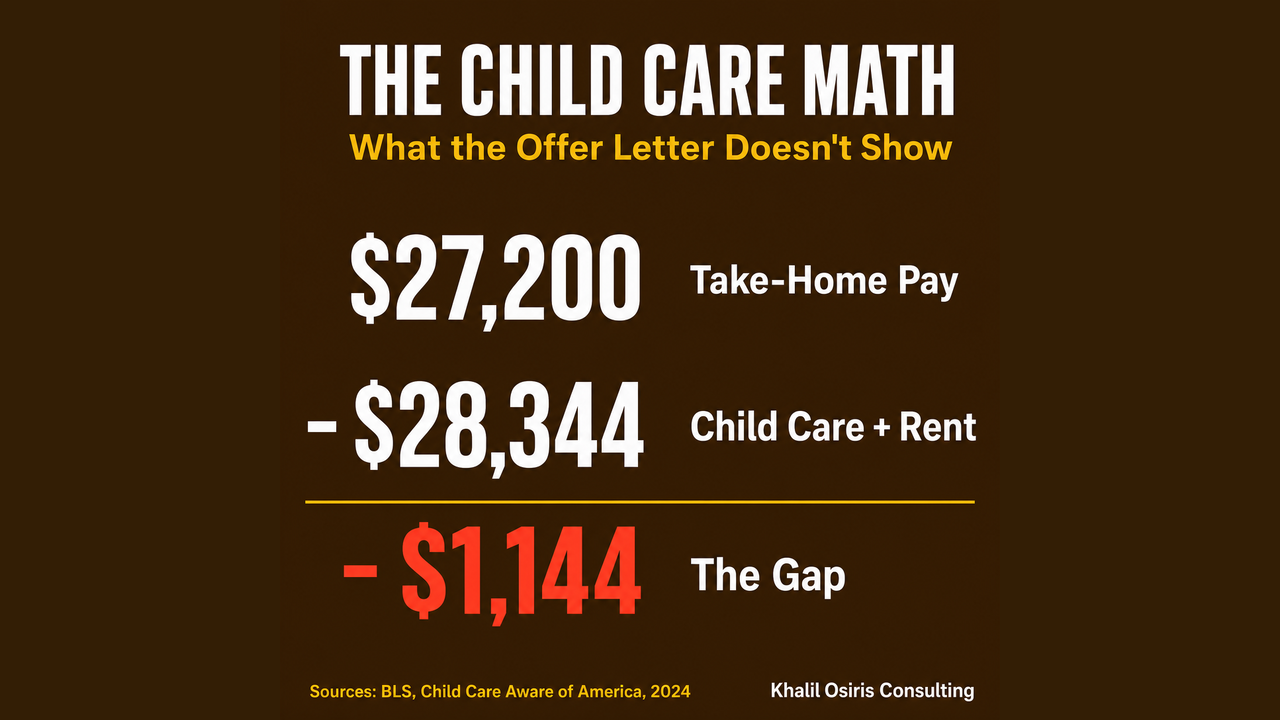
Child care + rent combined: $31,028
Take-home pay: $30,150
The household is $878 in the red for the year, before it buys a single bag of groceries, pays a utility bill, or puts gas in a car.
That is the calculation nobody ran before the offer letter went out. And it is the reason the worker who looked "stable" at day 90 is gone by month five.
The Reframe
Here is what that failure looks like inside one household.
Lamar Thompson finishes a reentry workforce program. He is placed in a warehouse logistics role at $17 an hour.
The program logs a successful placement.
The employer claims a $2,400 Work Opportunity Tax Credit (IRS; 40% of the first $6,000 in first-year wages for a qualified hire).
His partner Keisha works part-time. Their daughter Nia is three. Their son Jaylen is seven. Child care for two children, even at below-average rates, easily exceeds $18,000 a year. At national average rates, combined care for an infant/toddler and school-age child approaches $23,000 annually (Care.com, 2026; CCAoA, 2024).
Then the cascade the metrics never see:
Month three: the household borrows from family for groceries.
Month four: Keisha cuts her hours to pull Nia from daycare. Her income drops.
Month five: the lost income destabilizes rent.
Month six: Lamar takes a second shift. He stops sleeping. His work slips.
Month seven: Lamar is let go.
The program already counted him. The employer already claimed the credit. Nobody measured the household.
This is not a motivation problem. It is a compensation architecture problem, and it was visible on day one, if anyone had run the math.
The National Scale
This is not an edge case. It is a structural pattern.
Child care as a barrier to employment is 19% higher now than before the pandemic (Federal Reserve Bank of Chicago, December 2024).
Among mothers of children under five who work part-time, child care is the primary reason they cannot increase their hours, mothers in this group are more than twice as likely to cite child care barriers as fathers or mothers of older children (Chicago Fed, 2024).
The toll: more than 20 million potential work hours lost every week to child care barriers. Approximately 80% of that potential gain would come from parents moving from part-time to full-time work (Federal Reserve Bank of Chicago, 2024).
From 2021 to 2025, child care prices rose 23%, nearly matching overall inflation at 24% (Child Care Aware of America, 2025 Price & Supply Report). The problem is not that child care is rising faster than everything else. The problem is the base: a five-figure annual bill that sits on the household before rent, food, or transportation.
In all 47 states with data, center-based care for two children costs more than median annual rent, and more than a mortgage in 39 of them (Child Care Aware of America, 2025).
The child care system is not failing at the margins. It is structurally incompatible with entry-level wages. Every hiring program that ignores it is building placements on a foundation the household cannot hold.
The Fix: Household-Integrated Hiring
The fix is three shifts.
- Run the child care math before the offer letter.
Calculate the gap before anyone starts: (after-tax wage) minus (local child care cost) minus (local median rent). If the result is negative, the placement collapses without a child care intervention. The offer is not an opportunity. It is a countdown.
- Connect the hire to child care infrastructure inside 30 days.
In the first month, connect every worker with children to:
- The Child Care and Development Fund (CCDF) subsidy in your state
- Head Start / Early Head Start screening
- Employer-sponsored backup care, if available
- Your local child care resource and referral agency (childcareaware.org)
This is not social work. It is retention strategy. A subsidy connected in week one is an investment in month twelve.
- Track child care as a retention indicator.
Add one question to every 30-, 90-, and 180-day check-in: "Has your child care arrangement changed since you started?" A yes means the household is destabilizing. That is your signal to act, before the resignation, not at the exit interview.
Who Owns This:
- Hiring managers: Run the household math before you extend the offer. If you can't name the child care gap for your next hire, you are not ready to make it.
- Workforce operators: Put child care navigation in week-one onboarding. If your program ends at placement, your retention ends at month four.
- Funders and policymakers: Stop funding placement-only metrics. Require child care access reported alongside employment at 6 and 12 months.
Timeline: Run the child care calculation within 30 days. Build navigation partnerships within 90. Start tracking child care status at every check-in now.
The Decision
Here is the fair chance hiring calculation your HR team has never run.
Take the average starting wage of your justice-impacted hires. Subtract median child care in your market. If what's left falls below what a single-income household needs to survive, you did not extend an opportunity. You issued a financial emergency with a start date.
That is not a worker motivation problem. It is a compensation architecture problem, and you can fix it before the next offer letter goes out.
What does your organization score on this?
Take the free Durability Index Self-Assessment. Twenty questions. Five domains. One score.
Until next time, keep building what they said couldn't be built.
Khalil Osiris
Author and Founder, Khalil Osiris Consulting | Market Architect, The Durability Economy Workforce Architecture
The Durability Economy. Workforce redesign, fair chance hiring, and household stability. For leaders who measure what lasts.
Change the metrics. Change the outcomes.
Subscribe to The Durability Economy
Get the weekly briefing on workforce transformation, criminal justice reform, and the 2Gen Economy, delivered straight to your inbox. Evidence over ideology. Households over headcounts.
We hate SPAM. We will never sell your information, for any reason.