You're Already Paying for Household Stability. You Just Call It Turnover.
Jun 16, 2026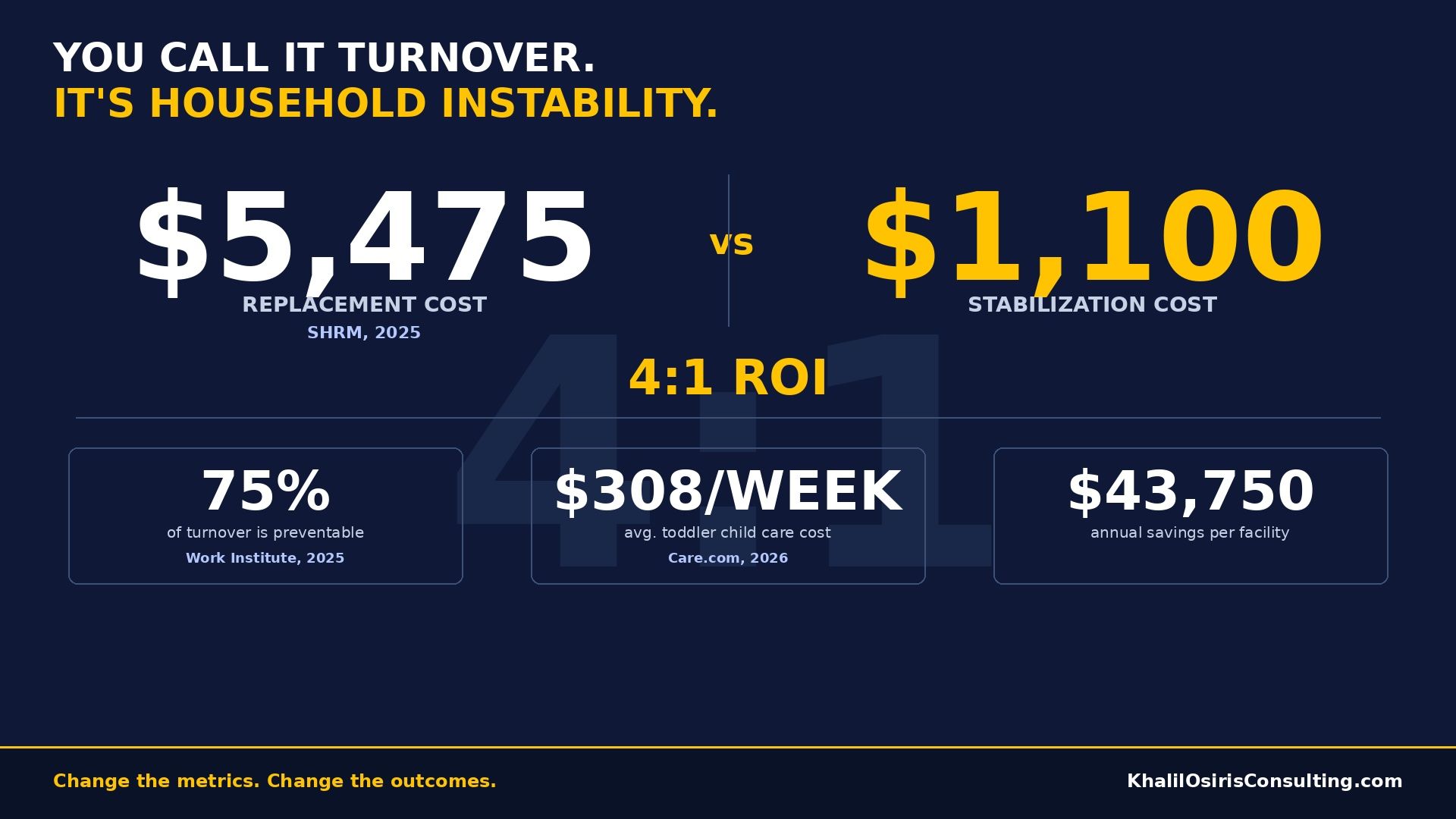
The cost is already on your books. You just filed it under the wrong line item.
Every employer in the country tracks turnover.
How many left. How many were replaced. What the recruiter cost. What the temp agency charged to fill the gap while the req sat open.
Here is the number almost none of them track: the household condition of the worker who quit.
Not the exit interview answer. The real one. The child care arrangement that collapsed. The rent payment that fell behind. The second shift that destroyed the first.
That is not a missing metric. It is a design choice. And it is the reason your turnover budget keeps growing while your retention programs keep failing.
The Evidence
Replacing a single employee costs $5,475 on average for non-executive roles (SHRM, 2025 Benchmarking Report).
For roles requiring specialized training or certification, the figure climbs to one-half to two times the employee's annual salary (Gallup).
Now multiply.
A warehouse operation with 200 employees and 60 percent annual turnover replaces 120 workers a year. At $5,475 each, that is $657,000.
A distribution center with 500 workers at the same rate: $1.64 million a year.
These numbers sit in your operating budget every quarter. Your finance team books them as cost of doing business. Staffing expense. Operational overhead.
It is none of those things.
It is the cost of household instability arriving at your loading dock disguised as a resignation letter.
The Reframe
Here is what that budget line looks like from the other side of the offer letter.
Lamar Thompson is placed in a logistics role at $17 an hour through a fair-chance hiring program.
The program logs a successful placement. His employer claims a Work Opportunity Tax Credit.
At home, his partner Keisha works part-time. Their daughter Nia is three. Their son Jaylen is seven.
Center-based toddler daycare averages $308 a week nationally (Care.com, 2026 Cost of Care Report).
After-school care for a school-age child adds another $120 a week or more. At even moderate rates, child care for two children easily exceeds $18,000 to $22,000 a year, before transportation, meals, or backup care.
Month three: the household borrows from family to cover groceries.
Month four: Keisha drops her hours to pull Nia from daycare. Household income falls.
Month five: rent destabilizes.
Month six: Lamar picks up a second shift. Sleep disappears. Performance drops.
Month seven: Lamar is terminated.
Your HR system records this as voluntary attrition. Your finance team processes the $5,475 replacement cost. Your hiring manager posts the role again.
Nobody in that chain ever asked: what happened in the household between month three and month seven?
The answer was visible on day one. The child care math made the collapse inevitable.
The retention failure was not a workforce quality problem. It was a household stability problem that arrived on your P&L under the wrong name.
The Math Your Finance Team Has Never Run
Here is the cost comparison nobody has put on the same spreadsheet.
Cost of replacing Lamar after month seven: $5,475.
Cost of connecting the household to a Child Care and Development Fund (CCDF) subsidy and a local resource and referral agency in week one: approximately $200 to $500 in staff time.
Cost of a monthly household stability check-in through month twelve: roughly $50 per month in case manager time. That is $600 for the year.
Total stabilization investment: $800 to $1,100.
Total replacement cost absorbed instead: $5,475.
The employer paid more than four times the stabilization cost and still lost the worker.
That is not a support-services line item. It is a retention investment with a 4-to-1 return that your budget currently files under "turnover."
And the math scales.
If 10 of your 120 annual replacements were household-stability exits, and each one could have been prevented for $1,100 instead of $5,475, you are absorbing $54,750 in replacement costs when $11,000 in stabilization would have held them.
That is $43,750 a year in a single facility, visible in a single budget review, recoverable on Monday morning.
The National Scale
This is not one warehouse. It is a structural pattern.
The highest turnover rates belong to workers earning under $40,000 a year, in logistics, retail, food service, and light manufacturing.
Warehouse and distribution operations consistently run above 40% annual turnover, with many facilities exceeding 60% during peak seasons (BLS Job Openings and Labor Turnover Survey, 2025).
The first six months are the highest-risk window, precisely when household pressures peak: child care gaps, housing instability, transportation breakdowns, and benefit cliffs.
A 2025 Retention Report from the Work Institute, based on an analysis of over 120,000 exit interviews, found that 75% of employee turnover is preventable.
This isn't solved with better perks, pizza parties, or retention bonuses that arrive long after a household's stability has collapsed. Instead, prevention requires structural interventions at the very point where that stability begins to falter.
The pattern repeats across industries: employers invest in recruiting, onboarding, and training, then watch the investment walk out the door because the household could not hold the worker long enough for the job to stick.
Every one of those exits was a retention expense disguised as a hiring expense.
The Fix: Retention Infrastructure
The fix is three shifts.
- Add a household stability screen to onboarding.
In week one, ask three questions: Is your child care arrangement stable for the next 90 days? Is your housing secure through month six? Do you have transportation that does not depend on someone else's schedule?
A "no" is not a red flag about the worker. It is a signal that your retention is already at risk, and a $200 connection to the right resource is cheaper than a $5,475 replacement.
- Track household indicators alongside performance indicators.
Add one question to every 30-, 60-, and 90-day check-in: "Has anything changed at home that is affecting your ability to get here or stay here?"
This is not social work. It is supply chain management for your own labor force. A yes at day 30 is a $200 intervention. A resignation at month five is a $5,475 loss.
- Reclassify stabilization spending as retention investment.
Move child care navigation, transportation support, and housing referral partnerships out of "employee assistance" and into "retention infrastructure." When your CFO sees the line item next to the turnover line, the ROI conversation changes overnight.
Who Owns This
Hiring managers: Run the replacement cost against the stabilization cost for your last five hires who left before month six. If stabilization was cheaper every time, you have been paying the wrong bill.
HR and workforce operators: Build household stability into week-one onboarding. If your retention strategy starts at the performance review, you are intervening four months too late.
CFOs and finance teams: Relabel the budget. The money you spend on turnover is already a household stability expenditure. You are just paying the premium version: replacement instead of prevention.
Timeline: Run the cost comparison within 30 days. Add the household stability screen to onboarding within 60. Start tracking household indicators at every check-in now.
The Decision
Here is the cost test your finance team can run today. Add up the fully loaded cost of recruiting, onboarding, and training a hire who exits at month four. Compare it to what targeted household stabilization would have cost over those same four months.
If stabilization is cheaper than the churn you already absorb, you are not saving money by skipping it. You're paying the same bill twice, but calling the second payment "turnover."
Run the number before you approve the next req.
What does your organization score on this?
Take the free Durability Index Self-Assessment. Twenty questions. Five domains. One score.
Until next time, keep building what they said couldn’t be built.
Khalil Osiris
Author & Founder, Khalil Osiris Consulting | Market Architect, The Durability Economy Workforce Architecture | Fair-Chance Hiring · Household Stability · Workforce Durability | Publisher, The Durability Economy
Subscribe: If this edition of The Durability Economy challenged your thinking, share it with a colleague. Already measuring household impact? Tell me about it. I might feature your work in a future edition.
Change the metrics. Change the outcomes.
Subscribe to The Durability Economy
Get the weekly briefing on workforce transformation, criminal justice reform, and the 2Gen Economy, delivered straight to your inbox. Evidence over ideology. Households over headcounts.
We hate SPAM. We will never sell your information, for any reason.