Why Fair-Chance Hiring Is Not Enough: Building a 2Gen Workforce Economy
May 02, 2026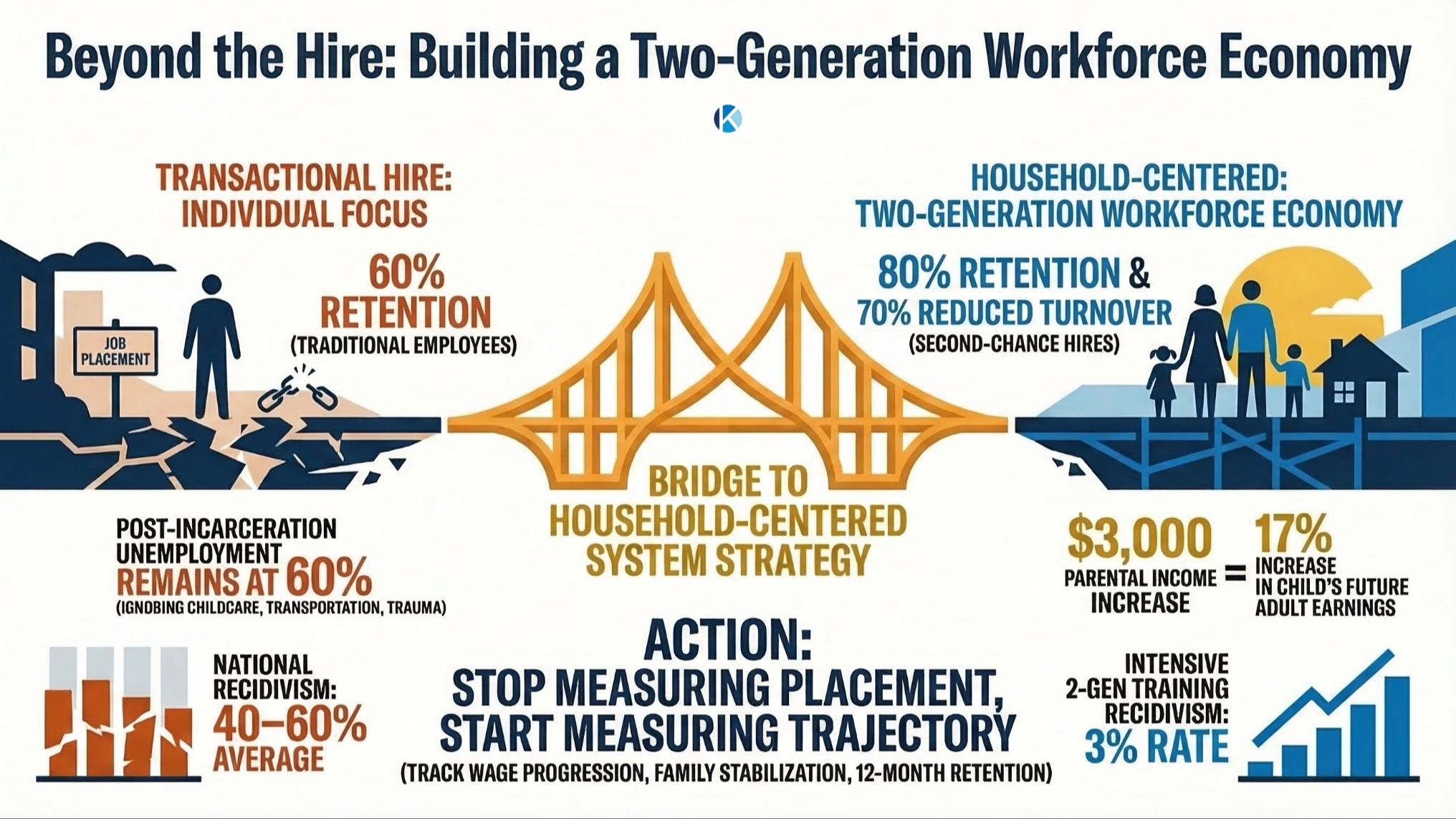
Fair-Chance Hiring has expanded access to employment for justice-impacted individuals.
But hiring alone does not produce household stability. A 2Gen Workforce Economy goes beyond individual job placement to build the systems architecture: employer retention infrastructure, household stability measurement, and cross-sector coordination, that turns a hire into lasting economic mobility for the worker and their family.
This article explains why Fair-Chance Hiring programs need to evolve from access strategies into household economic architecture.
The Blindspot
Here is the pattern:
We keep measuring the hire.
We keep celebrating the placement.
We rarely measure whether the job actually stabilizes a household.
That is the blindspot.
Access Is Not Architecture
The market loves access. It avoids architecture.
The current second-chance conversation is too small.
It focuses on whether employers are willing to hire people with records.
That matters.
A lot.
Employer case studies increasingly show that fair-chance hiring can strengthen the talent pipeline when it is paired with retention infrastructure.
The point is not that every employer will see the same numbers.
The point is that retention improves when the hiring strategy accounts for onboarding, coaching, scheduling, transportation, supervision requirements, and household stability.
The Unit Is the Household
Those gains still leave a deeper question.
If employer-level results can improve, why do so many justice-impacted people and families remain economically fragile?
Because the conversation is still trapped inside the wrong unit of analysis.
The unit is not just the worker.
The unit is the household.
That is where many workforce systems still struggle to measure impact.
A paycheck without child care can become fragile.
A job without transportation can become fragile.
A worker carrying untreated trauma back into a stressed household may face greater instability.
A parent who gets hired but cannot stabilize rent, routine, and relationships may still remain economically fragile.
And then the system does what it often does.
It mislabels structural instability as personal failure.
Talent Strategy vs. System Strategy
Fair-Chance Hiring is a talent strategy.
A 2Gen Workforce Economy is a system strategy.
A talent strategy asks:
Can we get this person into a job?
A 2Gen strategy asks:
Can this job improve the economic trajectory of a household, reduce future system contact, and change what happens to the next generation?
One is transactional.
The other is transformational.
One looks at intake.
The other looks at outcomes.
One celebrates access.
The other asks whether access produced stability, financial growth, stronger relationships, and future mobility.
That is why I keep pushing a household-centered frame.
Because workforce development that ignores the household is still optimizing for fragments.
And fragments do not scale.
What the Evidence Actually Shows
The evidence keeps pointing in the same direction.
A 2024 randomized trial on transitional employment programs delivered mixed and largely disappointing results.
The study found that broad, one-size-fits-all employment models did not significantly reduce rearrest when individualized needs were left unaddressed.
That should have been a wake-up call.
It reinforced a difficult conclusion:
Placement-based models may be too shallow for the complexity of reinvention.
They often fail to account for trauma, family strain, and the difference between getting someone hired and helping them stay economically anchored.
And trauma is not isolated to the individual.
A 2024 mixed-methods pilot study found clinically significant PTSD indicators in 69% of justice-involved registrants and 62% of their family members.
Read that again.
Not just the worker.
The family.
Not just the record.
The household.
That helps explain why Fair-Chance Hiring, by itself, cannot carry the weight people keep putting on it.
You cannot hire your way out of a systems failure if the systems around work remain unchanged.
This Is About Economic Growth
This is not just about reinvention. It is about economic growth.
That's where the conversation needs to mature.
A 2Gen Workforce Economy is not a niche moral argument.
It is an economic design argument.
When parental income rises, children’s future outcomes tend to improve.
A $3,000 increase in parental income during a child’s early years is associated with a 17% increase in that child’s future adult earnings.
A $10,000 annual increase in parental income is associated with a 3.7% increase in the quality of that child’s health in adulthood.
That is not charity.
That is long-horizon economic development.
It means the labor market is not just allocating jobs.
It is also connected to future earnings and future health.
Now layer in the justice data.
In 2024, New York City saw 680 juvenile arrests.
That was a 28% increase from the prior year and a 111% increase from 2022.
Young adults account for about 20% of the city’s probation population.
Nearly 1 in 5 probation revocations result from technical violations alone.
Those figures reflect the cost of reactive systems.
They also suggest the cost of waiting until instability hardens into contact.
But there is another path.
Credible Messenger programs have historically been associated with meaningful reductions in re-arrest and violent offending.
Internal program data from 2Gen workforce implementations shows that the recidivism rate for individuals who completed intensive 2Gen workforce training was significantly lower than the national average.
That suggests a meaningfully different approach.
What a 2Gen Workforce Economy Actually Requires
So what does a 2Gen Workforce Economy actually require?
It requires leaders to stop mistaking participation for transformation.
If you are funding this work, measuring this work, or running this work, here is what matters.
Funders: Stop Paying for Movement and Calling It Progress
Do not just ask how many people were placed.
Ask what happened to the household 90 days, 180 days, and 12 months later.
Did income rise?
Did retention hold?
Did child care stabilize?
Did transportation barriers shrink?
Did family stress decrease?
Did the household move closer to durable economic security?
If you're only paying attention to placement metrics, you might be falling into a compliance trap.
You're rewarding activity, not results.
Not outcomes.
Policymakers: Design Around Households
Policy often treats justice involvement as an isolated status.
It is not.
It is closely connected to labor markets, family economics, probation rules, and broader household conditions.
Definitions drive metrics.
Metrics drive incentives.
Incentives drive practice.
So redesign the metrics.
Measure household impact.
Measure retention.
Measure wage progression.
Measure family stabilization.
Measure whether the next generation is moving farther from system contact, not closer to it.
That is system transformation.
Operators and Employers: The Hire Is the Beginning
The hire is the beginning.
If you want better retention and stronger performance, consider building around the real conditions of work.
That means wraparound support.
That means family-aware scheduling.
That means advancement pathways.
That means training supervisors to manage performance without creating stigma.
That means partnerships that address household stability and long-term mobility.
Employer commitments matter.
Coalitions matter.
Public statements matter.
But commitments are not architecture.
Architecture determines whether a worker can settle down, grow, and build a future for their family.
Where Next-Generation Leadership Begins
This is where next-generation leadership begins.
Who had the best slogan won't define the next generation of leaders.
It will be defined by who built the better system.
Today's most effective leaders are willing to confront an uncomfortable truth:
Fair-Chance Hiring can improve employer outcomes and still leave the larger workforce economy structurally broken.
That is the moment we are in.
We do not need a better public relations story.
We need a better market design.
One that is household-centered.
One measured by outcomes.
One that understands reinvention, workforce development, and economic mobility as part of the same ecosystem.
One that stops asking if someone deserves a chance, and starts asking if our systems can create stability for everyone.
That is the work.
That is the opportunity.
That is the future of workforce development.
Here's the question leaders should be asking:
Are you building a Fair-Chance Hiring program?
Or are you building a 2Gen Workforce Economy?
Because those are not the same thing.
And the future will reward the people who know the difference.
What does your organization score on this?
Take the free Durability Index Self-Assessment. Twenty questions. Five domains. One score.
Until next time, keep building what they said couldn't be built.
Khalil Osiris
Author and Founder, Khalil Osiris Consulting | Market Architect, The Durability Economy Workforce Architecture
The Durability Economy. Workforce redesign, fair-chance hiring, and household stability. For leaders who measure what lasts.
Change the metrics. Change the outcomes.
Subscribe to The Durability Economy
Get the weekly briefing on workforce transformation, criminal justice reform, and the 2Gen Economy, delivered straight to your inbox. Evidence over ideology. Households over headcounts.
We hate SPAM. We will never sell your information, for any reason.