Stop Calling It Second Chances: Start Calling It a Talent Strategy
Mar 03, 2026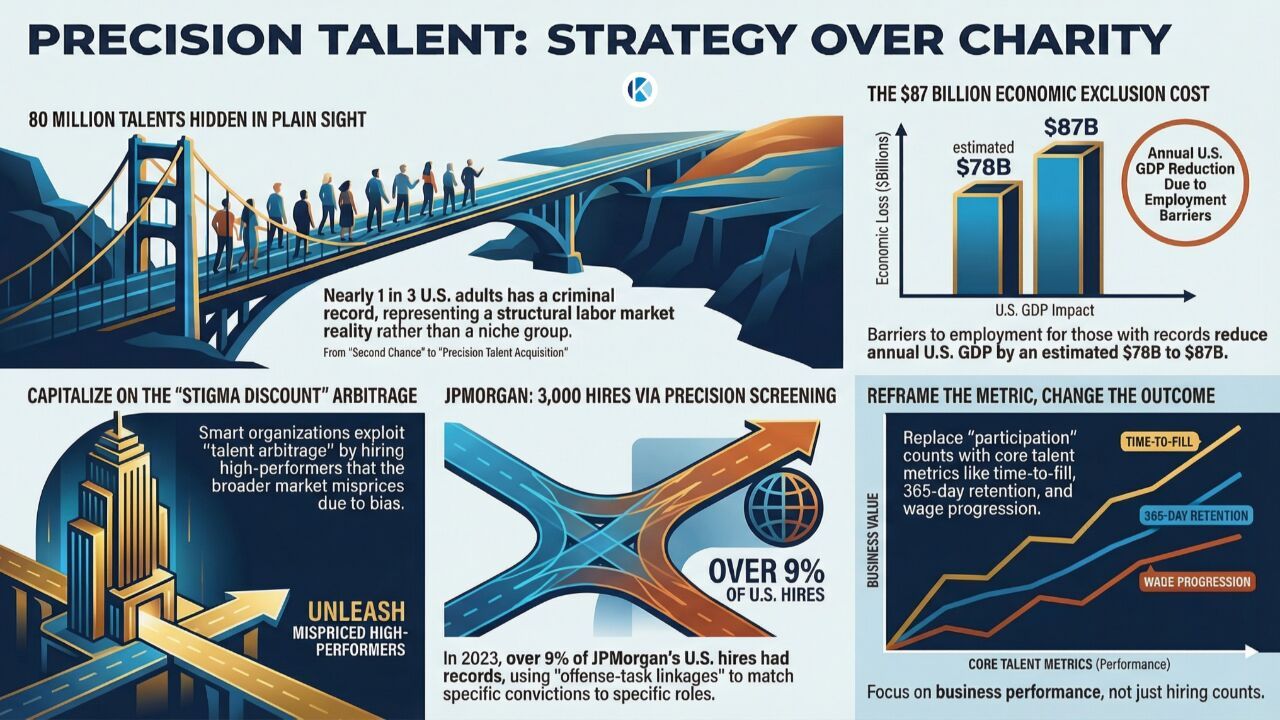
I was arrested at 16. I earned my degrees in prison.
I’ve spent the last two decades watching employers announce their “commitment” to Fair Chance Hiring.
They post the logos. They sign the pledges. They show up at the conferences.
And then they go back to the office and wonder why they can’t fill roles.
Here’s what no one in the room is willing to say:
The frame is the problem.
Fair Chance Hiring is not a charitable act. It is a talent strategy backed by 80 million potential workers and $87 billion in unrealized GDP. When employers reframe the conversation from charity to precision talent acquisition, retention rates outperform traditional hiring pipelines.
Not because the intent is bad. Because the label is strategically weak.
It turns a business decision into an act of kindness.
And kindness is optional.
When You Label It Wrong, You Fund It Wrong
This is the pattern I see over and over:
You name it “second chance.” So the organization files it under “nice to do.”
What happens next is predictable.
-
The work gets parked outside core talent acquisition
-
The KPI becomes “participation” instead of performance.
-
The budget depends on mood and messaging.
-
The moment the market tightens, it gets cut “temporarily.”
This is not a values problem.
It’s an incentives problem.
And incentives follow metrics.
Change the Metric, Change the Outcome
So let’s talk metrics.
Because the data is not subtle.
The Market You Are Ignoring
The National Employment Law Project (NELP) estimates roughly 80 million U.S. adults have a criminal history record, nearly one in three.
That’s not a niche group.
That’s a labor market reality.
And in most companies, having a criminal record is an automatic disqualification.
Not role-specific. Not time-bound. Not tied to actual job requirements.
Just… excluded.
Not because the person can’t do the work.
Because a checkbox triggers the system.
That’s not “risk management.”
That’s blunt-force filtering.
And blunt-force filtering creates a distortion.
Name the Distortion: Talent Arbitrage
In financial markets, arbitrage is capitalizing on a price discrepancy, buying undervalued assets the broader market mispriced.
That’s exactly what’s happening in hiring.
The “stigma discount” artificially lowers the perceived value of millions of workers.
It’s not a productivity discount.
It’s a perception discount.
Created by fear, bias, and outdated policy, then enforced by default background-check practices.
So here’s the real question:
Are you building a talent strategy… or are you running a checkbox policy that your competitors already learned how to exploit?
Because some organizations are taking advantage of it.
And they’re not doing it quietly.
Proof That This Scales
JPMorgan Chase reports hiring over 3,000 individuals with a criminal record, representing more than 9% of all new hires in the U.S. (2023 Annual Report)
That’s not a special program.
That’s a repeatable system.
And the mechanism matters:
They use what they call “offense-task linkages,” a simple, disciplined question: Does this specific conviction actually affect this specific role?
That question is a design choice.
It moves you from blanket exclusion to role-relevant screening.
It turns “we don’t hire people like that” into “we evaluate job fit.”
That’s not charity.
That’s precision.
The Cost of Exclusion Is Measurable
Let’s stop pretending this is a “soft” issue.
NELP reports that people with criminal convictions lose at least $370 billion in annual earnings nationwide.
The Center for Economic and Policy Research (CEPR, 2016) estimates that employment barriers lower U.S. annual GDP by about $78 billion to $87 billion.
Read that again.
Tens of billions in output, every year, because our hiring systems default to exclusion.
This isn’t a motivational speech.
It’s a macroeconomic indictment of how we allocate opportunity and labor.
And it shows up in the most practical place possible:
Employment.
After prison, people don’t just “bounce back” in the job market, they face a lockout.
Federal data from the Prison Policy Initiative shows that 33% of people released from federal prisons had no employment over four years post-release (BJS/PPI, 2010 cohort).
At any given time, no more than 40% of that cohort was employed.
This is why “second chance” language frustrates me.
Because “chance” implies an individual moment.
But the data shows a long, structural pattern.
A system that keeps people out, again and again, across years.
Not because they can’t work.
Because the gate stays closed.
Wage Suppression Is Part of the System
NELP reports that people who have been incarcerated earn about half as much annually as those who haven’t.
They also cite a study finding nearly 1 in 4 workers on parole were paid less than minimum wage, and nearly 1 in 5 were not paid overtime.
Let that land.
That’s not “reintegration.”
That’s exploitation.
And when exploitation becomes normal, employers don’t just lose workers.
They lose trust.
They lose stability.
They lose households.
Because the household is the unit of change.
What You Call It Determines What You Build
When you call it charity, you make it optional.
Optional programs don’t get funded in downturns. Optional programs don’t get operational ownership. Optional programs don’t get real accountability.
So the frame isn’t just branding.
The frame is architecture.
It determines:
-
Where it sits (CSR or Talent).
-
Who owns it (Comms or Operators).
-
How it’s measured (stories or outcomes).
-
Whether it survives (good times only, or always).
And if we’re serious about fair chance hiring, serious about workforce development, serious about recidivism reduction:
We can’t keep building “optional.”
From Second Chance to Precision Talent
Here’s the shift I’m asking for:
Old language: “Fair-Chance Hiring.”
New language: Precision talent acquisition.
Old question: “Will you give someone a chance?” New question: “Does the record actually predict performance in this role?”
Old metric: “How many did we hire?” New metrics: time-to-fill, retention at 90/180/365, wage progression, and supervisor-rated performance.
Old owner: brand and goodwill. New owner: the talent function, with legal aligned to enable, not block, role-specific decisions.
That’s how you rename the category.
And when you rename it, you change the room it gets discussed in.
You move it from applause… to execution.
The 30-90 Day Playbook
If you’re a CEO, CHRO, Head of Talent, or workforce operator, here’s what to do next.
Day 1–30: Fix the gate
-
Audit your current screening: where does the checkbox exist, and what triggers an automatic no?
-
Identify “high-volume roles” and decide which convictions are actually job-relevant vs. “legacy exclusion.”
-
Create a role-specific review path (this is where “offense-task linkage” logic lives).
Day 31–60: Build the measurement
-
Define the outcome metrics: time-to-fill, 90/180-day retention, 12-month retention, wage progression, and incident rate.
-
Assign an operator owner: someone whose job is to ship this, not just talk about it.
-
Create a single dashboard view. If it can’t be reviewed monthly, it’s not a system.
Day 61–90: Scale what works
-
Expand to additional roles based on outcomes, not opinions.
-
Train hiring managers with scripts that reduce fear and increase consistency.
-
Publish internal guidance: what gets reviewed, what gets approved, and what gets escalated;so managers stop guessing.
This is how you turn “chance” into process.
And process is what scales.
What We Are Really Building: Household Stability
I didn’t build the Durability Economy Workforce Architecture to argue about labels.
I built it because employment alone has never been the destination.
Household stability is the destination.
A job is the beginning of the argument, not the end of it.
If your hiring system brings someone in, but your systems still block their banking, housing, transportation, or scheduling stability, you didn’t “solve” anything.
You created churn.
And churn is expensive.
So yes, rename the category.
But don’t stop at the words.
Change the metric.
Change the incentives.
Change the outcomes.
The Closing Question
If the talent pool is 80 million people deep…
If a major employer can hire 3,000+ people with records in a single year…
And if the cost of exclusion is $78B–$87B in lost GDP annually…
Why are you still calling it charity?
Rename it. Reframe it. Build it like strategy.
What does your organization score on this?
Take the free Durability Index Self-Assessment. Twenty questions. Five domains. One score.
Until next time, keep building what they said couldn't be built.
Khalil Osiris
Author and Founder, Khalil Osiris Consulting | Market Architect, The Durability Economy Workforce Architecture
The Durability Economy. Workforce redesign, fair chance hiring, and household stability. For leaders who measure what lasts.
Change the metrics. Change the outcomes.
Subscribe to The Durability Economy
Get the weekly briefing on workforce transformation, criminal justice reform, and the 2Gen Economy, delivered straight to your inbox. Evidence over ideology. Households over headcounts.
We hate SPAM. We will never sell your information, for any reason.