The Door Is Open. The Architecture Is Still Broken: Why Fair-Chance Hiring Isn't Working
Mar 17, 2026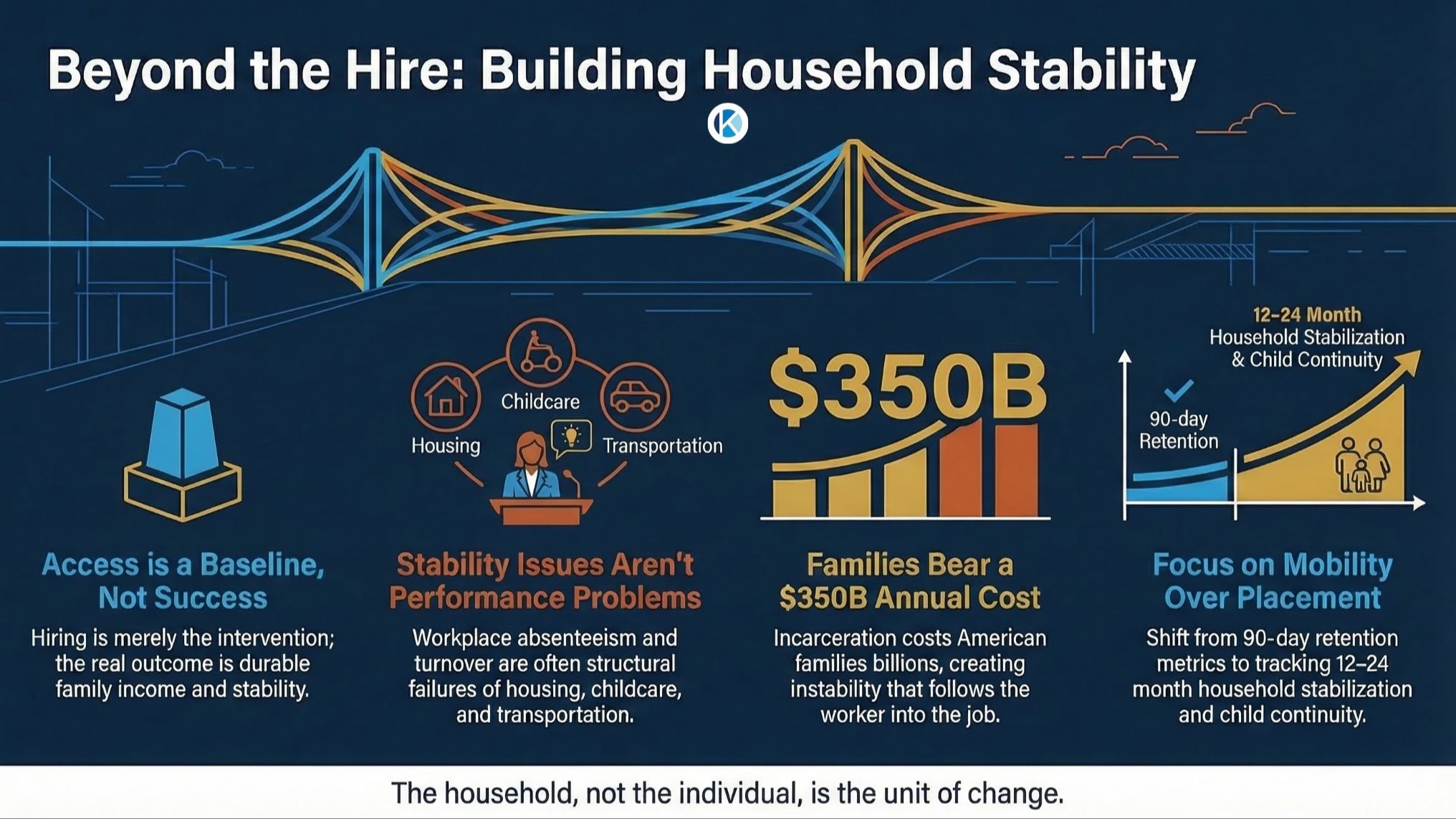
Fair-Chance Hiring has opened doors for justice-impacted workers.
But access alone does not produce household stability.
When workforce systems focus on job placement without addressing the structural barriers ; housing instability, child care gaps, benefits cliffs, and disconnected services ; that surround the worker, retention collapses and the system calls it individual failure. This article examines why the architecture behind Fair-Chance Hiring must be redesigned to stabilize households, not just fill openings.
The Real Problem
Fair-Chance Hiring is not enough. It is a door without a floor. When the system celebrates placement without measuring household stability at 18 months, it has designed attrition into the architecture. The door is open. The infrastructure behind it is still broken ; and the funding pathways remain misaligned.
The Second Chance Business Coalition has done important work. It helped move Fair-Chance Hiring into the mainstream and helped employers treat justice-impacted talent as talent.
That matters.
But let's be honest about what that work actually solves.
It solves for access.
It does not yet solve for durability.
It opens the door. It does not fully design what happens after the person walks through it.
Because hiring is not the outcome. Hiring is the intervention.
The real outcome is whether the job creates household stability, strengthens family income, reduces volatility, and changes the trajectory of the next generation.
That is where the field still falls short.
And that is where my work begins.
The Blind Spot
Most Fair-Chance Hiring efforts are still built around the worker as the unit of change.
I reject that assumption.
The household is the unit of change.
If the partner is unemployed, if child care is unstable, if housing is fragile, if transportation is inconsistent, and if family income is one emergency away from collapse, then the job is carrying far more than a worker.
It is carrying household instability.
And when that instability shows up at work, the employer often reads it as a performance problem: tardiness, absenteeism, turnover, low engagement.
The diagnosis becomes personal.
But the failure was structural.
Families absorb the cost of incarceration long before employers absorb the cost of turnover. FWD.us estimated in 2025 that incarceration costs American families nearly $350 billion annually.
Families absorb the missed rent. Families absorb the child care breakdown. Families absorb the school disruption.
Then the labor market acts surprised when instability shows up on the job.
But instability did not begin at work.
Work is where it becomes visible.
What the Data Is Telling Us
The latest reinvention research has already started correcting the old frame.
The Council of State Governments Justice Center's 2025 brief argues that reinvention success cannot be understood through recidivism alone and instead should be measured across five categories: recidivism progression, employment and financial stability, housing security, health and wellbeing, and social reintegration.
That matters because recidivism alone is too narrow. Employment alone is too narrow. Housing alone is too narrow.
And even that broader frame does not go far enough unless the household becomes visible.
Because the deeper question is not only whether someone gets a job, avoids reincarceration, or secures housing.
The deeper question is whether the household stabilizes.
CSG’s April 2026 housing stability guide identifies housing cost burden as a concrete stability measure, using HUD’s standard threshold: housing is unstable when rent and utilities exceed 30% of income and severely unstable when they exceed 50%.
That is exactly the point.
A job placement can look successful on paper while the household is still financially fragile in real life.
That is why access without support is fragile. That is why placement without design is temporary. That is why hiring alone cannot carry the weight of a broken architecture.
The Market Failure
This is the trap.
We celebrate the hire. We do not design for the conditions that make the hire durable.
We optimize for placement. We optimize for 90-day retention. We optimize for wage at hire.
Then we act surprised when instability shows up downstream.
The problem is not that these metrics are useless.
The problem is that they are incomplete.
And incomplete metrics create distorted incentives.
If a workforce board is judged by placements, it will optimize for placements. If a nonprofit is funded on short-term retention, it will optimize for short-term retention. If an employer gets recognized for fair-chance hiring commitments, it will optimize for front-door access.
And if no one is accountable for household stability, family income progression, partner employment, or child continuity, then no one will build for those outcomes.
Even the Second Chance Business Coalition's own 2025 announcement of a new metrics framework signals that the field knows simple hiring counts are not enough.
My argument is that we still have to go further.
We measure what is easy. Then we call it success.
That is the market failure.
Why My Position Is Different
I am not arguing against Fair-Chance Hiring.
I am arguing against stopping there.
Fair-Chance Hiring is a talent strategy.
The 2Gen Economy is a market strategy.
One asks how to get more people hired. The other asks what we are actually building.
One improves access. The other redesigns the system around long-term economic mobility.
That is a different level of ambition.
And a different level of accountability.
The Second Chance Business Coalition helped validate the business case for second chance employment.
Good. That work matters.
But opening the door is not the same as designing the future.
My work is about the design.
I am the architect of the 2Gen Economy Workforce Ecosystem.
That framework starts from a different premise: if the goal is durable workforce participation and generational mobility, then the household has to become the unit of analysis, the unit of support, and the unit of measurement.
That changes what we track, what we fund, what employers own, what workforce boards define as success, and what policymakers call return on investment.
What Leaders Should Do Next
If you are a funder, stop rewarding placement alone. Reward household stabilization measured at intake, 6, 12, 18, and 24 months.
If you are an employer, stop reading every retention issue as an individual discipline problem. Examine the pressures surrounding the worker and build retention strategies that account for them.
If you are a workforce board, stop calling short-term attachment success if long-term stability never follows.
If you are a policymaker, stop treating recidivism as the only scoreboard that matters. Public dollars should be tied to how people actually live: housing, income, family stability, child continuity, and mobility.
That is what a serious workforce strategy looks like.
Not symbolic inclusion. Not performative fairness. Not press releases without redesign.
Real architecture.
The Real Opportunity
The Second Chance Business Coalition opened the door.
That was necessary.
But the next era of leadership will belong to the people who can answer a harder question: what happens after the door opens?
That is the question I am answering.
Not with slogans. Not with surface reform.
With a new architecture.
Fair-Chance Hiring is not the win.
Household stability is.
Workforce durability is.
Generational mobility is.
If your strategy stops at access, you are not transforming the system. You are managing breakdown with better branding.
Build for the household.
Change the metric.
Start this quarter.
What does your organization score on this?
Take the free Durability Index Self-Assessment. Twenty questions. Five domains. One score.
Until next time, keep building what they said couldn’t be built.
Khalil Osiris
Author & Founder, Khalil Osiris Consulting | Market Architect, The Durability Economy Workforce Architecture | Fair-Chance Hiring · Household Stability · Workforce Durability | Publisher, The Durability Economy
Subscribe: If this edition of The Durability Economy challenged your thinking, share it with a colleague. Already measuring household impact? Tell me about it. I might feature your work in a future edition.
Change the metrics. Change the outcomes.
Subscribe to The Durability Economy
Get the weekly briefing on workforce transformation, criminal justice reform, and the 2Gen Economy, delivered straight to your inbox. Evidence over ideology. Households over headcounts.
We hate SPAM. We will never sell your information, for any reason.