Moving the Goalpost: Why Recidivism Is a Failed Metric
Feb 17, 2026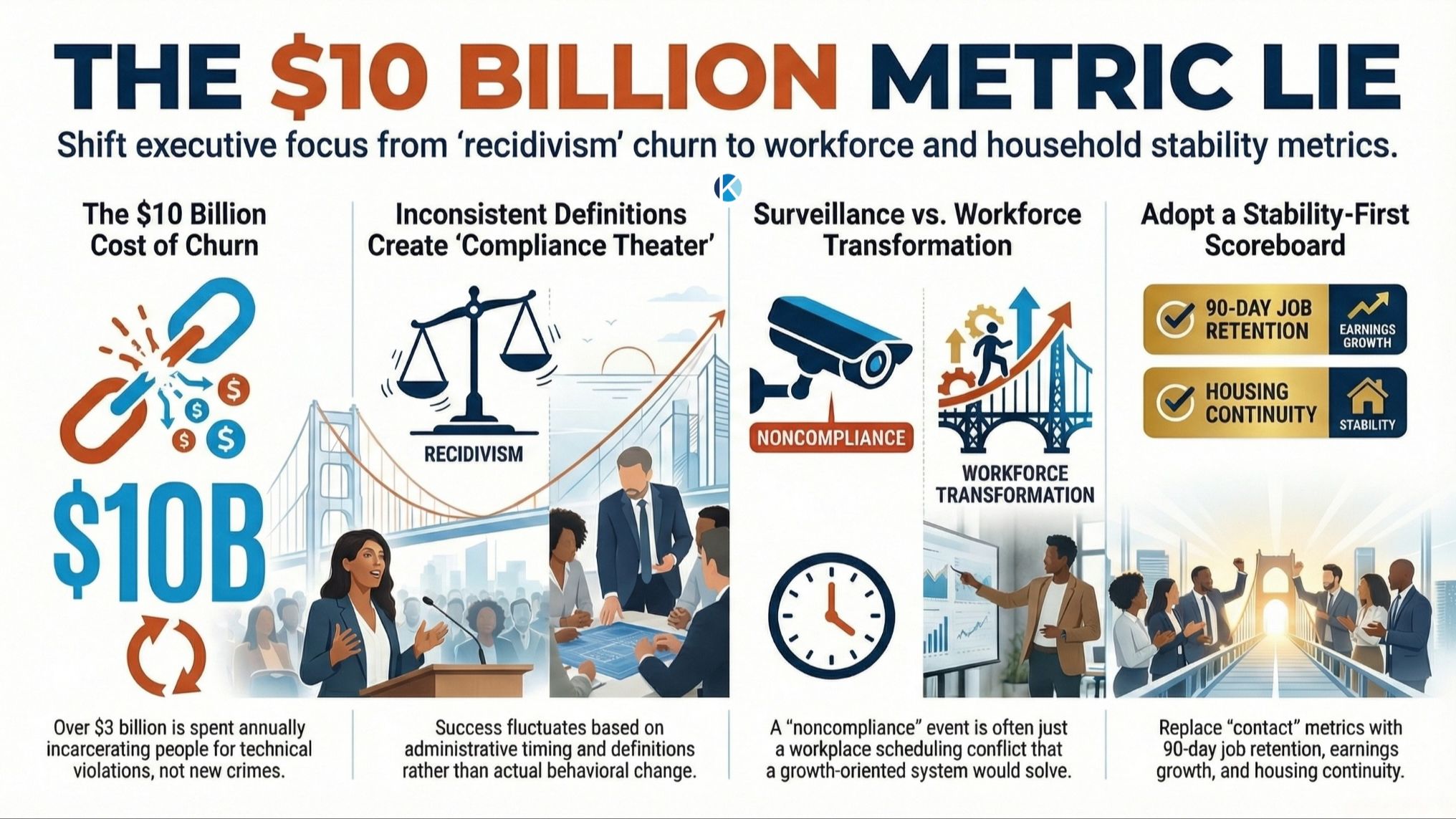
In 2023, states spent an estimated $10 billion incarcerating people for supervision violations (Council of State Governments Justice Center).
Let that number hit you.
Because it isn’t just a criminal justice problem. It’s workforce transformation. It’s economic growth. It’s social impact leadership ; grounded in lived experience as system intelligence.
We keep calling it accountability. But too often, it’s a system rewarding itself for doing more of the same.
Here’s the uncomfortable truth.
Measurement is destiny.
Change the metric. Change the outcome.
And if you’re serious about the future of work, you can’t ignore the scoreboard that’s quietly shrinking your labor force.
The metric lie
Recidivism is not a measure of rehabilitation. It is a measure of re-arrest. When the metric tracks system contact instead of household stability, every program is scored on the wrong outcome. The goalpost does not move. It was placed in the wrong field.
We built a field around one question.
Did they come back?
Simple. Clean. And dangerously incomplete.
Because “recidivism” isn’t one thing. Some systems measure it as rearrest. Others as reconviction. Others as reincarceration.
Same label. Different realities.
And when definitions change, “success” changes. Without a single thing changing about the person.
That’s the scam.
Here’s the real leadership problem.
When a board asks, “What’s your recidivism rate?” they think they’re asking for truth. But they’re often asking for a story shaped by definitions, timing, and administrative choices.
One cohort can show a wide spread across measures. Same people. Same time horizon. Different definition. Different “failure rate.”
So which number do you fund? Which number do you celebrate? Which number do you punish?
This is why recidivism reform isn’t a messaging debate.
It’s a systems redesign requirement.
Because metrics don’t just describe reality.
They create incentives.
And incentives don’t care about your mission statement. They care about what you pay for. What you punish. What you report.
If the metric is broken, the market gets broken.
And workforce transformation gets stuck in compliance theater.
The time-horizon trap
Now let’s talk about timing.
Because timing can lie.
Virginia reports a 17.6% three-year re-incarceration rate. And they also tell you something most systems hide: they wait years before finalizing it so court data can fully mature.
That matters.
Because early numbers aren’t “real-time.” They’re unfinished.
Virginia even shows the rate shifts when you calculate too early.
So no, recidivism isn’t always a clean behavioral signal. It can be a paperwork signal. A court-processing signal. A database-maturation signal.
And definitions can carry hidden traps.
A recidivism “event” can include technical violations. It can include sentences tied to offenses that occurred before release.
So even a low rate can be shaped by supervision design and legal timing, not just new harm.
Here’s why this matters for the future of work.
If your workforce dashboard is built on “recidivism,” you might be measuring how fast the system processes people… not how well the system supports stability.
That’s not a minor analytics problem.
That’s an executive decision problem.
Because the wrong time horizon creates the wrong urgency. And the wrong urgency creates the wrong interventions.
Short horizons reward short moves. More surveillance. More conditions. More technical violations.
It feels like “accountability.” But it often functions like churn.
And churn is not workforce development.
The churn engine
Now back to that $10 billion.
If you want to understand why recidivism is broken, stop staring at people. Start staring at incentives.
Community supervision accounts for a huge share of prison admissions. In 2023, nearly 200,000 people were admitted to prison for violating probation or parole, over 110,000 for technical violations.
Technical violations.
Not new convictions. Not new harm.
Missed check-ins. Failed drug tests. Curfew violations. Skipped treatment sessions.
And too often, the system treats technical violations like new criminal offenses.
Same consequence. Different severity.
That’s not public safety strategy.
That’s churn, disguised as accountability.
And the “new crime” story people tell themselves doesn’t hold up the way they think.
In practice, supervision violations for new criminal activity were a tiny slice of total arrests. The system spends massive energy on supervision churn… while the “new crime” narrative plays a far smaller role than the public assumes.
Follow the money again
That $10 billion includes over $3 billion spent incarcerating people for technical violations alone.
That is a budget choice. And it’s a workforce choice.
Because every dollar burned on churn is a dollar not invested in capacity.
Job attachment. Employer partnerships. Transportation. Credential pipelines. Family stability.
Here’s a simple picture.
A dad gets a job offer. Night shift. He misses a daytime check-in.
A system built for surveillance calls it “noncompliance.” A workforce system built for growth calls it a scheduling conflict, and solves it.
Same person. Different system design.
And if you want to see how deep technical churn goes beyond prison admissions, national jail data suggests over 100,000 people are in jail at any given time for supervision violations (BJS, 2023) without new criminal charges.
That is labor force disruption at scale. That is household disruption at scale.
And no, this isn’t a call to ignore harm.
Some supervision-violation incarcerations are necessary to respond to serious behavior and protect community safety.
This is a call to stop treating low-risk noncompliance like a new felony.
It’s a call for social impact leadership that can distinguish “risk” from “rules.”
Because the future of work can’t be built on a pipeline that keeps pulling workers out of the labor market for paperwork failures.
The 2Gen scoreboard
Here’s what the recidivism conversation misses.
People don’t return to “the community.” They return to a household.
A partner. Children. Rent payments. Schedules. A fragile support network.
If you’re building on the Durability Economy Workforce Architecture, you’re not just placing workers.
You’re stabilizing households so children can thrive and adults can sustain employment.
That’s workforce transformation. That’s workplace innovation. That’s what social impact leadership looks like when it’s serious about outcomes.
Recidivism doesn’t measure household stability. It measures contact.
And when contact is shaped by technical rules, administrative timelines, and violation policy, you’re not measuring success.
You’re measuring how tight the net is.
That’s why I keep pushing this line:
Diagnose incentives, not people. Protect dignity. Redesign systems.
So what do we measure instead?
So what do we measure instead?
We don’t need fewer numbers. We need better numbers.
Numbers you can act on in 30, 60, 90 days. Numbers that tell you what lever to pull next week.
Here’s the metric shift, in plain language.
Old question: Did they fail? New question: Are they progressing, and what did the system do to help or hurt?
Old scoreboard: one recidivism rate. New scoreboard: a small set of indicators that separate outcomes, incentives, and harm.
If you want a next-generation workforce ecosystem, measure what you manage:
Outcome integrity. Track rearrest, reconviction, and reincarceration separately, because they are not the same story.
Supervision performance. Track the share of violations resolved without incarceration. Track time from violation to response. Track technical vs new offense as separate lanes.
Public safety clarity. Separate new offense violations from technical violations.
Workforce ecosystem performance. Time from release to first workforce touchpoint. 30/90/180-day job retention. Earnings movement over time.
Household stability. Housing continuity. Child care reliability. Transportation stability.
That’s a dashboard leaders can run. Not a slogan. Operations.
And we have proof stability moves outcomes.
Record-sealing reforms show measurable improvements in employment and personal finances for a significant share of participants. Guaranteed income pilots show measurable reductions in homelessness among participants.
That’s not “soft.” That’s capacity building.
This is why recidivism reform and workforce transformation belong in the same sentence.
Because the metric you choose decides the interventions you fund. And the interventions you fund decide whether households stabilize.
Here’s how to fix it (30/90 days)
If anyone tells you that technical churn is inevitable, it's often an excuse for poor design.
And design can change.
States have significantly reduced supervision-driven admissions by implementing policy changes.
That’s not luck. That’s governance.
So here’s the playbook. Built for funders, policymakers, and operators.
In the next 30 days:
- Name your metric out loud. If you say “recidivism,” state which measure, what window, and what triggers the event.
- Split technical from new offense. If your dashboard blends technical violations with new criminal behavior, you’re guaranteeing the wrong incentive.
- Audit your last 100 returns. Categorize new offense vs technical, and low-risk noncompliance vs serious violations.
- Put churn on the board agenda. Bring the $10 billion reality into the room. Make it a workforce conversation.
In the next 90 days:
- Redesign your violation response grid. Move from one-size punishment to graduated response, aligned to seriousness and risk.
- Rewrite the incentives in your contracts. Stop paying for contact. Start paying for stability.
- Publish a workforce ecosystem dashboard. Track what leaders can act on in real time;and what stabilizes households.
- Adopt time-horizon discipline. Stop using premature recidivism numbers as real-time management.
Here’s the question we can't ignore:
What are we funding: placement, or progress?
What does your organization score on this?
Take the free Durability Index Self-Assessment. Twenty questions. Five domains. One score.
Until next time, keep building what they said couldn't be built.
Khalil Osiris
Author and Founder, Khalil Osiris Consulting | Market Architect, The Durability Economy Workforce Architecture
The Durability Economy. Workforce redesign, fair chance hiring, and household stability. For leaders who measure what lasts.
Change the metrics. Change the outcomes.
Subscribe to The Durability Economy
Get the weekly briefing on workforce transformation, criminal justice reform, and the 2Gen Economy, delivered straight to your inbox. Evidence over ideology. Households over headcounts.
We hate SPAM. We will never sell your information, for any reason.