You Placed 200 Workers Last Year. The Households Are Still Sinking.
Jun 30, 2026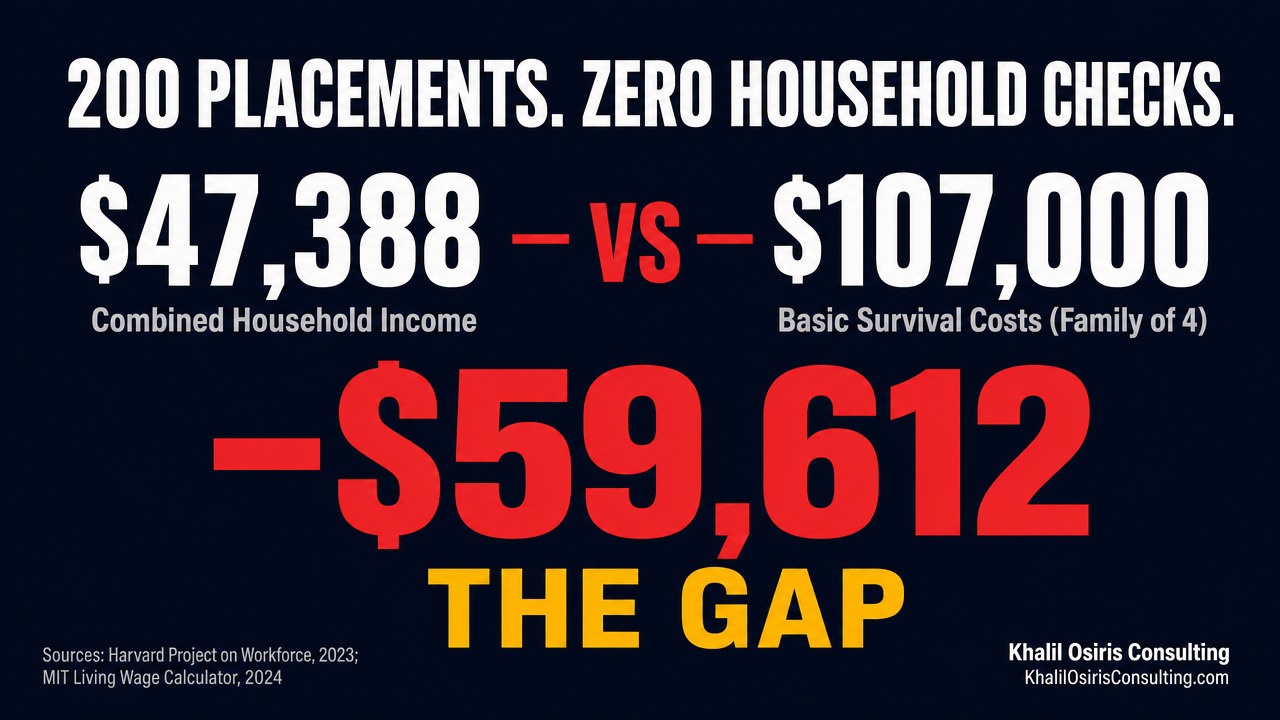
Your workforce program placed 200 people last year and never checked whether a single household survived the offer.
Here is the question nobody on your board asked: how many of those 200 workers earned enough to keep a roof over their family, child care covered, and food on the table at the same time?
Not sequentially. Simultaneously.
The answer was not in your report. The placement was the finish line. The household was never part of the equation.
And your annual report called it a success.
The Math Your Program Never Runs
The median WIOA training program places participants into jobs paying $14.13 an hour. That is $29,388 per year. According to Harvard's Project on Workforce, which analyzed more than 75,000 federally funded training programs, over 40% of WIOA participants earn less than $25,000 annually (Harvard Kennedy School, 2023).
Now run it against what a household actually needs.
SmartAsset's analysis of MIT Living Wage Calculator data, reported by CNBC in 2024, puts the basic-necessities threshold for a family of four at $107,000 per year. Not savings. Not vacations. Not emergencies. Just housing, child care, transportation, health care, and food.
Here is the subtraction stack:
- Median WIOA Eligible Training Provider program earnings: $29,388 (annualized)
- Partner income (national median part-time): $18,000
- Combined household income: $47,388
- Basic necessities for a family of four: $107,000
- The gap: -$59,612
Your program counted the placement. The household is $59,612 short of surviving.
And this is the conservative estimate. In Massachusetts, the threshold is $150,578. On Long Island, it is $137,418. The national floor of $107,000 is the most generous reading of the data. Your program did not clear it.
The Thompson Household: Month by Month
Lamar Thompson completed a 12-week logistics training program in March. His workforce provider celebrated the placement: $15.50 an hour at a regional distribution center. Full-time. Benefits eligible after 90 days.
Here is what the program never modeled.
Month 1. Lamar's gross monthly income is $2,687. Rent is $1,450. Keisha works part-time at $12.50 an hour, bringing in $1,083. Combined: $3,770 before taxes. After rent, they have $2,320 for everything else a family of four needs to function.
Month 2. Child care for Jaylen and Nia costs $1,100 per month. Transportation to two jobs across town: $485. They are now at $735 for food, utilities, health care co-pays, and the rest of life.
Month 3. Jaylen needs shoes for school. Nia has a dental visit not covered under Medicaid. The $735 is gone by the 18th. Keisha picks up a weekend shift, but the child care math no longer works when both parents work weekends. Sixty-one percent of parents with children have no formal child care arrangement (U.S. Census Bureau, 2022). The Thompsons just joined that statistic.
Month 4. Lamar's car needs a $400 repair. There is no emergency fund because the household has been running a deficit since day one. He misses two shifts. The distribution center issues a final warning.
Month 5. Lamar is terminated. The workforce program records this as a successful 90-day retention. The dashboard is green. The Thompson household is in crisis.
No one ran the household math before the placement. No one modeled whether $15.50 an hour could sustain a family of four in their zip code. The program measured the hire. It missed the household.
This Is Not One Family. This Is the Architecture.
The Thompson story is not an outlier. It is the median outcome of a system that measures placements without modeling households.
- 41.3% of all U.S. households fall below the ALICE Threshold of Financial Survival (United Way, 2024).
- Formerly incarcerated workers earn just 53% of the median U.S. worker's wage, and that suppression persists for years after release (Prison Policy Initiative, 2022).
- In North Carolina, individuals who found employment after leaving prison in 2021 earned a median of just $7,300 per year (NC Department of Commerce, 2021).
- The median WIOA training participant earns less than a worker without a high school diploma, who averages $31,512 (Harvard Project on Workforce, 2023).
Every one of these data points intersects at the same place: the household. And every workforce program in the country reports placement rates without touching it.
Three Shifts That Close the Gap
From placement metrics to household math
Run the household income model before the placement. Take the target wage, multiply by 2,080 hours, and subtract local housing, child care, and transportation costs using county-level data. If the subtraction stack comes back negative, the placement is not a success. It is a setup.
MIT Living Wage Calculator: livingwage.mit.edu
United Way ALICE Threshold data: unitedforalice.org
Set a Household Stability Target alongside the placement target. Define success as combined household income reaching 80% of the local ALICE Threshold within 18 months. Track it quarterly. Report it to your board.
ALICE Income Thresholds by state: unitedforalice.org/state-overview
EPI Family Budget Calculator: epi.org/resources/budget
Integrate 2Gen support architecture into the placement pipeline. Child care access, transportation subsidies, and benefit cliff navigation are not program add-ons. They are the infrastructure that determines whether the placement survives past 90 days.
Durability Index Self-Assessment: khalilosirisconsulting.com/durability-index
Child Care Aware locator: childcareaware.org
Run the subtraction stack this week. Set your Household Stability Target within 30 days. Score the Durability Index before your next placement.
Who Owns This
- Workforce boards: Run the subtraction stack on every program in your portfolio before the next reauthorization cycle.
- Employers: Ask your workforce partners what household income threshold their placements are designed to reach.
- Program directors: Model the household before you celebrate the hire using the MIT Calculator, which takes ten minutes.
The Decision
Your program placed 200 workers last year at a median of $29,388. Every one of those placements left a family of four $59,612 short of basic needs.
The tools exist. The MIT Calculator is free. The ALICE data is public. The Harvard data names the median. The math takes ten minutes.
If the subtraction stack comes back negative and you report the placement anyway, you are not documenting a success. You are documenting a household emergency with a start date.
What does your organization score on this?
Take the free Durability Index Self-Assessment. Twenty questions. Five domains. One score.
Until next time, keep building what they said couldn't be built.
Khalil Osiris
Author and Founder, Khalil Osiris Consulting | Market Architect, The Durability Economy Workforce Architecture
The Durability Economy. Workforce redesign, fair-chance hiring, and household stability. For leaders who measure what lasts.
Change the metrics. Change the outcomes.
Subscribe to The Durability Economy
Get the weekly briefing on workforce transformation, criminal justice reform, and the 2Gen Economy, delivered straight to your inbox. Evidence over ideology. Households over headcounts.
We hate SPAM. We will never sell your information, for any reason.