You have diagnosed the retention problem for years. One factory already built the fix.
Jul 07, 2026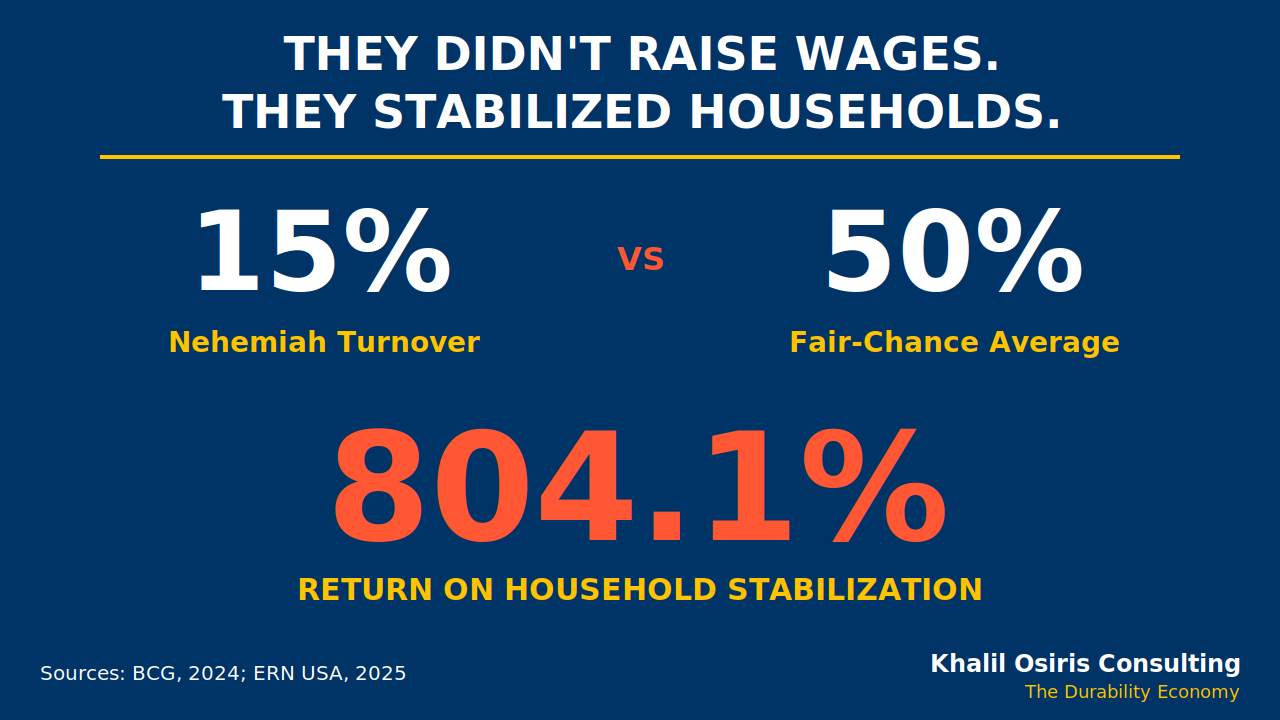
Every workforce leader in America can recite the diagnosis by now.
Placements collapse. Retention leaks. The metrics count the wrong thing.
You have read it a dozen ways. You have read it from me.
Here is what almost no one puts in front of you. An employer who stopped diagnosing the problem and built the fix.
Not a pilot. Not a theory. A factory, with numbers.
The factory that stopped losing people
Nehemiah Manufacturing in Cincinnati staffs most of its floor with people who have criminal records. That alone is not the story. Plenty of employers run fair-chance programs and still watch people walk out the back door within months.
What Nehemiah did differently is where the story lives. Early on, their fair-chance hires kept quitting, even the ones performing well.
So the company did the thing most employers never do. It went looking for why.
The answer was never the worker. It was the household around the worker.
Unstable housing. No child care. A transportation gap or a probation appointment that collided with a shift.
None of it showed up in a performance review. All of it ended employment anyway.
So Nehemiah hired social workers and built the support to stabilize those barriers directly. They put wraparound family supports inside the job itself.
The result is the number the whole field keeps calling impossible. Turnover fell to 15%, in an industry where fair-chance competitors routinely run above 50% (Boston Consulting Group, 2024).
Same workers. Same records. A different design around them.
Why it worked
Nehemiah did not out-motivate its people. It out-designed the barriers that were pushing them out.
A worker rarely quits for lack of grit. They quit because the car died, the child care fell through, the housing wobbled, and the job had no way to absorb any of it.
You cannot coach someone out of a transportation gap. You cannot incentivize away a housing crisis. Those are design problems, and they take a design response.
Picture it on an ordinary Tuesday. A worker's child care falls through.
At most employers, that becomes three missed shifts, a write-up, and a termination the system quietly files under "attendance." At Nehemiah, it becomes a social worker on the phone, a backup arrangement, and a worker still on the line Thursday.
Same event. Opposite outcome. The only difference is whether the design was built to catch it.
Stabilize the household, and the retention problem you have been diagnosing for years simply stops producing turnover. The person was never the variable. The design was.
That is the whole move. Not a better applicant, but a better architecture around the applicant you already hired.
What they actually stabilized
Look closely at what those social workers were doing, and you will see a scorecard.
They were tracking housing stability, financial resilience, and the justice-system friction of a probation calendar that collides with a work schedule. They were protecting employment retention by catching the disruption before it became an absence.
That is not a soft-services line item. It is the Durability Index, run in real time by a manufacturer who never called it that.
Nehemiah did not measure whether someone got hired. It measured whether the household held. That is the entire shift, and it is the one your current dashboard is built to miss.
The return is not soft
This is where the CFO leans in. Stabilizing the household is not charity with a good story stapled to it. It is one of the highest-return moves an employer can make.
Watch the loop Nehemiah built. It funded the social workers straight out of the turnover savings they produced, so the fix pays for the fix.
The company estimates the low turnover saves it between $315,000 and $525,000 a year in onboarding costs alone, with average tenure around seven years against a sector norm closer to five (Fortune, 2024).
And the pattern holds well beyond one factory. Employer Resource Networks, the model that funds on-site coaches to keep workers stable through exactly these disruptions, report an average employer return of 804.1% across 167 employers and 5,394 employees served (ERN USA, 2025).
Read that again. For every dollar spent stabilizing the household around the worker, employers get more than eight back.
This is not a manufacturing quirk. The ERN return spans employers across sectors, which means the mechanism travels. Stabilize the household, keep the worker, book the return, whether the floor is a factory, a warehouse, a hospital, or a call center.
Why the field stays stuck
So why does most of the field keep diagnosing instead of building?
Because diagnosis is safe and construction is accountable. Naming the problem costs nothing and commits you to nothing.
Building the fix means owning a budget line, a metric, and a result someone can check. Nehemiah accepted that exposure. It put money against the barriers, tracked what happened, and let the number speak.
That is the difference between a field that studies a problem and an employer that ends one.
The diagnosis is over
Here is the uncomfortable part. The architecture is not unproven. It is not waiting on another study.
It is running right now, in a Cincinnati factory, at a return most of your capital projects would envy.
Which means the question has changed. It is no longer whether stabilizing the household works. It is why you have read the diagnosis a hundred times and built the fix zero.
Who owns this
If you are an employer, stop benchmarking your turnover against other companies that are also failing. Benchmark it against Nehemiah, and ask what your people are quitting to deal with that your job refuses to touch.
If you are a funder, stop funding another study of the problem. Fund the coaches, the navigation, the wraparound family supports the return data already validates. The evidence phase is finished.
If you run a workforce program, put household stabilization inside the job, not in a referral you hand out at orientation. A referral is a hope. A coach is a design.
Where you start
You do not need Nehemiah's scale to begin. You need one honest audit.
Pull your last twelve months of separations and read the real reasons, not the exit-interview codes. Count how many trace to a household event the job had no way to absorb: a car, a caregiver, a court date, a rent spike.
That number is your retention leak, and it is almost certainly larger than your hiring problem. Fix the leak first. It is cheaper than the funnel, and the return data says it pays.
The only variable left
The proof you have been waiting for already exists. A factory built it.
That return confirms it. The only variable left is whether you copy it.
That copy is the entire architecture of my next book. Lived Experience Is System Intelligence releases July 14, and it hands you the blueprint the diagnoses never did.
More next week.
Until then, stop benchmarking against the field. Benchmark against the fix. The distance between the two is the retention you keep paying for and calling inevitable.
Take the free Durability Index Self-Assessment. Twenty questions. Five domains. One score.
Until next time, keep building what they said couldn't be built.
Khalil Osiris
Author and Founder, Khalil Osiris Consulting | Market Architect, The Durability Economy Workforce Architecture
The Durability Economy. Workforce redesign, fair-chance hiring, and household stability. For leaders who measure what lasts.
Change the metrics. Change the outcomes.
Subscribe to The Durability Economy
Get the weekly briefing on workforce transformation, criminal justice reform, and the 2Gen Economy, delivered straight to your inbox. Evidence over ideology. Households over headcounts.
We hate SPAM. We will never sell your information, for any reason.