You Gave Your Employee a Raise. It Made Her Poorer.
Jun 23, 2026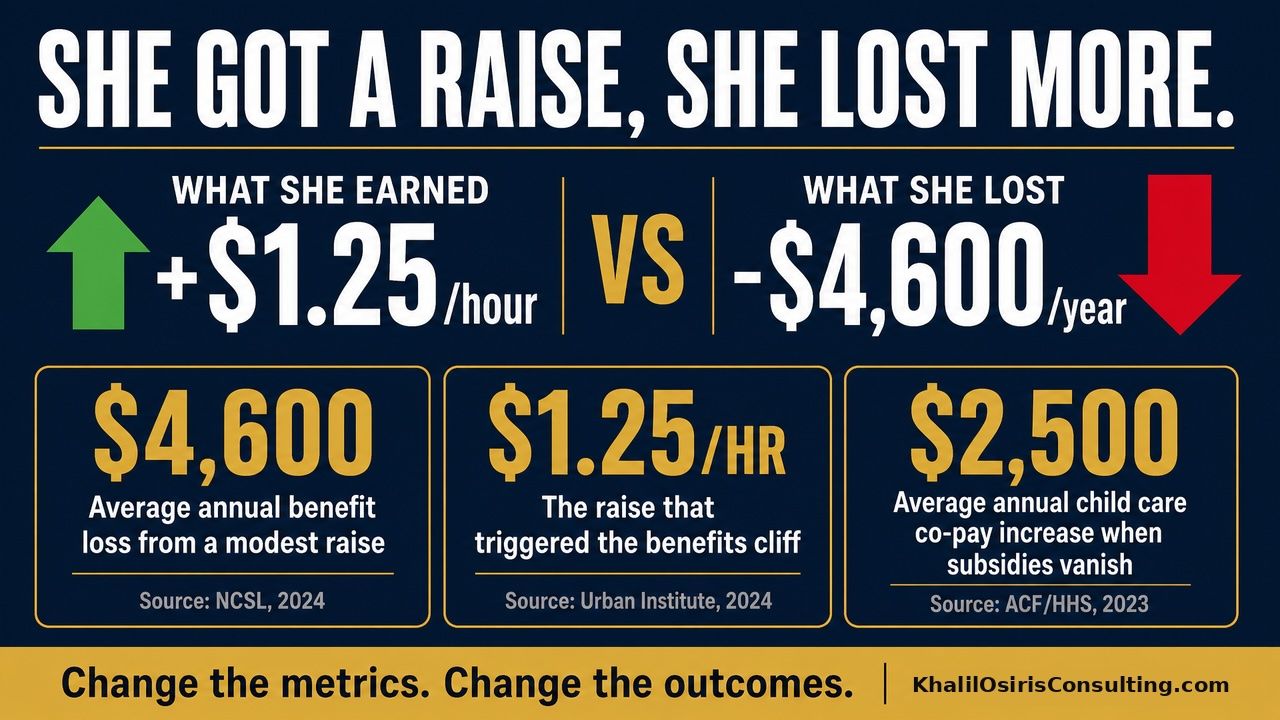
Keisha Thompson got a raise last month. One dollar more per hour. Her supervisor signed the paperwork. HR sent the congratulations email. Payroll updated the system.
Nobody modeled what happened next.
That $1/hour raise, $2,080 per year before taxes, pushed her household income from $33,000 to $34,000.
In Ohio, that $1,000 increase triggered the loss of more than $4,600 in public benefits (Sen. Jon Husted, Upward Mobility Act, 2026).
The raise your HR team celebrated just cost her household more than $2,500.
This is not a policy abstraction. This is happening in your organization right now. And most HR systems are not designed to see it.
The Number Nobody Models
This is the benefit cliff. A small increase in earned income triggers a sharp reduction, or total loss, of public assistance.
The cliff does not taper. It drops.
And the math is worse than most employers realize.
A mother of two receives a $0.10/hour raise. That $200 annual increase caused her to lose $9,000 per year in child care subsidies (Federal Reserve Communities, cited in NCRC, 2025).
A mother of four earns an additional $1/hour. That extra $160 per month makes her ineligible for SNAP, and she loses $800 per month in food assistance (Federal Reserve Communities, cited in NCRC, 2025).
In Ohio, a single dollar over the SNAP eligibility threshold results in a reduction of over $8,000 in benefits for a family of three. No phase-out. No transition period. One dollar (NCRC, Atlanta Federal Reserve Policy Rules Database, FY2024).
Your payroll system processed a raise. The benefits system processed a penalty.
These are not exceptions to the system. This is how the system works.
The benefit cliff is not a glitch. It is a structural feature of every major federal assistance program: SNAP, Medicaid, child care subsidies, housing vouchers, and TANF.
Each program has its own eligibility threshold. Each threshold has its own cliff. And most of them are not coordinated with each other.
That is not Keisha's problem to solve. It is yours to understand.
This Is Not an Edge Case
Forty million low-wage workers in the United States receive public benefits (Washington University Center for Social Development, 2025).
One in five has experienced the benefit cliff directly. That means 1.3 million young adult workers are being affected at any given time (Washington University CSD, 2025).
In Utah, 43% of benefit recipients reported intentionally limiting their earnings to avoid triggering a cliff (Sutherland Institute, cited in APHSA Benefits Cliffs Resource Hub, 2025).
Nearly half of workers on benefits are turning down raises, refusing extra hours, and declining promotions. Not because they lack ambition. Because the math punishes it.
Think about what that means operationally.
You have workers on your floor who are making rational decisions to stay poor, because accepting a raise, a promotion, or additional hours would make their household worse off.
Your retention strategy does not account for this. Your performance management system does not account for this. Your compensation philosophy does not account for this.
Forty-two percent of working single parents earn less than $17 per hour (Oxfam, 2024).
Single-parent households spend an average of 24% of their income on center-based child care, more than triple the 7% federal affordability benchmark set by the U.S. Department of Health and Human Services (Child Care Aware of America, cited in NCRC, 2025).
These are not edge cases. They are your workforce.
The Cascade You Already Paid For
If you read Issue #3, you saw the child care math. Keisha's household needed $28,344 per year for two children in center-based care (Care.com, 2026).
Her take-home covered $27,200. The deficit was $1,144 per year.
The child care subsidy closed that gap. It kept her working. It kept her household stable. It kept her on your payroll.
Now she got a raise. And the subsidy disappeared.
This is the part that connects to Issue #4. When Keisha cannot solve the child care equation, she does what the data says more than 1 in 4 parents do (Center for American Progress, 2023).
She leaves the job.
Her replacement costs your organization approximately $5,475, 33% of her annual base salary, consistent with Work Institute's 2025 Retention Report methodology.
Her institutional knowledge walks out the door. Her team absorbs the disruption. Her manager spends the next six to eight weeks recruiting, screening, and onboarding someone new.
And here is what does not show up on any report: her replacement will likely need the same public benefits Keisha needed.
They will face the same cliff. And if your organization gives them a raise without modeling the household impact, the cycle repeats.
You did the right thing. The system turned it into a loss for everyone.
What Employers Can Design
The benefit cliff is a design flaw, not a behavior problem. And design flaws have design solutions.
You do not need to wait for Congress.
Three interventions are available right now.
1. Model before you promote.
Before announcing a raise, model the total household impact. The Atlanta Federal Reserve's CLIFF Tools: Career Ladder Identifier and Financial Forecaster are free and available to any employer.
They show exactly where the cliffs fall for each employee's household composition and geography. Enter the worker's household size, current income, and benefit profile. The tool maps the cliff.
If your HR team is not running these models, your raises are guesses. Well-intentioned guesses, but guesses.
2. Bridge the gap.
Employer Resource Networks are collaborative, employer-funded programs that provide on-site success coaches to help workers navigate benefit transitions, connect to alternative supports, and maintain household stability during wage increases.
The coach is not a counselor. They are a navigator, someone who knows the benefit system, knows the local resources, and knows how to sequence a transition so that a raise does not become a crisis.
Across 26 networks, 167 employers, and 56,542 employees, they have demonstrated an average ROI of 804% (ERN USA 2025 KPI Report).
The investment is modest. The return is not.
3. Time the raise to the recertification window.
Most benefit programs have annual recertification periods. A raise timed to align with that window gives the household time to prepare, apply for transitional benefits, and adjust their budget. A raise that arrives two weeks before recertification triggers an immediate cliff with no runway.
This requires knowing your workers' benefit profiles, which means building the kind of trust that allows that conversation to happen.
That is a culture question as much as a policy question. But the mechanics are simple.
Timing is not generosity. It is precision.
The Durability Lens
The Durability Economy measures what lasts.
A raise that destabilizes the household does not last. A promotion that triggers a child care crisis does not produce employment stability.
A retention strategy that ignores the benefit cliff is not a strategy. It is a payroll event.
Domain 1, Employment Retention: The raise looked like progress. The cliff made it a departure risk.
Domain 4, Financial Resilience: The child care subsidy was the bridge. The raise removed it.
When you measure durability, you measure the whole household. Not just the line item.
The Upward Mobility Act, introduced by Sen. Jon Husted and now advancing through the 119th Congress, would give states flexibility to combine federal anti-poverty programs and eliminate the cliff that punishes work.
Twelve states have already begun piloting benefit cliff mitigation strategies through the APHSA Benefits Cliffs Resource Hub (APHSA, 2025). The policy infrastructure is forming.
The question is whether your organization will wait for legislation or start designing now. Because the workers currently limiting their own earnings to avoid the cliff are making a rational decision inside a broken system.
Your job is not to judge that decision. Your job is to build a system where they do not have to make it.
Forty-two percent of voluntary turnover is preventable (Gallup, 2025). The benefit cliff is one of the reasons it is not being prevented.
Who Owns This
Compensation teams: Model the full benefit impact before approving a raise. A $0.10 increase that triggers a $9,000 subsidy loss is not a raise. It is a destabilization event.
HR leaders: Build benefit cliff awareness into onboarding and manager training. If your team cannot name the income thresholds where subsidies disappear, they cannot design around them.
Hiring managers: Stop celebrating retention metrics that ignore household math. A worker who stays but cannot afford child care is already halfway out the door.
You gave her a raise. Run the rest of the math.
What does your organization score on this?
Take the free Durability Index Self-Assessment. Twenty questions. Five domains. One score.
Until next time, keep building what they said couldn't be built.
Khalil Osiris
Author and Founder, Khalil Osiris Consulting | Market Architect, The Durability Economy Workforce Architecture
The Durability Economy. Workforce redesign, fair-chance hiring, and household stability. For leaders who measure what lasts.
Change the metrics. Change the outcomes.
Subscribe to The Durability Economy
Get the weekly briefing on workforce transformation, criminal justice reform, and the 2Gen Economy, delivered straight to your inbox. Evidence over ideology. Households over headcounts.
We hate SPAM. We will never sell your information, for any reason.