The 90-Day Illusion
Jun 15, 2026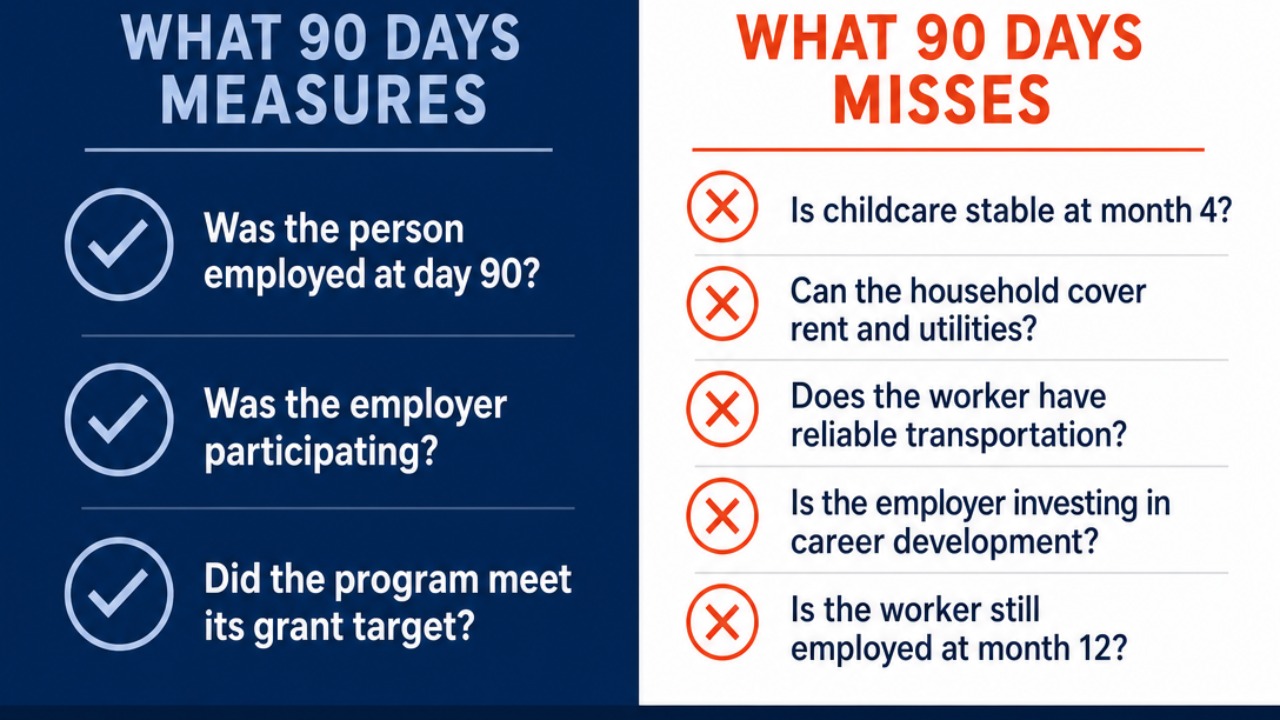
Your retention metric is hiding a collapse.
Every workforce board in the country has a 90-day retention number.
It sits in grant reports. It shows up in board presentations. It gets celebrated in press releases.
Here is what it actually measures: the minimum amount of time someone has to stay employed before a funder considers the placement "successful."
Not whether the worker is stable. Not whether the household is solvent. Not whether the job will last past month four.
Ninety days measures compliance. It does not measure durability.
The Evidence
The data is not ambiguous.
According to BambooHR research, approximately 1 in 3 employees (31%) leave their job within the first six months. Of those who leave early, approximately 68% exit within the first three months.
Read that again.
The majority of early attrition happens inside the window that programs are celebrating as a success.
Now look at what happens after the 90-day checkpoint:
- Average replacement cost: A single nonexecutive employee costs $5,475 to replace (SHRM, 2025 Benchmarking Report). For mid-career roles, total replacement costs can reach 150% of annual salary (Gallup).
- Why workers leave: McKinsey's Great Attrition research found that 41% of employees who quit cited lack of career development as the primary reason : not salary, not scheduling, and not a single factor that 90-day metrics are designed to capture.
The federal system itself has already moved past the 90-day marker.
Under the Workforce Innovation and Opportunity Act (WIOA), the primary employment indicators measure retention at the second quarter (6 months) and fourth quarter (12 months) after exit (U.S. Department of Labor, Employment and Training Administration).
WIOA does not have a 90-day indicator because the architects of the law understood that 90 days tells you almost nothing about long-term employment stability.
National WIOA data confirms the pattern. For Adult program participants, the employment rate at Q2 after exit is 72.2%, and at Q4 it holds at 72.3% (PY 2024 WIOA National Performance Summary, U.S. Department of Labor).
Yet most state-level workforce programs, grant-funded reentry initiatives, and local workforce boards still report 90-day retention as their primary success metric.
The federal standard moved forward. The field stayed behind.
The Reframe
Here is what 90-day retention actually incentivizes:
Place fast. Report the number. Move on.
It rewards speed of placement over quality of match. It rewards employer participation over household stability. It counts a body in a chair without asking whether the chair is sustainable.
Consider Lamar Thompson. Lamar completes a workforce readiness program. He is placed in a warehouse role at $17 per hour. At day 90, his program reports him as a success.
By day 120, Lamar's child care arrangement falls apart. His mother, who had been watching his son Jaylen, takes a job of her own. Without reliable child care, Lamar starts missing shifts. By month five, he is let go.
The program already counted him. The funder already celebrated the number. Nobody tracked what happened to his household.
This is not a workforce failure. It is a measurement failure. The metric was designed to measure program output, not worker durability. And the incentive structure follows the metric: if the measurement stops at 90 days, so does the support.
The Fix: A 12-Month Household Stability Tracker
The fix is not complicated. It requires three shifts.
- Extend the measurement window to 12 months.
Align with WIOA's fourth-quarter-after-exit standard. If the federal government recognizes that 90 days is insufficient, your program should too.
- Add household indicators alongside employment status.
At minimum, track four factors at 30, 90, 180, and 365 days:
- Housing stability: Same address or planned move vs. eviction or displacement
- Child care access: Reliable arrangement vs. informal or no arrangement
- Transportation reliability: Owned vehicle, public transit pass, or employer-provided vs. dependent on others
- Financial stress indicator: Self-reported, single question: "In the past 30 days, how often did you worry about covering basic expenses?"
- Report retention AND durability together.
Create a dual metric: a 12-month employment retention rate paired with a household stability score. Present them side by side in every grant report.
A program with 90% employment retention and a 40% household stability score is not succeeding. It is delaying failure.
Who owns this:
- Workforce board directors: Adopt the dual metric as a standard reporting requirement for all funded programs.
- Program operators: Build the household check-in into case management at 30, 90, 180, and 365 days.
- Funders: Stop funding programs that only report 90-day retention. Require 12-month outcomes with household indicators.
Timeline: Begin collecting household indicators this quarter. Report the first dual-metric dataset within 12 months.
The Decision
Pull your program's 90-day retention data from last year. Now pull the 12-month employment data for the same cohort. If you cannot produce the second number, you do not have a retention program. You have a placement counter.
That silence is not an oversight. It is a design choice. The system was built to stop measuring at the exact point where the hard problems begin: child care collapses, housing destabilizes, financial stress compounds, employer culture mismatches surface. The metric does not fail to capture these things. It was never designed to.
You do not need to track five domains across 36 months tomorrow. But you do need to start somewhere past day 90. The Durability Index exists for programs ready to measure what lasts. Your next move is deciding whether your program is one of them.
What does your organization score on this?
Take the free Durability Index Self-Assessment. Twenty questions. Five domains. One score.
Until next time, keep building what they said couldn't be built.
Khalil Osiris
Author and Founder, Khalil Osiris Consulting | Market Architect, The Durability Economy Workforce Architecture
The Durability Economy. Workforce redesign, fair-chance hiring, and household stability. For leaders who measure what lasts.
Change the metrics. Change the outcomes.
Subscribe to The Durability Economy
Get the weekly briefing on workforce transformation, criminal justice reform, and the 2Gen Economy, delivered straight to your inbox. Evidence over ideology. Households over headcounts.
We hate SPAM. We will never sell your information, for any reason.