Retention Is Infrastructure. Most Employers Still Budget It as Charity.
Jul 14, 2026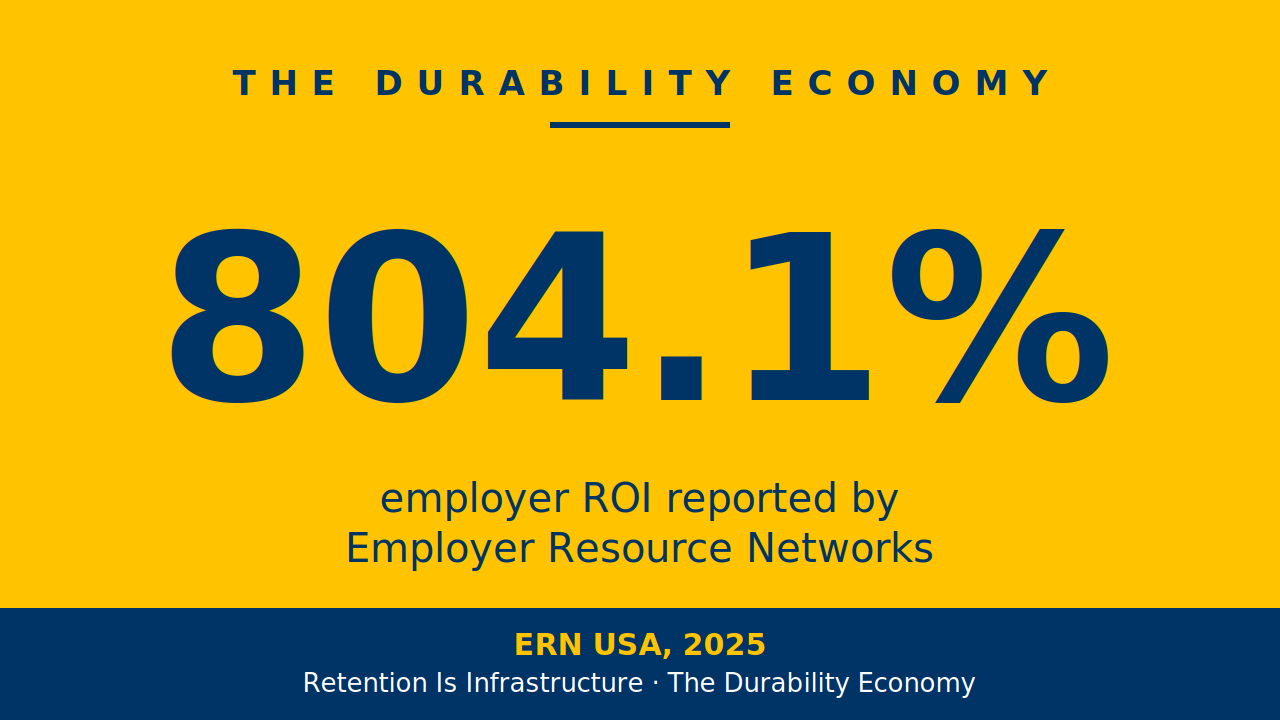
The most expensive line item in most workforce budgets does not have a name.
It hides inside other names. Recruiting. Onboarding. Overtime. Temp coverage. Training hours for people who leave before the training pays back.
Added up, those names describe one thing: the cost of losing workers you already had.
Most employers treat that cost as weather. It happens, you absorb it, you hire again. But a growing group of employers treat it as an engineering problem instead.
They have a structure for it, the structure has a track record, and in ERN USA's 2025 national figures, the model reported an 804.1% return on investment.
The structure is called an Employer Resource Network. This is how it works, why it works, and what it would take to bring one to your region.
What an ERN actually is
An Employer Resource Network is a shared-cost arrangement with one job at its center.
A group of employers, often mid-sized companies that could not justify the expense alone, pool resources to fund a success coach.
The coach works inside their workplaces. Not a benefits hotline. Not a portal. A person, on site, on payroll through the network, whose entire role is catching worker instability before it becomes a resignation.
What does the coach actually handle? The problems that never appear in an exit interview but drive the exits anyway.
A car that will not start and a shift that begins before the buses run. A child care arrangement that collapses at 6 a.m. A utility shutoff notice. A benefits cliff that makes a small raise into a net loss for the household.
Each of those is small enough to solve on Monday and large enough to end a job by Friday.
The coach solves them on Monday.
Why it works: the unit is the household
Here is the design insight that separates the ERN model from a wellness perk.
Turnover looks like an individual event. One worker, one resignation, one file closed. So employers respond with individual tools: engagement surveys, recognition programs, another pizza Friday.
But workers do not quit in isolation.
The sequence almost always runs the other way: the household destabilizes first, and the job loss follows. Transportation, child care, housing, health, a partner's lost shift.
The job is often the last thing to fall, not the first.
Which means the individual was never the right unit of intervention. The household was.
The ERN coach works directly with the entire household system. Same worker. Same job. Same wages. Different unit.
That single design change is what the return figure reflects.
This is also why the model matters so much for fair-chance employment. Employers who hire people rebuilding their lives often watch those hires end for reasons that had nothing to do with performance: the household carried more load than one paycheck could hold.
The coach is the difference between a fair-chance hire that lasts and one that becomes a cautionary tale in the next hiring meeting.
The old model treats retention as luck. The ERN model treats retention as infrastructure.
And infrastructure is the right word. No employer expects the loading dock to maintain itself. Yet most expect workforce stability to persist with zero structural investment, then book the collapse as an unavoidable cost of doing business.
The ERN model simply extends normal infrastructure logic to the workforce: fund the maintenance, prevent the failure, collect the return.
What the number means, and what it does not
Precision matters here, so let me be exact about the figure.
The 804.1% return on investment is ERN USA's reported national figure for 2025. It is organization-reported program data: the network's own accounting of costs against savings from reduced turnover and retained productivity across participating employers.
It is not a randomized controlled trial, and I will not dress it up as one.
What it is: a hard number, from a named source, current within the year, describing a model that has operated across multiple states for years. In a field that runs on vague claims and vintage statistics, that combination is rarer than it should be.
And the direction of the number matches what any employer can verify from their own books. Price your last five preventable exits honestly. Recruiting costs. Job postings. Interview hours. Onboarding.
The productivity gap while the seat sits empty, and the overtime paid to cover it. Now compare that figure to the shared cost of one coach spread across a network of employers.
You do not need anyone's national statistic to see which number is larger. The national statistic just tells you how much larger it tends to be.
What to do with this
If you are an employer: run the exercise above this week. Five preventable exits, fully costed, next to the price of an ERN seat. Then contact ERN USA and ask whether a network already operates in your region.
Joining an existing network is faster than building one, and the model is designed for exactly the mid-sized employer who cannot fund a coach alone.
If you run a workforce board: you hold the position no single employer holds. Networks form when someone convenes them, and boards that broker the first three or four employer commitments have stood up ERNs where none existed.
That is a concrete, fundable initiative with a current national return figure attached, and it moves your board from placing workers into jobs to keeping households under workers stable. Those are different missions. The second one is the one that lasts.
If you fund workforce systems: look hard at what this model implies about your portfolio. Stabilization is usually funded as an afterthought, a supportive-services line trailing the training budget. The ERN figure suggests the priority is backwards.
The coach is not a soft add-on to the real investment. On the reported numbers, the coach may be the highest-performing component in the entire stack. Fund the coach, not just the training.
If you are the worker these systems talk about: notice what this model admits. The instability that threatens your job was never a personal failing. It is a structural gap that an entire network of employers found worth paying to close, because closing it returns more than it costs.
Your stability has measurable economic value. You have always known that. Now the employers' own accounting says it too.
The bigger architecture
One honest limitation: an ERN is one room, not the whole house.
The coach can stabilize a household through a crisis. The coach cannot, alone, close the structural gap between what typical placement wages pay and what durable household stability costs.
That gap is real, it is measurable, and it is the subject of a much larger redesign of how justice, workforce, and family systems measure success.
That redesign is the work of my new book, Lived Experience Is System Intelligence: A New Architecture for Redesigning Justice, Workforce, and Family Systems (Book Two of the Reinvention Trilogy).
I am launching it properly next week, and next Tuesday this blog and my newsletter will walk through the full architecture.
The reason for the deliberate pace is the same standard this post just applied to the ERN figure: proven beats promised, and verification comes before celebration.
For today, the practical takeaway stands on its own. Somewhere in your budget is an expensive line item with no name. The ERN model names it, prices it, and shows a documented return on fixing it.
The strategy is proven. The number is current. The only missing piece is the decision.
Until next time, keep building what they said couldn't be built.
Khalil Osiris
Author and Founder, Khalil Osiris Consulting | Market Architect, The Durability Economy Workforce Architecture
The Durability Economy. Workforce redesign, fair-chance hiring, and household stability. For leaders who measure what lasts.
Change the metrics. Change the outcomes.
Subscribe to The Durability Economy
Get the weekly briefing on workforce transformation, criminal justice reform, and the 2Gen Economy, delivered straight to your inbox. Evidence over ideology. Households over headcounts.
We hate SPAM. We will never sell your information, for any reason.