From Fair Chance to 2Gen Durability: The New ROI of Retention
Apr 28, 2026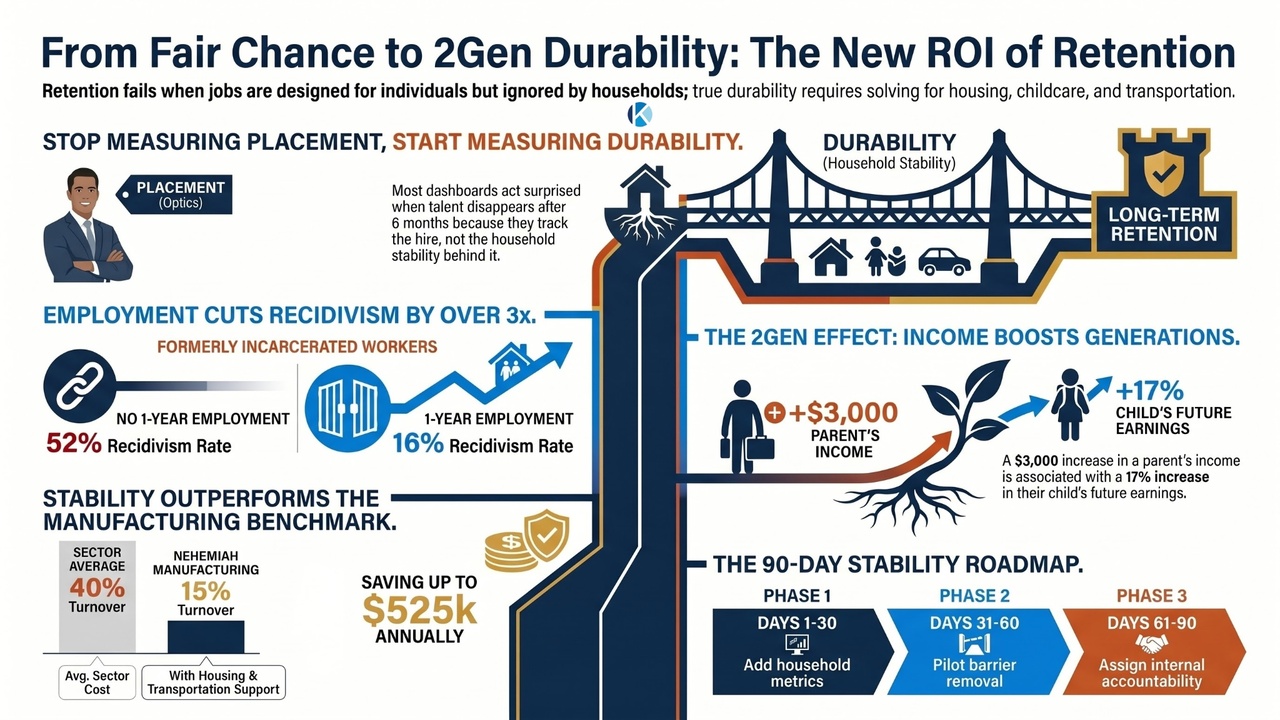
Retention dashboards built around placement metrics miss the most important variable in workforce durability: household stability. When employers track hires but ignore housing, child care, and transportation barriers, talent disappears within 6 to 12 months—and leadership calls it a pipeline problem. It is not. It is a measurement problem. This article breaks down the ROI case for shifting from fair-chance hiring to a full 2Generation talent strategy, with data from the U.S. Chamber of Commerce, Ascend at the Aspen Institute, and employer case studies showing how household-centered workforce design cuts turnover, saves hundreds of thousands annually, and changes outcomes across generations.
The Pattern: Fair Chance Stops at the Offer Letter
The workforce exists. The problem is that too many employers are still screening for compliance while managing for short-term optics.
Data from the U.S. Chamber's 2024 report highlights a significant issue: while approximately 1 in 3 U.S. adults have a criminal record, the industries where many formerly incarcerated individuals have experience are struggling to fill nearly 1.9 million job openings.
The issue is not that the labor pool does not exist. The issue is that most fair-chance strategies still stop at the offer letter. They track the hire. They celebrate 90 days. They post the story. Then the system starts leaking talent.
Why? Because the job was never designed to hold a household together.
The Uncomfortable Truth About Retention
A worker does not show up to work as an isolated unit. A worker shows up inside a housing situation, a child care arrangement, a transportation reality, a supervision schedule, and a family budget.
When those systems are unstable, the employer feels it later as absenteeism, churn, lower engagement, and preventable turnover. But most dashboards cannot see that.
They measure the individual transaction. They miss the household conditions behind it. That creates the trap:
- Measure placement
- Optimize for speed
- Get churn
- Then call it a pipeline problem
It is not a pipeline problem. It is an incentive problem.
This is why the dashboard can say win while the kitchen table says crisis. On paper, the role is filled. At home, one missed bus, one child care gap, or one schedule conflict can put the whole household back into instability.
If leadership is not measuring that reality, they are not truly measuring retention.
The ROI Math: Employment, Recidivism, and Generational Impact
The U.S. Chamber reports that people who maintain employment for one year after release have a three-year recidivism rate of 16%. For peers who do not maintain employment, that number is 52%.
That gap describes public safety, labor force participation, and household stability simultaneously.
Now extend the time horizon. Ascend at the Aspen Institute reports that a $3,000 increase in parents' income when a child is young is associated with a 17% increase in that child's future earnings.
That is the 2Gen argument in one line: a more durable job does not just stabilize a worker—it changes the trajectory of a household.
In April 2025, Ascend reported that public and private sectors had invested $500 million in 2Generation approaches over the past decade, and that 73% of voters supported the core 2Gen premise in 2024 polling. This is not soft language. This is market logic with a longer time horizon.
The Proof: Nehemiah Manufacturing and CHG Healthcare
Nehemiah Manufacturing is one of the clearest case studies in the country. Fortune reported in 2024 that Nehemiah employs about 170 formerly incarcerated workers—nearly 70% of its staff. Its turnover rate is about 15%, compared to the manufacturing benchmark of around 40%. Average tenure is around seven years versus a sector average of around five. Leadership estimates that lower turnover saves the company $315,000 to $525,000 a year in onboarding costs.
Nehemiah did not solve retention by giving a speech about resilience. It built a support model around the real break points: housing, transportation, education access, and social-service support. Different design. Different outcome.
CHG Healthcare makes the same point from a different labor segment. Utah Business reported that CHG now retains 95% of mothers returning to work after childbirth. Out of 171 women who had babies, 159 returned. Leadership said those policies preserved 62 future leaders and saved $2 million to $2.5 million directly.
What changed? Twelve weeks of paid parental leave, a slower return-to-work transition, dependent-care support, flexible hours, and remote work options. Different population. Same mechanism. When work design matches household reality, retention improves.
From Fair Chance to 2Gen Talent Strategy
This is the shift. Fair chance hiring asks whether you will open the door. A 2Gen talent strategy asks whether the opportunity behind that door is strong enough to create stability over 12 to 24 months.
It moves the unit of analysis from the individual worker to the household. It moves the metric from placement to durability. And it changes the leadership question—not "How many people did we hire?" but "What are we funding: placement, or progress?"
For people impacted by the justice system, this question is especially important because the barriers they face extend beyond the workplace:
- Housing instability does not disappear because someone got an offer letter
- Transportation barriers do not disappear because the company filled a requisition
- Supervision requirements do not disappear because HR marked the role as closed
If your system measures access but ignores stability, churn is not an accident. It is the expected outcome.
A Better Scoreboard: What to Track
If you want better outcomes, your dashboard must show you where retention actually breaks. That means tracking more than headcount and 90-day retention:
- 12- and 24-month retention
- Wage progression
- One household-level barrier indicator
- Whether the job is becoming more resilient—or whether the worker is still one disruption away from crisis
That is not mission drift. That is operational visibility.
Who Needs to Move
For funders: Stop rewarding placement alone. Tie dollars to 12- and 24-month retention, wage progression, and barrier reduction.
For policymakers: Stop treating workforce, reentry, child care, and transportation as separate lanes. Align incentives around family economic durability, not program throughput.
For operators: Stop waiting for enterprise transformation. Pick one high-churn role, one barrier, one owner, and one measurable target.
The 90-Day Stability Roadmap
Days 1–30: Add one household-level metric. Track 12-month retention. Track wage progression. Track one barrier indicator—such as transportation, child care, or housing support completion.
Days 31–60: Run one barrier-removal pilot. Test one intervention where retention actually breaks: shift alignment, transportation help, child care support, or coordination around supervision schedules.
Days 61–90: Assign accountability. Name one internal owner. Add one external partner if needed. Set one target for retention improvement and review it in writing.
That is how strategy becomes implementation.
The Bigger Shift
The next generation of workforce leadership will not be defined by how many second-chance hires a company can count. It will be defined by whether leadership knows how to convert opportunity into durability.
Household stability is the most important part of any retention strategy. Change the metrics. Change the outcomes.
Until next time, keep building what they said could not be built.
Khalil Osiris
Founder & CEO, Khalil Osiris Consulting
Market Architect, 2Generation Economy Workforce Ecosystem
Board Member, National Association of Reentry Professionals (NARP)
Subscribe to Justice & Second Chances, then audit one frontline role this quarter: are you measuring placement, or progress?
Learn more at KhalilOsirisConsulting.com.
Sources
- U.S. Chamber of Commerce, The Workforce Impact of Second Chance Hiring (September 18, 2024).
- U.S. Chamber of Commerce, Second Chance Hiring Guide (September 18, 2024).
- U.S. Chamber of Commerce, Employer Guide to Second Chance Hiring Programs and Tax Credits (September 13, 2024).
- Fortune, Second chance strategy: A company that hires formerly incarcerated people has seen some huge upsides (April 11, 2024).
- Ascend at the Aspen Institute, 2Gen Approach.
- Ascend at the Aspen Institute, The 5 Guiding Principles of 2Gen.
- Ascend at the Aspen Institute, The 2Gen Investment Case: Making the Most of Capital in All its Forms (April 2025).
- Utah Business, Save millions by adopting family-friendly policies (July 22, 2024).
Want the Full Blueprint?
Download the free 2Gen Economy Starter Kit, the evidence-based playbook for building workforce ecosystems that stabilize households and reduce recidivism. Trusted by policymakers, funders, and workforce leaders nationwide.
Subscribe to Justice & Second Chances
Get the weekly briefing on workforce transformation, criminal justice reform, and the 2Gen Economy, delivered straight to your inbox. Evidence over ideology. Households over headcounts.
We hate SPAM. We will never sell your information, for any reason.