What Happens When Lived Experience Gets a Seat at the Design Table
Jun 15, 2026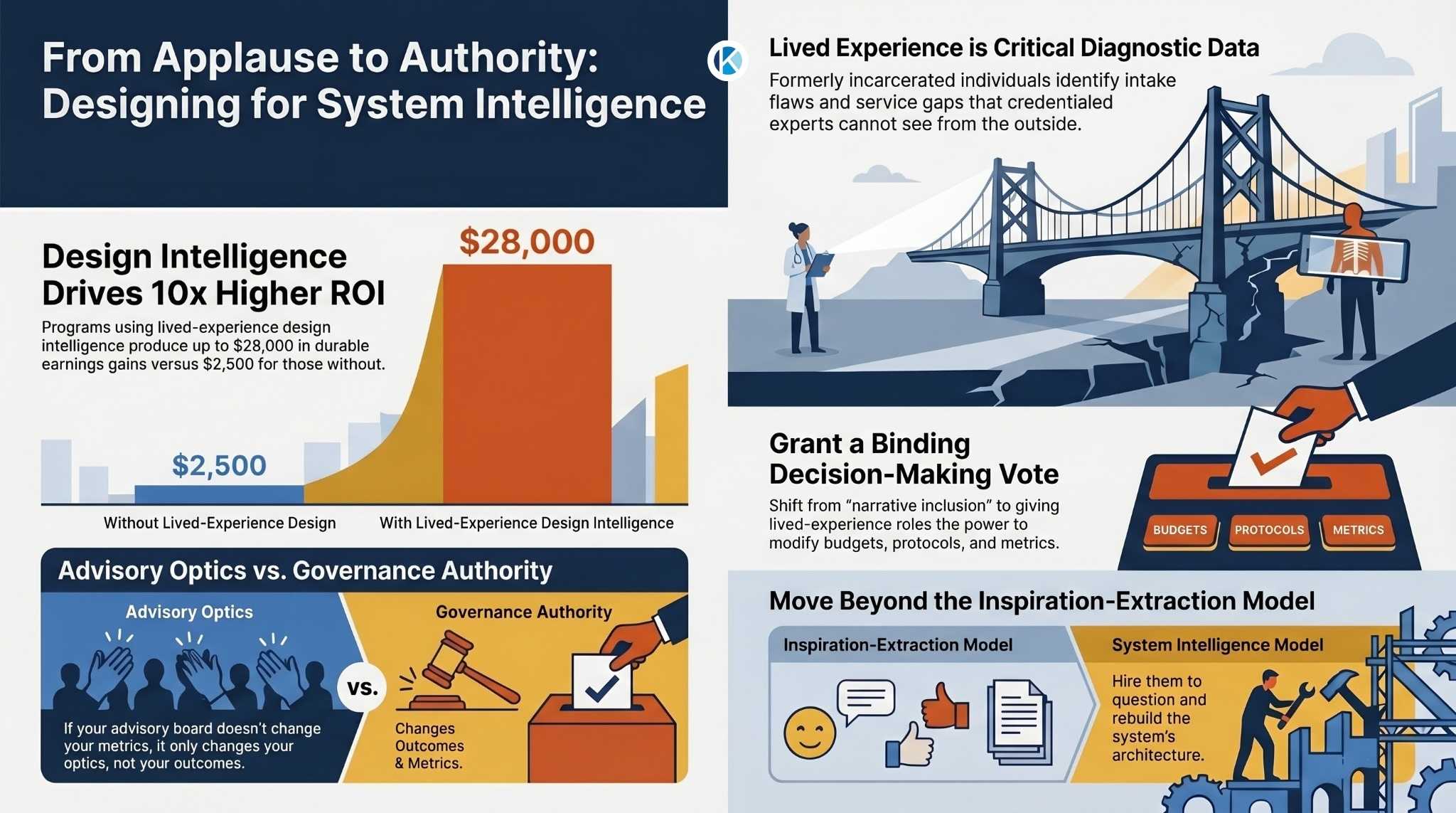
Somewhere in America, a reentry conference is giving a standing ovation to a person they will bar from the next session.
The next session is about funding, metrics, and program design.
Nobody asks why the person who navigated the system's failure mode is not in the room when the system gets redesigned.
Nobody asks why the most detailed diagnostic data in the building just walked out the door.
The field was not built to ask.
It was built to applaud.
Here is what the research confirms: organizations routinely ask people with lived experience for their input, but they rarely give them the power to make decisions.
A 2024 scoping review protocol published in BMJ Open, studying community advisory boards across participatory research, found that formal decision-making authority, such as the power to change metrics, redirect budgets, or veto designs, consistently remains with organizational leadership, while people with lived experience are confined to providing input and narratives (Nelson et al., BMJ Open, March 2024).
A 2026 qualitative study published in the International Journal of Mental Health Nursing confirmed this pattern directly in workforce settings.
Analyzing the experiences of lived experience workers and clinicians in multidisciplinary mental health teams, the study found that successful integration requires more than structural reform, it demands role clarity, shared accountability, and relational trust.
Without addressing differing attitudes about authority and recovery, lived experience integration risks being symbolic rather than transformative (International Journal of Mental Health Nursing, February 2026).
The CSG Justice Center's own Lived Experience Advisory Panel (LEAP) guidance acknowledges this gap explicitly, advising organizations to 'identify areas of the process where the panel will be actively involved in decision-making and have an equal say.'
That the guidance must say this signals that equal voice remains the exception, not the standard (CSG Justice Center / C4 Innovations, 2024).
The field invites lived experience to speak.
It does not invite it to decide.
The applause was never the problem. The problem was what happened after it stopped: the design meeting that started without the person who got the standing ovation.
The Extraction Economy
The gap between inclusion language and design authority is not accidental.
It is structural.
The reinvention field has built a very specific architecture for lived experience, and that architecture has a name: the inspiration-extraction model, the systematic gap between inclusion language and design authority.
It works like this. An organization hires someone for a role like 'peer specialist' or 'lived experience coordinator.' While the title sounds meaningful, the person is typically hired to validate the program's existing design, rather than question it.
The CSG Justice Center documented this pattern in a 2021 brief on peer support specialists in behavioral health-criminal justice programs.
Interviews with peers from three Justice and Mental Health Collaboration grantees reveal a common obstacle: the effectiveness of peer roles is consistently undermined by how they are implemented.
The core finding: peer roles are concentrated in direct service delivery, with no clear path to advance into supervisory, evaluation, or program design positions (CSG Justice Center, 2021).
A November 2024 brief by the Center for Health Care Strategies confirmed that state behavioral health funders rarely require meaningful lived experience engagement beyond advisory representation.
The compliance threshold typically ends at representation on an advisory board.
Formal governance authority remains with organizational leadership in the majority of programs reviewed (CHCS, November 2024).
The knowledge flows in one direction: from the person with lived experience into the system.
The authority stays exactly where it was.
This is not a staffing oversight.
It is a knowledge production problem.
A formerly incarcerated person can tell you which intake question makes people lie.
They can tell you which 'support service' goes unused because the office closes at 4:30 and the bus stops running at 5.
They can tell you which metric the program celebrates while the household quietly collapses.
That is not testimony.
That is diagnostic data.
The field is logging it as inspiration instead of intelligence.
Organizations integrate lived experience into their language. The governance structure remains unchanged. The metrics stay the same. The design stays the same.
The ROI of System Intelligence
Here is the math the field is not running.
Every program that excludes lived experience from design authority is paying for a specification it could get for free.
Every advisory board that advises without authority produces the same recommendations, every quarter, that change nothing.
Design authority, the ability to modify metrics, protocols, or budget allocations, is not a governance nicety. It is the variable that separates programs that produce durable results from programs that produce summary documents.
Brookings Institution research on sectoral employment programs, the model that requires practitioners to understand which supports participants actually use, documents consistent earnings gains of 11 to 40 percent over baseline for program graduates.
Per-participant costs for high-quality sectoral programs range from $10,000 to $45,000.
By contrast, standard WIOA training programs, which lack this design intelligence, generate modest gains of $1,500 to $2,000 per year per participant (Brookings Institution, April 2025; Aspen Institute, August 2025; Holzer, Brookings, 2023).
The pattern is consistent: programs built with people who know where the system fails produce materially better outcomes than programs that consult them afterwards.
Old model: Advisory board. Four meetings a year. Summary document. Nothing changes.
New model: Design authority. Metric approval. Budget input. Outcomes that hold at 12 months.
The ROI is not theoretical.
The programs producing durable results are the ones built with the people who know where the system fails.
Lived Experience Is System Intelligence
Here is the reframe the field needs:
Lived experience is not a perspective to be included.
It is a unique form of intelligence about a system that cannot be gained in any other way.
In its June 2023 National Model Standards for Peer Support Certification, SAMHSA recommends organizations use peer knowledge to improve programs and quality, not just to deliver services.
This framing moves peer expertise closer to evaluation and quality improvement (SAMHSA, June 2023).
But even SAMHSA's framing stops short of the structural change the evidence demands. Integration into evaluation is not the same as authority over design.
A qualitative study for 2026 in the International Journal of Mental Health Nursing, analyzing lived experience workers and clinicians across multidisciplinary mental health teams, found that successful integration requires more than structural reform.
Sustainable inclusion depends on role clarity, shared responsibility and accountability, and relational trust.
Programs that stop at representation, the study found, produce the same outcomes as programs that never asked (International Journal of Mental Health Nursing, February 2026).
Consider what a person with ten years of system contact actually knows.
They understand that measuring stability is fundamentally different from measuring compliance.
They know which parole conditions create employment conflicts that never surface in official reports.
They know that the 'warm handoff' between prison and community services breaks down at 6 PM on a Friday when the case manager's phone goes to voicemail, and the housing voucher office closed three hours ago.
No survey instrument captures this. No program evaluation accounts for it.
It is knowledge produced by navigating failure.
It is the single most underutilized dataset in the workforce development field.
The person who survived the system's design flaws has a specification sheet that no credentialed expert can write from the outside.
The question is whether the field will treat that specification as a design input or continue to file it under 'inspiring stories'.
The Grant Application Test
Here is a scenario that plays out in foundation offices every quarter.
A program officer named Rebecca reviews a grant application from a mid-sized workforce organization. The proposal is polished. The logic model is clean. On page four, under 'Community Engagement,' the program lists a 'Lived Experience Advisory Board': twelve people with direct justice system contact, meeting four times a year, providing 'guidance and input on program direction.'
Rebecca checks the box. Community voice: included. The application moves to the next round.
But here is what Rebecca does not ask.
Does that advisory board approve the program's outcome metrics? Does it have authority to modify intake protocols? Can it redirect budget allocations? Does any member sit on the actual governance board with a binding vote?
A November 2024 brief from the Center for Health Care Strategies found that this pattern is the norm, not the exception. State and federal funders systematically underweight governance integration in grant scoring. Compliance thresholds typically end at advisory board representation. Formal governance power remains with organizational leadership in most programs reviewed (CHCS, November 2024).
The board advises. Leadership decides. The metrics stay the same. The design stays the same. The advisory board meets again in three months and watches the same recommendations get absorbed into a summary document that changes nothing.
Rebecca is not negligent. She operates inside a funding architecture that rewards narrative inclusion and does not measure design integration. The incentive structure produces exactly the outcome it was built to produce: programs that look inclusive on paper and operate identically to programs that never asked.
That is not a design partnership.
It is a listening session dressed up as governance.
If your lived-experience advisory board does not change your metrics, it does not change your outcomes. It changes your optics.
What This Means: By Audience
If you are a funder:
- Add a governance question to your grant application: Does your lived-experience advisory board have binding authority over any program metric, protocol, or budget allocation? Require a yes, not an aspiration.
- Require 12-month retention and metric-change documentation as grantee reporting items.
- Score narrative-inclusion language lower when governance authority is absent. Applause is not accountability.
If you are a policymaker:
- Commission an audit of every workforce program your office funds: how many employ people with lived experience in roles that carry design authority? The answer will be uncomfortable.
- Require peer-designed outcome metrics as a condition of state and federal program reauthorization. Not peer-informed. Peer-designed.
- Change the procurement standard: programs that cannot demonstrate lived-experience authority at the design level should not qualify for public workforce funding.
If you are a program director or workforce operator:
- Pull your org chart this week. Count every lived-experience role. Ask how many can change a single metric. If the answer is zero, that is your first 30-day deliverable.
- Give your lived-experience advisory board one metric to own. One protocol to approve or reject. Not four meetings a year. A binding vote.
- Report the result at 90 days. Not the number of meetings held. The number of design changes made.
The Design Authority Diagnostic
Here is the three-beat test your organization needs to run before the next board meeting.
Beat 1. Name the gap:
Pull your organizational chart. Identify every role occupied by a person with direct lived experience. Ask: how many of those roles have the authority to set or modify a program outcome metric? SAMHSA's June 2023 National Model Standards for Peer Support Certification recommends peer integration into evaluation and quality improvement. If your lived-experience staff are excluded from both, you are not integrating system intelligence. You are extracting narrative.
Beat 2. Name what the silence means:
If a person with lived experience in your organization cannot point to a single metric, protocol, or design element they changed in the last 12 months, you do not have a design partner. You have a testimonial resource. That is a governance decision, not a gap in your commitment.
Beat 3. Name the design implication:
The organizations producing durable outcomes are embedding lived experience into metric design, budget authority, and program evaluation, not just service delivery and conference panels. System intelligence was built for the design table your organization has not yet opened.
Thirty days. That is the window. Pull the org chart. Count the decision-authority roles. Name the gap.
The Forcing Question
Here is the one question no funder, no workforce board, and no program director is answering:
How many people with lived experience in your organization have influenced a metric, protocol, or design element in the past year?
If you do not have that number, you are not measuring integration.
You are tracking attendance.
What does your organization score on this?
Take the free Durability Index Self-Assessment. Twenty questions. Five domains. One score.
Until next time, keep building what they said couldn't be built.
Khalil Osiris
Author and Founder, Khalil Osiris Consulting | Market Architect, The Durability Economy Workforce Architecture
The Durability Economy. Workforce redesign, fair-chance hiring, and household stability. For leaders who measure what lasts.
Change the metrics. Change the outcomes.
Subscribe to The Durability Economy
Get the weekly briefing on workforce transformation, criminal justice reform, and the 2Gen Economy, delivered straight to your inbox. Evidence over ideology. Households over headcounts.
We hate SPAM. We will never sell your information, for any reason.