You Measure the Hire. You Miss the Household: Why Placement Rates Are Killing Your Retention
May 19, 2026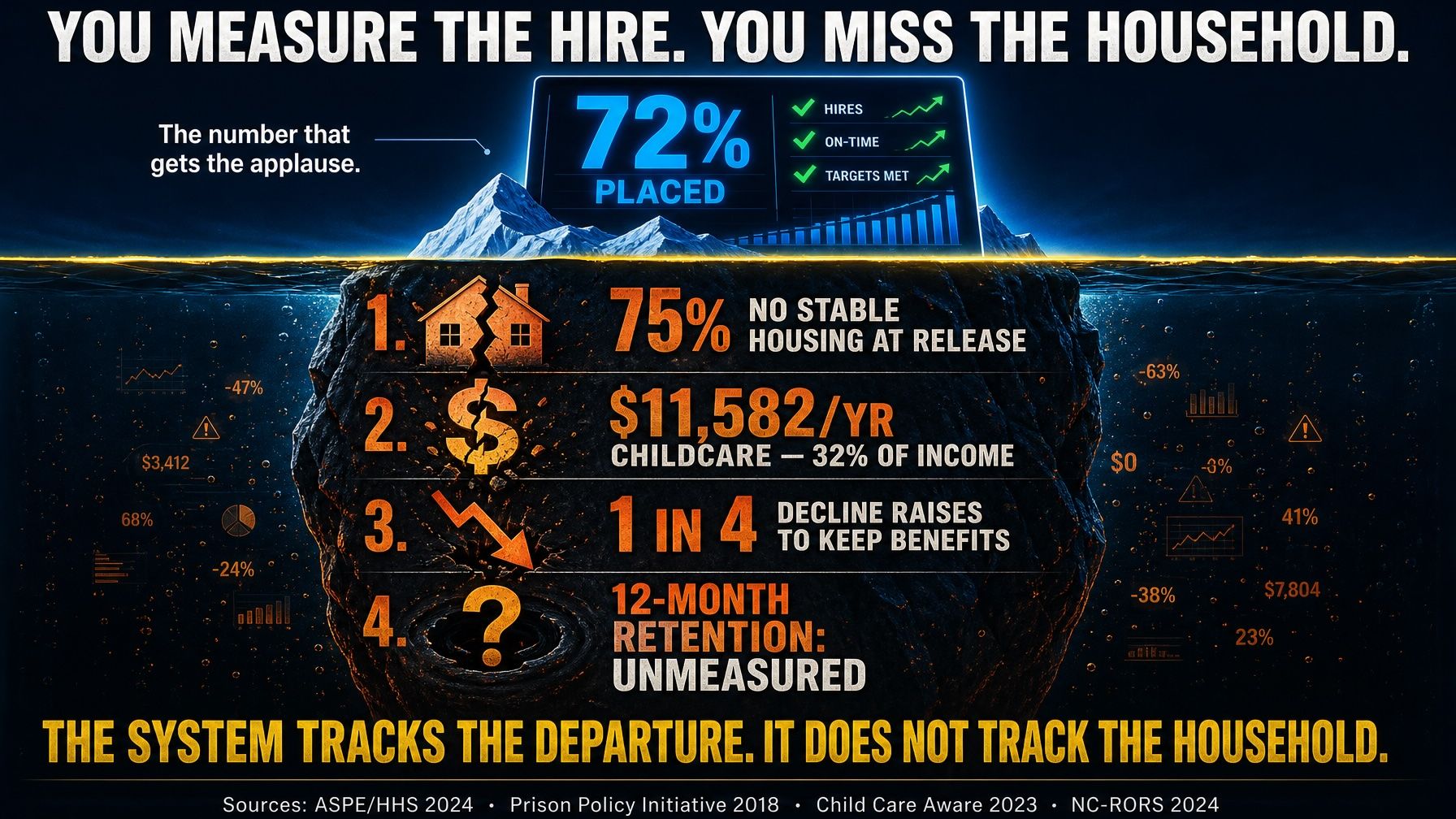
The workforce development system tracks one number: did the person get a job? But employment without household stability is a revolving door.
This piece names the blind spot that turns placement rates into vanity metrics, and asks the question no workforce board is answering.
The Number That Feels Like Progress
Across America, workforce boards are presenting their annual reports. A slide displaying the placement rate appears, drawing applause from the room. The executive director feels a sense of relief, the funder gives a nod of approval, and the meeting continues.
Nobody asks what happened at month seven. Nobody asks if the household made rent. Nobody asks whether the worker had to choose between child care and showing up for the second shift.
Nobody asks, because the system was not built to ask. It was built to count exits; ignoring the system intelligence that lived experience provides.
Here is what the data actually shows: a 2024 federal survey of state Departments of Corrections found that while 72% of systems reported assessing housing needs prior to release, and 63% have policies aimed at securing some post-release housing, fewer than 25% ensure that all returning individuals have a housing arrangement at the time of release. (U.S. HHS/ASPE, 2024)
The system tracks the departure. It does not track what happens to the household after the door closes.
“Placement is the moment the revolving door opens. Household stability is what determines whether it closes.”
What the Data Actually Shows
Research on reentry housing is clear: formerly incarcerated people are almost ten times more likely to experience homelessness than the general public. For those recently released from prison, the rate of homelessness is nearly twelve times higher. (Couloute, Prison Policy Initiative, 2018; confirmed by Georgetown Law Journal, 2025; ASPE/HHS, 2024)
This is not a marginal finding. It is one of the most replicated data points in reentry research.
Among individuals reentering from jail specifically, where reentry planning is least likely to occur, only one-quarter had a stable residence to return to at the point of release. The remaining three-quarters were precariously housed or without housing entirely. (ASPE/HHS, 2024)
These are people who may simultaneously be job-seeking, whose placement will count toward someone’s success metric, and whose housing status will appear in no workforce dashboard.
In North Carolina, home to one of the most rigorous state-level reentry tracking systems in the country, only 37% of individuals exiting prison in 2024 found employment within a year of release (NC RORS/LEAD, 2024), the lowest rate recorded since 2013. (NC Reentry Outcome Reporting System, 2024) That is the employment story.
The household story, what happened to those workers’ families at month twelve, remains, in most systems, entirely unmeasured.
Household Stability Is a Workforce Metric
Here is the reframe the field needs: household stability is not a social work metric. It is a workforce durability metric. The ASPE/HHS report (2024) states this directly: housing stability is a foundational element of reinvention success, it provides the base from which people secure employment, access behavioral health treatment, and rebuild social networks. Without it, employment gains erode. Retention fails.
A worker who seems successful at the 90-day mark is gone by the seventh month, and there’s no accurate record of why they left.
Let’s do the math for a justice-impacted worker in their first 90 days of employment. In 2023, the average annual cost for center-based child care was $11,582. That’s 32% of the median income for a single-parent household (Child Care Aware of America, 2023).
That is not a rounding error in a household budget. That is a crisis that arrives every month on the first.
Layer on the benefit cliff. A 2025 analysis by the Poverty Solution at the University of Michigan Poverty Solutions initiative found that workers earning between 100% and 200% of the federal poverty level, the exact wage band where most reinvention placements land, face a zone where accepting a raise, a promotion, or additional hours can trigger the loss of child care assistance, housing support, or food benefits.
One in four workers in this income bracket turn down raises or cut back their hours just to stay eligible for benefits.
For a justice-impacted worker just stabilizing after release, a promotion is not a career step. It can be a household emergency.
This is the architecture of workforce attrition that dashboards cannot see: a worker who wants to stay, who shows up, who performs, and who is quietly running impossible math every week. That worker’s 90-day retention number looks fine.
Their 12-month number would tell the true story. And in most programs, that number does not exist.
Retention starts at the kitchen table, not the job site.
What the HR Dashboard Doesn’t Show
Here is a scenario that plays out in workplaces across the country every week.
An HR director pulls the 90-day retention dashboard for fair-chance hires. The numbers look strong. She flags it as a win in the quarterly review and schedules a meeting with the reinvention partner to discuss program expansion.
What the dashboard doesn’t show is the personal struggle of an employee, let’s call him Lamar. For weeks, he has been forced to choose between paying rent and child care. Despite this, his performance at work is strong, and he even received a positive mid-cycle review from his manager.
But Lamar has started calling in sick on Fridays, not because he does not want the job, but because his child care provider called in sick first, and he has no backup plan, no savings cushion, and no supervisor equipped to understand what is actually happening.
At day 97, Lamar does not show up. The HR system logs a voluntary quit. The exit interview is marked ‘personal reasons.’ The retention number ticks down. The program continues.
Next quarter’s report will note the decline and recommend improving onboarding communication.
The real story never makes it into the report.
The ASPE/HHS research (2024) documents exactly this pattern: supervision requirements, compounding financial obligations, and absence of coordinated household support create cascading disruptions that surface not as systems failures, but as individual quit decisions logged in an HR platform.
Lamar was not a retention failure. He was a household stability crisis, invisible to every system supposed to support his success.
The next quit isn’t a motivation problem. It’s a math problem. And no workforce dashboard is currently running the math.
The Workforce Durability Test
Here is the three-beat diagnostic your board needs to run before the next reporting cycle.
Beat 1. Name the gap: Ask your program director what percentage of justice-impacted workers placed in the last twelve months were still employed, housed, and financially solvent at month twelve, not month three. Fewer than 25% of state correctional systems ensure returning individuals even have housing at release. (ASPE/HHS, 2024) If your 12-month household stability rate does not exist, you are not measuring workforce retention. You are measuring departure.
Beat 2. Name what the silence means: If you cannot produce that number, your program’s success story ends at the moment the revolving door opens. Every metric that stops at placement is a gap in architecture, not a gap in your workers’ motivation.
Beat 3. Name the design implication: That is not a data collection problem. That is a design decision. The organizations producing durable workforce outcomes measure housing stability, income continuity, child care access, and family integration at the 12-month mark, not just employment status at 90 days.
The Durability Index was built for the number your system does not have yet.
What does your organization score on this?
Take the free Durability Index Self-Assessment. Twenty questions. Five domains. One score.
Until next time, keep building what they said couldn't be built.
Khalil Osiris
Author and Founder, Khalil Osiris Consulting | Market Architect, The Durability Economy Workforce Architecture
The Durability Economy. Workforce redesign, fair-chance hiring, and household stability. For leaders who measure what lasts.
Change the metrics. Change the outcomes.
Subscribe to The Durability Economy
Get the weekly briefing on workforce transformation, criminal justice reform, and the 2Gen Economy, delivered straight to your inbox. Evidence over ideology. Households over headcounts.
We hate SPAM. We will never sell your information, for any reason.