Child Care Debt Is Destroying Your Fair-Chance Hiring Strategy
May 05, 2026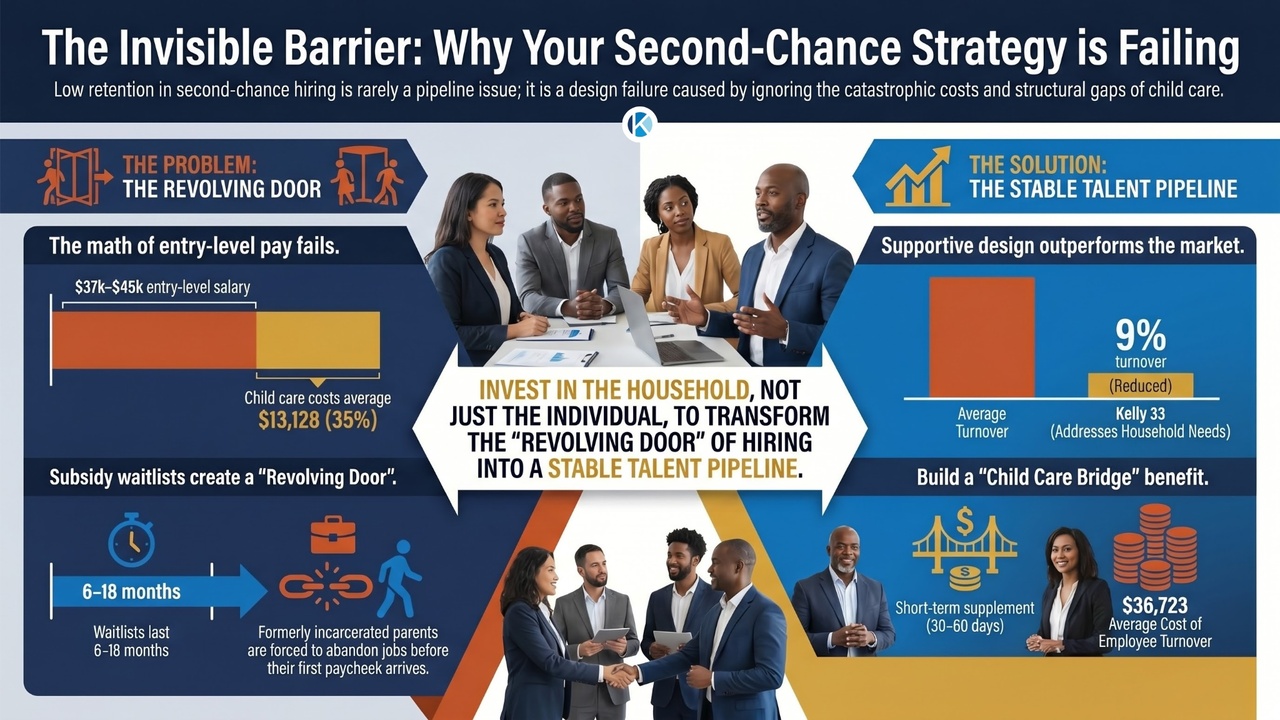
Your retention dashboard says the hire was successful. But the worker never made it to Day 30.
You called it a pipeline problem. It was not. It was a child care problem that no one in your hiring process ever asked about.
Full-time child care in the U.S. averaged $13,184 in 2025, a 23% increase since 2021. For single parents, that is 33% of median household income. In high-cost metros, it climbs to $25,535 per child, per year. Hold that number next to your First-Chance Hire.
They are likely a single parent. They may owe court fines still accruing. They may be in transitional housing. Their first paycheck is already spent before it clears. Now consider the math: a manufacturing or logistics entry-level role pays roughly $18–$22 per hour. That is $37,000–$45,000 annually before taxes. A single child in full-time care consumes 30–35% of that gross income, before rent, transportation, supervision fees, or court-ordered obligations are deducted.
The offer letter arrives. The math does not work. And no one in your hiring process ever asked.
That is not a talent failure. That is a design failure. And it is costing employers, funders, and communities far more than any retention dashboard is capturing.
Child Care Is Workforce Infrastructure; Not a Social Services Problem
Child care debt is not a personal budgeting problem. It is a workforce infrastructure failure that destroys Fair-Chance Hiring pipelines before the first paycheck clears. When a parent cannot afford care, the hire does not fail. The system that ignored the household failed.
Approximately 58% of women in state prisons have a child under 18 (PPI, 2022). An estimated 80% of women in jail are parents of minor children. These are not edge cases. These are the people your fair-chance program is designed to reach.
When they walk out of a facility, the clock does not start on employment. The clock starts on child care. They need care arranged before they accept a job offer, before they attend orientation, before they complete training. Without it, none of your other workforce investments;the coaching, the placement, the employer partnerships;can hold.
Research on formerly incarcerated mothers is explicit: inadequate access to child care subsidies and mandatory wait periods create a gap in care coverage during the critical first weeks after release, exactly when a returning citizen must secure employment and meet parole conditions.
The mechanism is simple and devastating:
No child care → no job start → parole condition violated → return to system.
That is not a character flaw. That is an incentive structure designed to fail.
When Subsidies Have a Criminal Record
You might assume child care subsidies solve this. They do not. Not for this population.
Nationally, only 15% of children eligible for CCDBG subsidies actually receive them. The gap between eligibility and access is not a processing delay;it is a structural funding shortfall that has persisted for decades, affecting millions of working families who qualify but cannot get in the door.
In Virginia alone, 19,000 families were placed on a child care subsidy waitlist between July 2024 and May 2025. Of those, nearly half left their jobs while waiting, and 80% faced food insecurity on the list.
Add a criminal record. Formerly incarcerated individuals are often disqualified from TANF-funded child care programs because of their convictions. In California, all convictions beyond minor traffic violations require a formal exemption process, taking months.
The loop:
- Justice-impacted parent gets a job offer.
- Needs child care to start.
- Subsidy waitlist: 6–18 months.
- Criminal record disqualifies them from TANF care.
- Private care costs $1,099/month; unaffordable on a new hire’s wage.
- Parent abandons the job.
- Employer calls it a pipeline problem.
What we are actually funding is a system that makes workforce participation structurally inaccessible for the people it claims to serve.
Diagnose incentives, not people. These incentives are broken.
What This Is Costing You
Turnover costs U.S. businesses an average of $36,723 per employee annually in rehiring expenses and lost productivity. SHRM estimates total turnover costs reach 90–200% of annual salary. Half of U.S. companies expect a turnover surge in 2026.
Now, let us see what happens when you solve the household problem, instead of ignoring it.
Kelly Services placed more than 2,000 workers at 17 employer clients through their Kelly 33 second-chance program in 2024. Monthly turnover for justice-impacted hires: 9%, lower than the general workforce average. Time to fill open positions dropped from 21 days to 11 days, and fill rates ran 25% higher than traditional hires.
Kelly proved that formerly incarcerated workers are not charity cases. When they have a supportive structure, they outperform the market. The difference is not the person. It is the design.
CHG Healthcare arrived at the same conclusion from a different direction. When the company invested in 12 weeks of paid parental leave, a phased return, and dependent-care support, 159 of 171 new mothers;95%;returned to work. Direct savings: $2–$2.5 million.
Different populations. Same mechanism. Design work around household reality, and you do not lose the talent.
Both case studies point to the same leadership question: how much of your current turnover is a talent problem, and how much of it is a design problem you have not yet chosen to fix?
The 2Gen Case: One Number Changes Everything
Ascend at the Aspen Institute reports that a $3,000 increase in a parent’s income when a child is young correlates with a 17% increase in that child’s future earnings.
Public and private sectors have invested $500 million in 2Gen approaches over the past decade, with 73% of voters supporting the core 2Gen premise in 2024 polling.
The argument is simple: you cannot stabilize a household by stabilizing only one member.
When a mother loses her job because child care was inaccessible, the loss does not stop at her paycheck. It follows her child into kindergarten, without consistent routines, without economic stability at home, without a parent available to show up for parent-teacher conferences because she is scrambling for income. It follows that child through adolescence as a household defined by financial precarity instead of forward momentum.
The research is not theoretical. The trajectory is documented.
Mass incarceration already costs families $348 billion annually in lost wages and out-of-pocket spending. When a parent is incarcerated, their family spends an average of $5,337 per year on child care. These costs often fall to grandparents or older siblings, which can put their own finances at risk.
Child care is not a downstream issue. It is a precondition for everything else you are funding.
What Needs to Change ; Now
If you fund workforce development or Fair-Chance Hiring, and your RFPs do not include a child care infrastructure question, you are funding motion, not outcomes.
Start asking:
- At intake: Does this participant have children under 13? Is child care currently arranged?
- At placement: What is the child care plan for the first 30 days of employment?
- At 90 days: Is the job intact? Is child care still in place? Has anything destabilized the household since hire?
- At 12 months: Has wage progression occurred? Is the household stable? Are children in consistent educational settings?
Then act.
Days 1–30: To understand the real retention risks before it is too late, confidentially survey your First-Chance Hires about their child care responsibilities and any gaps in coverage. Do not wait for exit interviews to find out why people leave. Make retention a focus from day one.
Days 31–60: Build a child care bridge benefit;a short-term supplement covering the gap between hire date and subsidy approval. Partner with a local provider, subsidy navigator, or CDFI. One bridge costs less than one replacement.
Days 61–90: Stop measuring retention at 90 days. Measure at 12 months. Track child care continuity, housing stability, and supervision disruptions alongside standard performance metrics. If your dashboard cannot see the household, it cannot see the real risk.
Measurement is destiny. Change the metric. Change the outcome.
Now Decide
You made the hire. You told the story at your board meeting. Six months later, the worker is gone, because child care collapsed in week three and no one in your system was watching.
Are you investing in Fair-Chance Hiring, or in the conditions that make it survivable?
Without child care built into the design, you are not building a talent pipeline. You are building a revolving door with better branding.
In the 2Gen Economy Workforce Ecosystem, success is measured by the progress of the entire household, not just the individual worker or a short-term job placement.
The child care bill is already on the table. The only question is whether your strategy is designed to pay it.
What does your organization score on this?
Take the free Durability Index Self-Assessment. Twenty questions. Five domains. One score.
Until next time, keep building what they said couldn’t be built.
Khalil Osiris
Author & Founder, Khalil Osiris Consulting | Market Architect, The Durability Economy Workforce Architecture | Fair-Chance Hiring · Household Stability · Workforce Durability | Publisher, The Durability Economy
Subscribe: If this edition of The Durability Economy challenged your thinking, share it with a colleague. Already measuring household impact? Tell me about it. I might feature your work in a future edition.
Change the metrics. Change the outcomes.
Subscribe to The Durability Economy
Get the weekly briefing on workforce transformation, criminal justice reform, and the 2Gen Economy, delivered straight to your inbox. Evidence over ideology. Households over headcounts.
We hate SPAM. We will never sell your information, for any reason.