The Durability Household Company
A family builds a small business from home, on their own terms.

The Durability Household Company is a model in which a person with a criminal record and their family build a small business together, with one operator directing a set of AI tools. It is written for households, not for investors.
It measures success in household stability: weeks of expenses covered, income the household controls, and a reserve that survives a bad month.
Two rules come before everything else, and both are yours to keep. The business starts alongside the income you already have, wherever possible, as an addition to your household's income mix before it is a replacement for any part of it. And the business pays the household first, on a written rule your family sets, before it pays for anything optional.
Start free: the Starter Guide
The Starter Guide teaches the first three steps of the model, free.
Unit 1 in brief: audit the household's floor first, housing, supervision conditions, identification and documents, banking access, and a benefits-cliff check, before any business step. Unit 2 in brief: inventory what the household actually holds, skills, trades, and the problems it knows from the inside. Unit 3 in brief: choose a first offer, and screen it against the barriers, licensing, bonding, background checks, and supervision compatibility, before anyone invests time or money.
It includes three worksheets you keep: the Household Stability Audit, the Asset Inventory, and the Offer Screen. If you work only these three units, you will have a completed audit, a completed inventory, and a completed screen, each an exercise output yours to act on.
Start with the free Starter Guide

The full curriculum
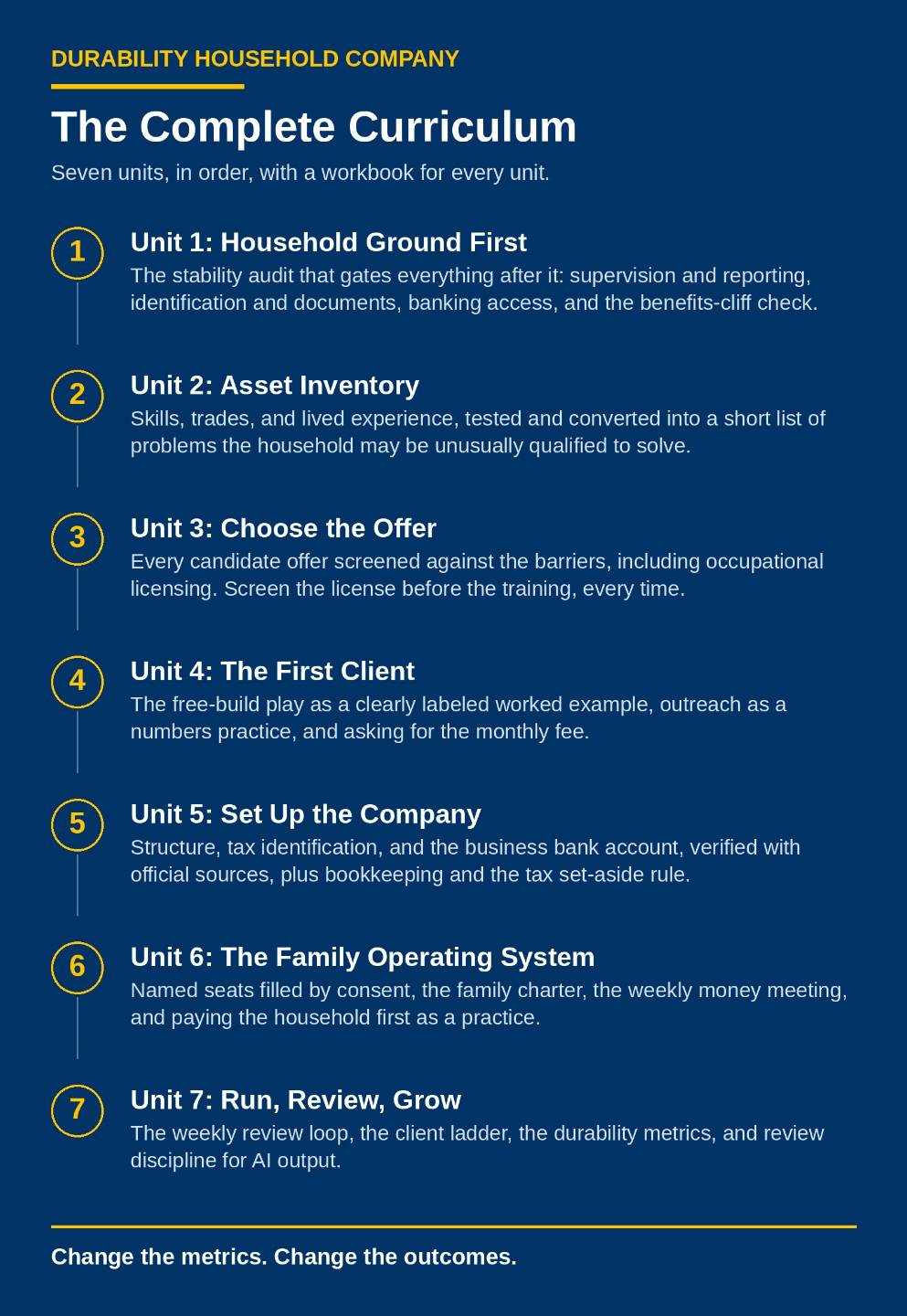
The complete curriculum teaches the whole distance in seven units, in order, with a workbook for every unit.
Unit 1: Household Ground First. The stability audit that gates everything after it: supervision and reporting, identification and documents, banking access, and the benefits-cliff check.
Unit 2: Asset Inventory. The household's skills, trades, and lived experience, tested and converted into a short list of problems it may be unusually qualified to solve.
Unit 3: Choose the Offer. The barriers screen run on every candidate offer, including occupational licensing, where a National Employment Law Project count found 27,254 state restrictions affecting people with criminal records (NELP, April 2016). Screen the license before the training, every time.
Unit 4: The First Client. The free-build play, a clearly labeled worked example, outreach as a numbers practice, and asking for the monthly fee.
Unit 5: Set Up the Company. Structure, tax identification, and the business bank account, taught as questions to verify with official sources, plus bookkeeping and the tax set-aside rule the family writes before the first payment.
Unit 6: The Family Operating System. Named seats filled by consent, the family charter, the weekly money meeting, and paying the household first as a practice, not a sentiment.
Unit 7: Run, Review, Grow. The weekly review loop, the client ladder, the durability metrics, and review discipline for AI output.
The materials pack
Inside the curriculum, as lessons and downloads:
- The AI Bench Prompt Pack. Eight named jobs (strategist, researcher, builder, writer, designer, operations automation, support drafting, analytics), each with a named tool on a free tier: ChatGPT, Perplexity, Wix, Canva, Todoist, and Microsoft Excel for the web. The bench is taught as a method: named jobs, review discipline, and a named tool for each job. Use free tiers first, and check each tool's current terms before relying on it.
- The Family Charter Template. One page that names the members and roles, states decision rights, fixes the weekly money meeting, and holds the pay-the-household rule in the family's own words.
- Outreach Scripts and a Tracking Sheet. The scripts for the first-client play, and the sheet that records sends and replies.
- The Money-Meeting Agenda Set. The fixed agenda for the weekly meeting where the household sees the business honestly.
- The Licensing-Screen Worksheet. The screen from Unit 3, as a worksheet you run on every candidate offer.
Every download carries the same worksheets and templates the lessons teach, ready to print or copy.
The honest terms
Nothing in this curriculum is legal advice, and nothing in it determines anyone's eligibility for anything. Laws on supervision, benefits, occupational licensing, business formation, and taxes differ by state and change over time. Wherever the curriculum touches a legal topic, it teaches a method for finding the official answer for your state, using official sources, and following what they say.
This model is not presented as proven, tested, or endorsed by anyone. No outcome is promised or implied. Whether a business creates stability for a household depends on the household's work, its market, and its circumstances.
Participation by any family member is voluntary and revocable, at any time, without penalty. Nobody is unpaid labor by default.
Price and enrollment
The Starter Guide is free. The complete curriculum is $97, one payment, with all seven units, every workbook, and the full materials pack.
Enroll in the complete curriculum ($97)Change the metrics. Change the outcomes.